![MaritimeJournal[Seawork]](https://www.maritimejournal.com/wp-content/uploads/2026/09/MaritimeJournalSeawork.svg)



Going DEEP: ‘Vanguard’ takes the plunge
Just weeks after outlining plans for a permanent human habitat beneath the waves, subsea technology company DEEP has deployed its Vanguard module on the seabed.
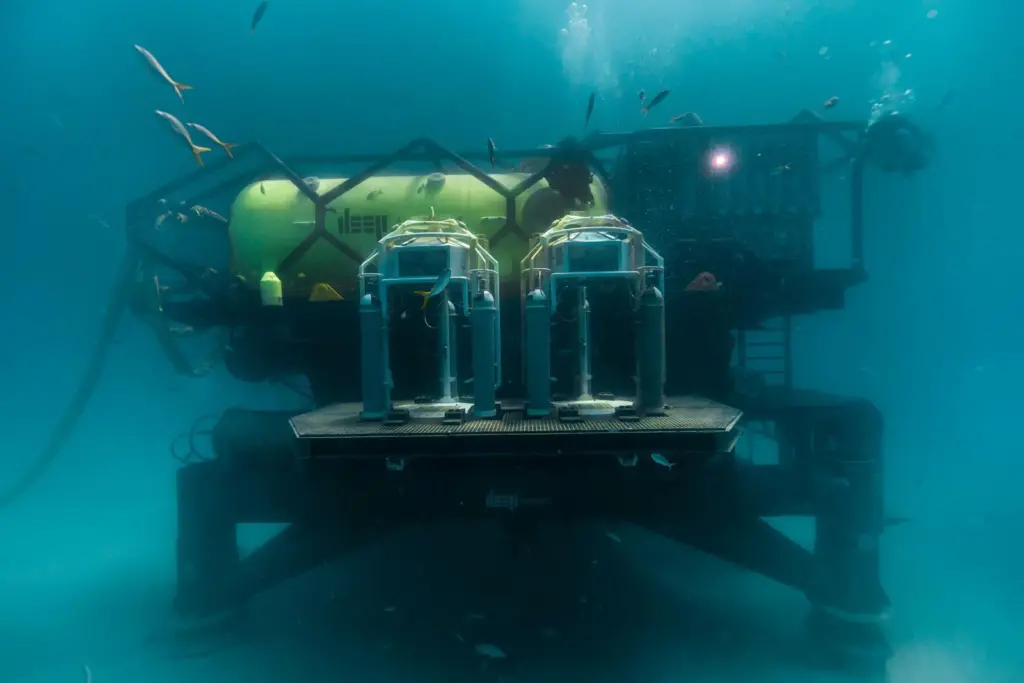
The 10.7m-long habitat has been installed at Tennessee Reef in the Florida Keys National Marine Sanctuary, where it now sits in 17m of water following what DEEP said was a complex marine operation. Commissioning and sea acceptance trials are now under way before crews begin living and working under water on multi-day missions.
The deployment marks the next stage of a project first reported by Maritime Journal in May, when Vanguard was undergoing final testing ahead of installation. At that stage, DEEP’s engineers were preparing to anchor the habitat to a seabed foundation before completing final classification and operational trials.
Designed to accommodate up to four aquanauts for missions lasting five days or more, Vanguard is intended to provide scientists with a continuous presence underwater, allowing significantly longer periods on task than conventional diving operations. Air, electricity and communications are supplied via an umbilical connected to a surface buoy, while external tanks provide 72 hours of emergency breathing air, which is enough time for divers to complete decompression should the primary life-support system fail.
Unlike deeper commercial saturation systems, Vanguard operates at a depth where occupants can breathe ordinary air rather than expensive helium-oxygen mixtures, reducing both operational complexity and cost. Speaking before deployment, DEEP chief operating officer Sean Taylor said the objective was to enable people to spend far longer working underwater than conventional diving allows, opening new opportunities for scientific research, environmental monitoring and specialist training.
Science matters
The Florida Keys site was chosen for its scientific importance. According to DEEP, initial missions will include coral reef restoration, long-term reef and climate monitoring, marine ecology surveys, testing of new ocean sensors and studies into human physiology in extreme environments.
The habitat is also expected to support astronaut training and other programmes where extended isolation in confined conditions provides a useful analogue for space flight.
Norman Smith, DEEP’s chief technology officer, said the installation represented the culmination of 18 months of intense design, build, and testing efforts.
“Successful deployment gets us closer to enabling a continuous human presence in the ocean and is a major step forward in DEEP’s mission to make humans aquatic,” he said.
The habitat is now entering its final commissioning phase ahead of DNV classification. DEEP has worked with the classification society throughout the design and construction programme to provide independent verification of the engineering and safety systems before operational service begins.
Vanguard also represents the first step in a broader programme. DEEP ultimately plans to develop a network of larger, modular subsea habitats, with experience gained from the pilot installation informing the design of its next-generation Sentinel system.
Before deployment, Taylor told Maritime Journal that the company’s ambition extended well beyond a single installation.
“We don’t just want to be a company that builds and operates one habitat,” he said. “The real value is when we deploy two, three, four, five. The vision is when there’s one in every ocean.”
Related Articles
 OTHER NEWS
 MARINE CIVILS
 MARINE CIVILS