![MaritimeJournal[Seawork]](https://www.maritimejournal.com/wp-content/uploads/2026/09/MaritimeJournalSeawork.svg)



Survey completed on branch of 950km subsea connection
All pre-installation survey work has been done on the eastern section of a double submarine cable engineering project that will connect the Italian mainland with Sicily and Sardinia.
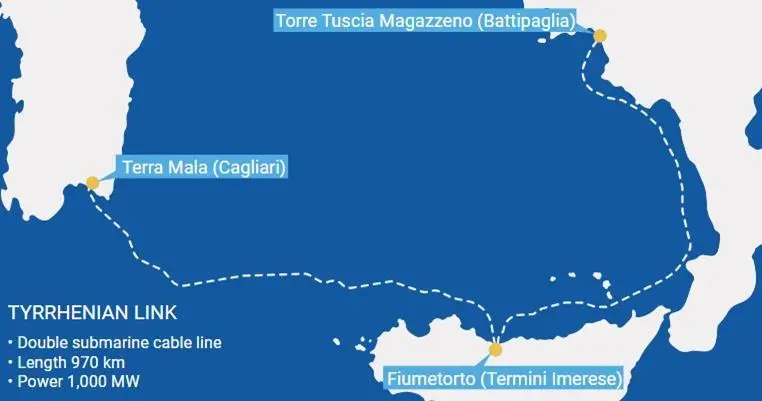
The European Investment Bank has provided approximately half of the €3,800 million cost of building the Tyrrhenian Link, which will consist of a 950km undersea high-voltage direct current (HVDC) cable, which will have an installed capacity of 1,000MW.
It comprises two stretches of approximately similar lengths – the western section, from Sicily to Sardinia, and the eastern section from Sicily to Campania.
Italian grid operator Terna is behind the project, which will involve resting the cable on the seabed and protecting it with reinforced concrete or bituminous mattresses.
Cemented sediment areas will be buried at 50cm, which will require jet machines and dredgers that in loose and low-cohesion sediment areas will need to be covered by a metre at the lowest depths.
The landing point for the underwater cables will be completed using Horizontal Directional Drilling, a straight drilling technique that avoids open pit excavations on the beaches.
“The result will be an enhanced stability of the electrical system of the two islands and allow a more flexible integration of the renewable energy sources, necessary to fulfil the objective of phasing-out of coal power plants according the targets established by the Integrated National Energy and Climate Plan,” say project leaders at Terna. “Such a plan foresees that, in 2030, renewables will cater for more than half of gross electricity consumption, 55.4%, with a complete phase-out of coal by 2025 that represents 8GW of reduced generation capacity, of which 1GW is in Sardinia.”
Pre-installation survey work
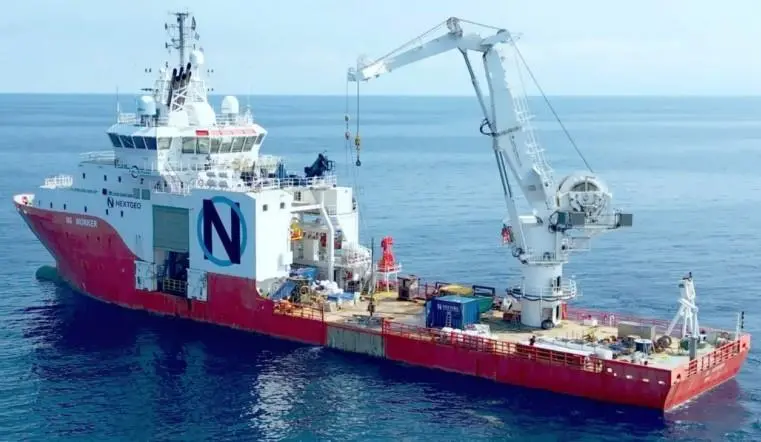
Naples head-quartered survey contractor Next Geosolutions (NextGeo) has completed the survey work for the eastern section, having been contracted by Prysmian, one of the largest cable-laying firms in the world.
“The works entailed extensive marine detailed geophysical, geotechnical, UXO, archaeological and environmental survey activities along Terna’s submarine power line connecting the landing points in Sicily and in Campania with two HVDC cables, approximately 485 kilometres long each,” said NextGeo.
“Additional survey tasks have been executed in the near-shore sections of the corridor, including boreholes, HDD survey, topography and geoelectrical investigations. More than 400 days of work and numerous ships were used to carry out the project, including the group-owned offshore vessels MPSV NG Worker and MPSV Ievoli Ivory, as well as the MV Eco-One and other smaller near-shore vessels.
“The Tyrrhenian Link is one of the most important energy infrastructures in the entire Mediterranean.” says Terna, which will ultimately spend at least €3.7 billion on the infrastructure.
Related Articles
 OTHER NEWS
 MARINE CIVILS
 MARINE CIVILS