![MaritimeJournal[Seawork]](https://www.maritimejournal.com/wp-content/uploads/2026/09/MaritimeJournalSeawork.svg)


Far reaching report on the Fairplay 22 accident
A detailed and far reaching report on the tragic accident involving the tug Fairplay 22 on 11 November 2010 has been published by the Dutch Safety Board.
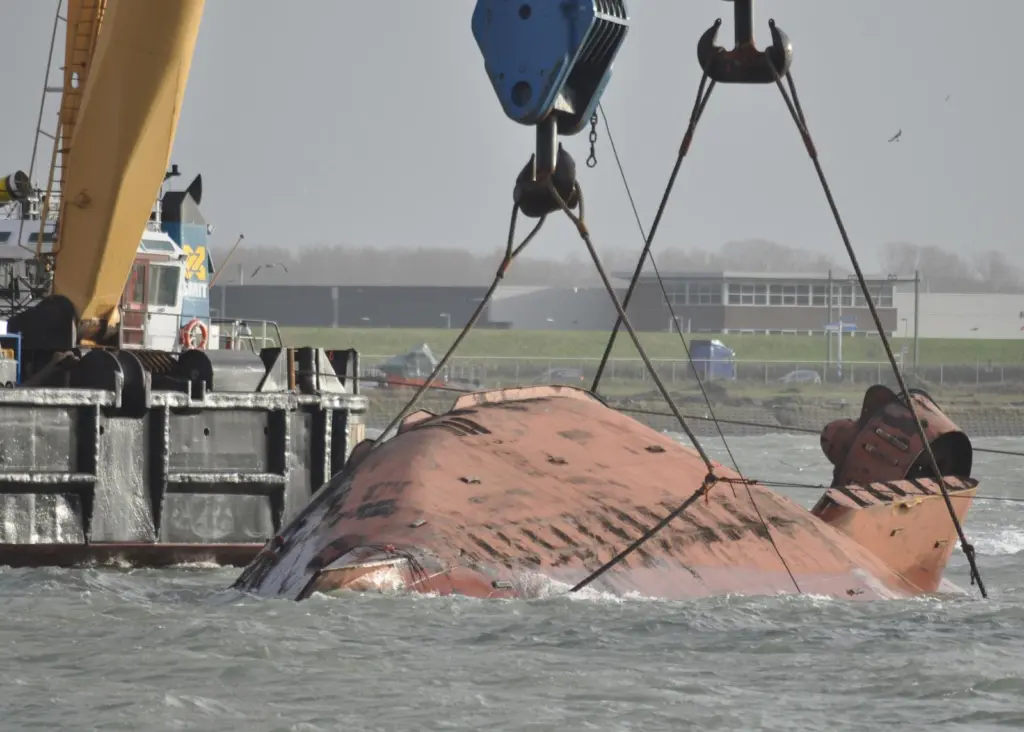
The report, comprising 101 pages, including 12 appendices, reflects an in-depth study of every aspect of the accident itself, the vessels involved, and the operating procedures in place at the time.
Fairplay 22 capsized in the New Waterway near the Hook of Holland while establishing a towage connection in readiness to assist Ro/Ro passenger vessel Stena Britannica to moor at the Hook of Holland pier. The accident resulted in the death of two persons, a third was slightly injured and the fourth escaped unhurt.
The ship ordered two tugs from Fairplay Towage to assist on account of a strong to gale-force southerly wind. Tugs Fairplay 22 and Fairplay III were deployed and, on VHF radio, the captains of Fairplay 22 and Stena Britannica agreed that Fairplay III would make a towing connection at the starboard side aft and Fairplay 22 on the starboard bow. They also agreed on a speed through the water of seven knots while picking up the towline. Fairplay 22 had to manoeuvre close to the bow of Stena Britannica in order to take the heaving line thrown from the bow of Stena Britannica. To avoid having to cast the heaving line into the wind, the tug positioned itself on Stena Britannica’s portside (lee side) which also prevented the gale-force winds from driving the tug against the ship during the manoeuvre.
Whilst making its second attempt, Fairplay 22 manoeuvred close to the bow of Stena Britannica to take the heaving line onboard and collided with the ship’s bulbous bow, after which the tug became broadside in front of the vessel’s bow. The collision caused the tug to be pushed over to port and subsequently capsize. The tug’s capsizing was accelerated by water flooding through vents and an open door.
According to the Casualty Investigation Code and EU directive 2AA9/78/EC, the accident constitutes a very serious casualty and the Netherlands, as coastal and harbour state, was required to ensure that an investigation be conducted. An investigation into the accident was also required under the Dutch Safety Board Decree. According to an agreement with the ships’ flag states, Antigua and Barbuda and the United Kingdom, the Netherlands was responsible for leading and conducting the investigations.
During the course of those investigations another similar incident occurred on 13 January 2011 while the twin screw tug Smit Polen was establishing a towage connection at the bow of a container ship. In this instance the tug also collided with the bulbous bow of the ship and again the tug was pushed over. However, unlike Fairplay 22, the Smit Polen was able to right itself shortly afterwards. In consultation with the relevant authorities, The Safety Board also decided to include in its investigation this further incident involving the Smit Polen.
Every aspect of the the Fairplay 22 accident was studied, aided by data available from VTS and AIS plots, subsequent research, and inspection of the vessels and their historical records. A similar but with less serious incident, involving sister ship Fairplay 21 in November 2009 was also studied by the Board, adding further data to the findings.
The mass of information, data and recommendations in the body of the report are well beyond the scope of this news feature but in the Conclusions, the following statements are made about:
1 – The direct cause of the collision:
“From the investigation it can be concluded that the high speed through the water was a crucial factor in the accident. The higher the speed through the water, the larger the hydrodynamic sphere of influence and hydrodynamic interaction between the ships. Sailing at high speed substantially increased the risk of the tug becoming uncontrollable and the risk of collision. The current and most probably also the drift angle contributed to this.”
The investigation could not determine to what extent the captain of Fairplay 22’s restricted view, his time to react, and the influence of the wind contributed to the collision.
2 – The direct cause of capsizing:
“Fairplay 22 was unable to move away from Stena Britannica’s bow after the collision. The hydrodynamic forces and the tug’s reserve power contributed to this. In addition, the limited human ability to anticipate may also have contributed given the circumstances.
“Fairplay 22 was pushed over and subsequently capsized. The tug’s capsizing was accelerated by the water flooding in. The limited design stability of the tug and the weather-tight openings that had not been closed were contributing factors to the capsizing and increased the speed at which the tug capsized.”
A comprehensive section on Underlying Causes and recommendations for Fairplay Towage, Stena, the Port of Rotterdam Harbour Master, and The Minister for Infrastructure and the Environment are also included, along with the highly detailed description of research that led to those findings.
Fairplay 22 was a 35.55m ASD tug designed for offshore and shiphandling duties, completed in 1998 and one of a series of similar vessels. The tug was powered by Deutz diesel main engines developing a total of 4,500 bhp to achieve a bollard pull of 52 tonnes and free running speed of 12.5 knots. Within days of the accident the tug had been raised and taken to a Rotterdam shipyard for inspection. The damaged vessel was subsequently sold to the Greek Compagny Aigaion Marine Ltd and towed to Tuzla, Turkey, for reconstruction. It is understood the tug will be managed by the Maritime Consortium of Thessaloniki Inc (Zouros) and bear the new name Vaya II.
The Dutch Safety Board report is entitled ‘Collision and Capsizing of Tug Fairplay 22 on the Nieuwe Waterweg near the Hook of Holland’. It is available to download in Dutch and English, in PDF format on the Safety Board web site: www.onderzoeksraad.nl
Related Articles
 SPECIAL REPORTS
 TUGS & SALVAGE
 EQUIPMENT