![MaritimeJournal[Seawork]](https://www.maritimejournal.com/wp-content/uploads/2026/09/MaritimeJournalSeawork.svg)




Is the Industry ready for EDDY?
As correspondent for towage industry matters for several decades, I have reported on countless new concepts that appear among the designs for shiphandling tugs and equipment.
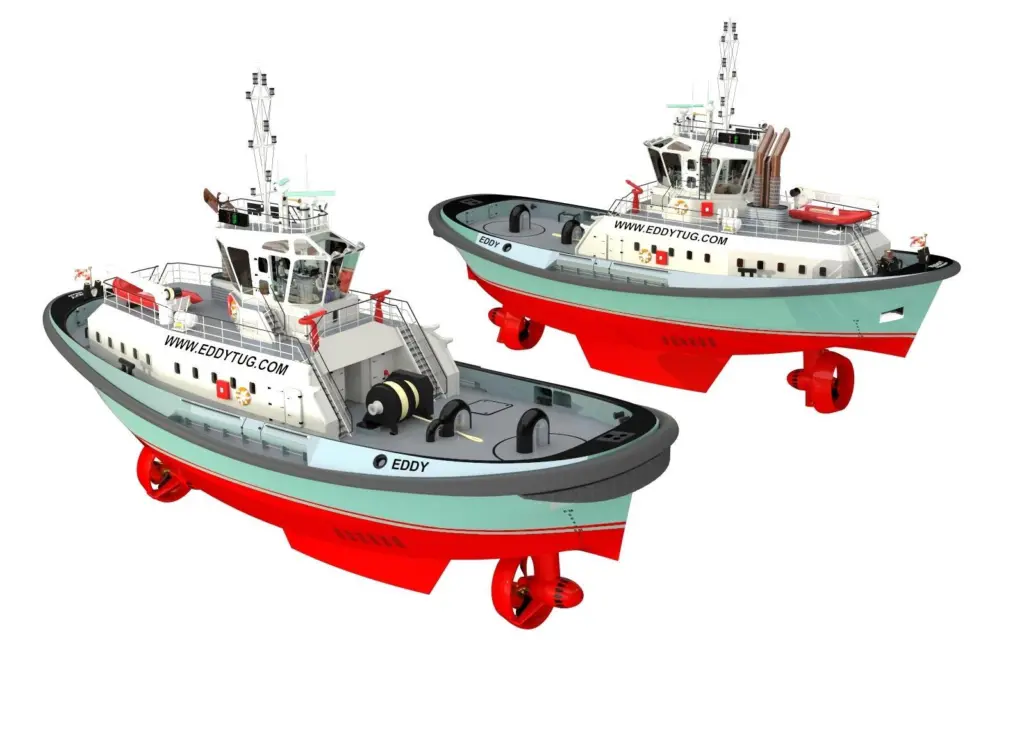
Several made good sense and one wonders why ‘no one has thought of it before’ and it becomes successful. Others are reported and perhaps prototypes are built but rarely heard of again. In recent weeks another new concept has come to the attention of the press. Known as an ‘Efficient Double-ended Dynamic’ tug, or EDDY, it appears to be a well conceived vessel powered by two fully azimuthing propulsion units, arranged on the centreline, one forward and one aft.
EDDY was first conceived in 2008 by consultants Baldo Dielen Associates Ltd whilst in search of an efficient, powerful and safe approach to shiphandling under a variety of conditions. In the intervening years a great deal of research and testing has been carried out, much of it actively supported by the Netherlands based SMIT, a member of Royal Boskalis Westminster NV, which sponsored the model testing programme.
The vessel is a truly double-ended tug with a hull form with no wide afterbody but high freeboards fore and aft, with an improvement in seaworthiness and operability when compared with a conventional ASD tug. A deep central skeg, located approximately midway between the two propulsion units, gives good directional stability and a substantial increase in line-pull when operating in the indirect towing mode.
A heavily, fendered bow and spacious foredeck is fitted out with a towing winch and two ‘staple’ style towing fairleads, one for close quarters shiphandling and one for (indirect) escort towing. Fender loads, in the case of an 80 tonnes bollard pull tug, have been reduced to just 14 tonnes/square metre. Thanks to the underwater shape with a long run aft, and lack of underwater appendages, running bow first is the most efficient direction, with regard to fuel consumption when running light.
Superstructure design offers single deck level accommodation for up to nine persons and is arranged to offer maximum clearance when working ‘under the flare’ of modern ships. ‘Walk-round’ space is generous and the size of the deckhouse can be reduced where a small crew reduces the demand for accommodation. The position and design of the engineroom ventilation outlets/inlets offers a high ‘down-flooding’ angle of 70°.
Controlling the EDDY is simplified by the basic fact that, whether the tugmaster is facing forward or astern, the individual controls for the propulsion units remain intuitive and logical. The latter simplifies training and increases safety considerably. Engine exhaust pipes are arranged in-line and positioned to give optimum all round vision from the tugmaster’s control position.
With ample space available, a variety of powerplant options are possible, including direct-diesel, diesel-electric, LNG or ‘Hybrid’ solutions, all of which offer substantial reductions in running costs and possibilities of large reductions in harmful emissions.
The nearest relative to the EDDY concept is the RAve design, a joint proposal put forward by Robert Allan Ltd and Voith Turbo Marine and widely publicised for the first time in 2010. With many similarities, the RAve has two Voith Schneider cycloidal propellers on the centreline, one at each end, and a hull form based on well tried principles used successfully in other tugs designs. To date no orders have been placed for vessels using the RAve concept in spite of comments from industry pundits that such a concept made good sense.
Baldo Dielen Associates Ltd has a portfolio of designs using the EDDY concept, including a 10m multi-purpose workboat embodying exactly the same principles as the full size tug. The proposed workboat has a very simple diesel-electric propulsion system with single generator providing power for two electrically driven prop units.
Related Articles
 SPECIAL REPORTS
 TUGS & SALVAGE
 EQUIPMENT