![MaritimeJournal[Seawork]](https://www.maritimejournal.com/wp-content/uploads/2026/09/MaritimeJournalSeawork.svg)



Romulo and Remo are Now in Service in Tarrogona
Romulo and Remo , two terminal tugs claimed to be the most powerful of their type in Spain, are now both in service ( MJ – December 2004).
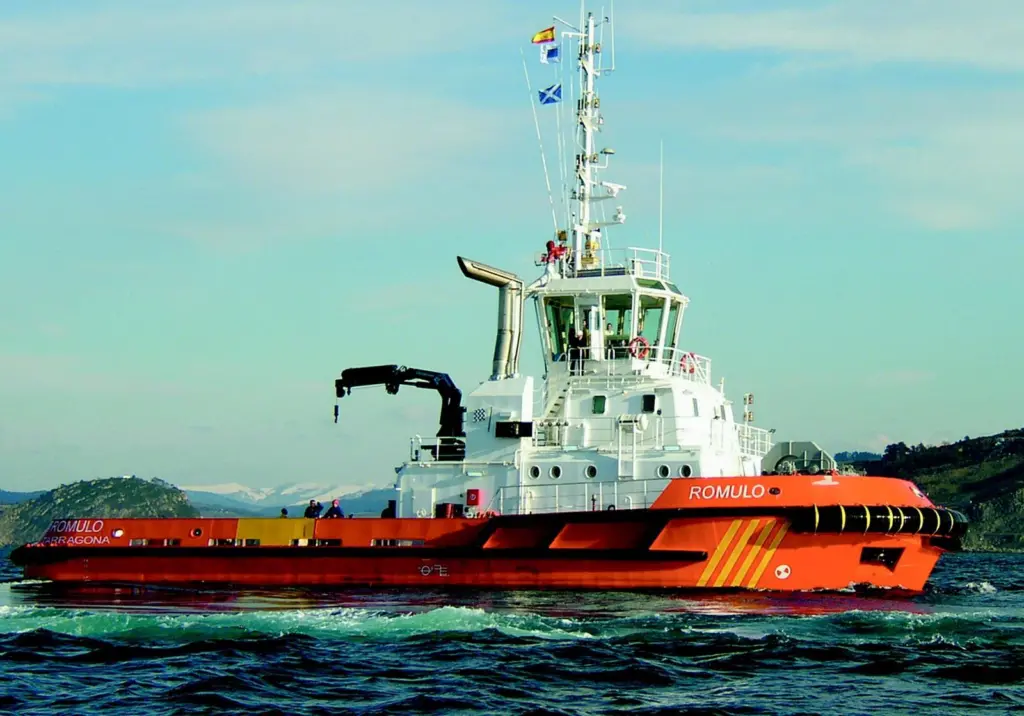
The tugs were built by the Astilleros Balenciaga Shipyard in Zumaia for the fleet of Remolcadores de Puerto y Altura SA – ‘Repasa’ of Tarragona, on the Mediterranean coast of Spain. Classified as ocean-going vessels, the tugs will replace older tugs and give a significant boost to towage services at the port. The tugs are now serving tankers calling at two oil jetties and a single buoy mooring, bulk carriers and car transporters in the harbour, and provide emergency response services in the adjacent coastal waters of the Mediterranean.
Virtually identical sister ships, the tugs measure 33.5m in length overall with a beam of 12m and design draft 4.4m. Design work was undertaken by top Spanish designer Cintranaval and the hull lines are characteristic of an ASD tug of this type, with a slightly raked bow profile, extending vertically down below the waterline to provide additional lateral area resistance to assist with the balance of forces when performing escort duties. In the stern area emphasis has been give to ensuring smooth water flow to the 2.8m diameter propellers and achieving good ‘stern-first’ performance. A semi-raised foredeck, long box keel and skeg are also incorporated. The hull structure is robust with 20mm plating in the forward and lateral pushing area with 16mm bottom plating surrounding the propulsion units. Germanischer Lloyd have classed the finished vessels +100 A5, Active Escort Tug, +MCAUT, Fi-fi 1, Oil recovery.
Romulo and Remo are both powered by two MAN B&W 7L27/38 main engines, developing a total of 4,760bhp (2380kW) while running at @ 800rpm.
The engines drive azimuthing propulsion units incorporating Steerprop SP35 fixed pitch propellers with HJ3-5 high efficiency nozzles. Each Steerprop unit features a slipping clutch, allowing a soft clutch take-up at idle and to enhance precise manoeuvring at closed quarters and where minimum speeds are required. A hydraulic driven Jastram bow thruster of 185kW has been fitted to assist in manoeuvring and station keeping, particularly during fire fighting operations. During trials a bollard pull 83 tonnes ahead and 75 tonnes astern was recorded and a free running speed ahead of 13.5 knots.
Two Caterpillar 3306 generating sets, with own brand SR4 alternators, each supply the ship’s electrical system with 150kW at 1500rev/min. All diesel engines and propulsion units are cooled by means of Bloksma box coolers fitted with ICAF protection systems.
Kumera step up gearboxes are fitted to the front end of both main engines and both power the pumps supplying the vessel’s hydraulic systems, including the winches, crane, towing pins and transverse bow thruster. Coupled to the starboard gearbox only, is a 2800m 3/h Kvaerner Eureka fire fighting pump feeding the two 1200m 3/h/h monitors and spray protection nozzles of the FiFi 1 external fire fighting system.
This unusual arrangement allows the fire fighting system to be driven by one engine and the other to be used to manoeuvre the vessel using full power if necessary.
Romulo and Remo areequipped with a combined forward winch and anchor windlass for shiphandling and escort work. The winch has a line pull of 115 tonnes and a maximum brake load of 200 tonnes and has a single drum accommodating 200m of 60mm diameter synthetic towline. This winch meets the requirements for escort tug notation.
A towing winch is installed on the after deck for towage at sea and is equipped to carry 600m of 54mm diameter steel wire rope and is provided with an automatic spooling device. This winch also has a 200 tonne brake load and is fitted with a capstan drum on port side. A 90 tonne towing hook with a pneumatic release is also fitted. Other equipment includes a hydraulic deck crane, Karmoy line handling equipment, a stern roller and provision to transport a 20ft ISO container. The bulwarks aft are open to allow the towing cable to run freely off the stern of the vessel and simplify deployment of oil booms. Both vessels are capable of recovering and storing spilt oil. Four dedicated integral tanks are installed and to facilitate unloading recovered products a tank heating system and boiler has been installed.
A comprehensive navigational and communications equipment package supplied by Simrad meets the requirements of GMDSS Area 3 and Promartec automatic positioning system gives single-lever ‘Joystick’ control of main propulsion and bowthruster.
Fully air-conditioned accommodation is provided for a crew of seven (maximum) in five cabins, four for single occupancy. Also provided is a galley, mess/day room, ships office, communal washroom, a large storage area and laundry.
Related Articles
 SPECIAL REPORTS
 TUGS & SALVAGE
 EQUIPMENT