![MaritimeJournal[Seawork]](https://www.maritimejournal.com/wp-content/uploads/2026/09/MaritimeJournalSeawork.svg)






Chartwell’s fast ferry triFoiler enters sea trials
Chartwell Marine, a trusted pioneer of next-generation vessel design, has announced the launch of its electric foiling high-speed trimaran demonstrator.
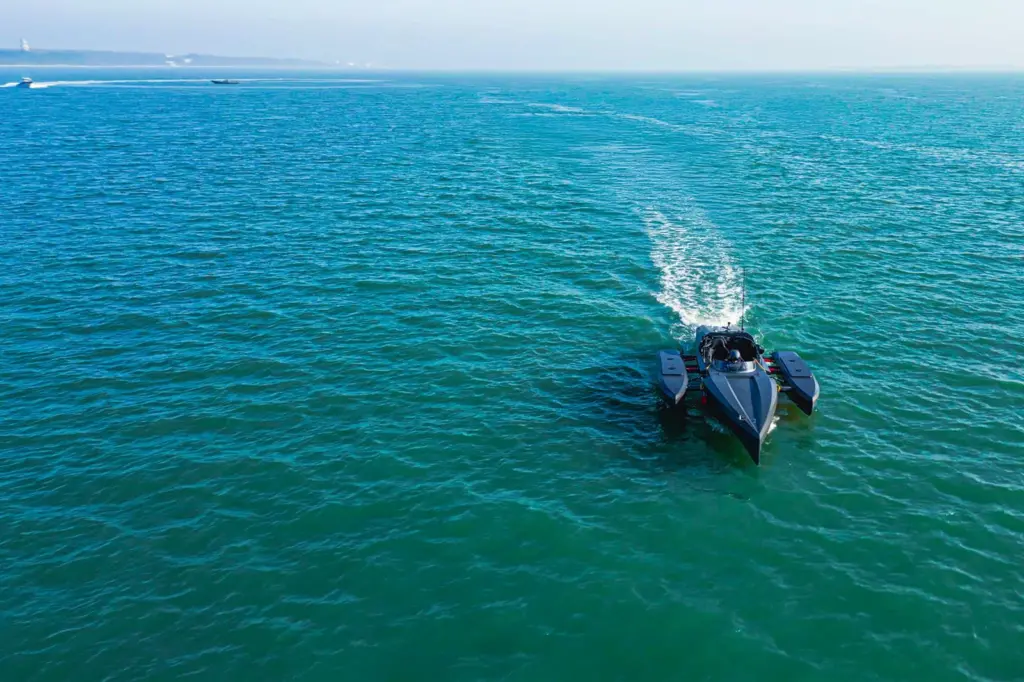
The vessel has now begun sea trials on Southampton water, due to finish at the end of March.
“We believe that the future of pure-electric commercial vessels lies in innovative, low-drag hull forms, with or without the assistance of foils. However, first and foremost, service reliability must be the priority,” said Andy Page, managing director of Chartwell Marine.
“Given that electric power has a lower energy density compared to traditional fuels, minimising energy usage is crucial for achieving optimal results. Finding the balance between efficiency and reliability is key.”
Cleaner ferries
Created in collaboration with Solent University and Newcastle Marine Services, the vessel aims to test a simpler, cost-effective, zero-emission foiling ferry concept.
The scaled demonstrator vessel was built with a GB£1.86 million UK Government grant awarded under the Clean Maritime Demonstration Competition Round 3 (CMDC3). It’s also funded through the UK Shipping Office for Reducing Emissions (SHORE) programme delivered by Innovate UK.
The TriFoiler was delivered on-time and within budget, with the build commencing in September 2024 at Designcraft Ltd, a Southampton-based specialist in composite vessel construction.
Featuring a lightweight trimaran hull, a fixed main foil and actuating foiling rudder, this design reduces energy consumption and power demand while maintaining speed.
Its energy-efficient layout also places the batteries in the sponsons, away from passenger areas, enhancing safety and helping maximise space onboard.
The TriFoiler demonstrator represents an important milestone in the journey towards decarbonising one of the most carbon-intensive sectors in the UK – transport – through innovations in maritime technology.
The month-long sea trial will provide data on the vessel’s handling, efficiency and performance across various sea and weather conditions.
As part of CMDC3, the findings from the trial will be shared at the end of April, informing the next stage of development, moving towards a full-scale, 24-metre, 40-passenger foiling ferry capable of speeds up to 28 knots.
The vessel could eventually be used for commercial operations on Southampton water, and future versions sold into the wider fast ferry market, both in the UK and abroad.
Related Articles
 OTHER NEWS
 ACCESSORIES & EQUIPMENT
 SPECIAL REPORTS