![MaritimeJournal[Seawork]](https://www.maritimejournal.com/wp-content/uploads/2026/09/MaritimeJournalSeawork.svg)


China claims world’s first battery seagoing vessel
China has built what it says is the world’s largest and ‘first built pure electric high-end intelligent seagoing vessel’.
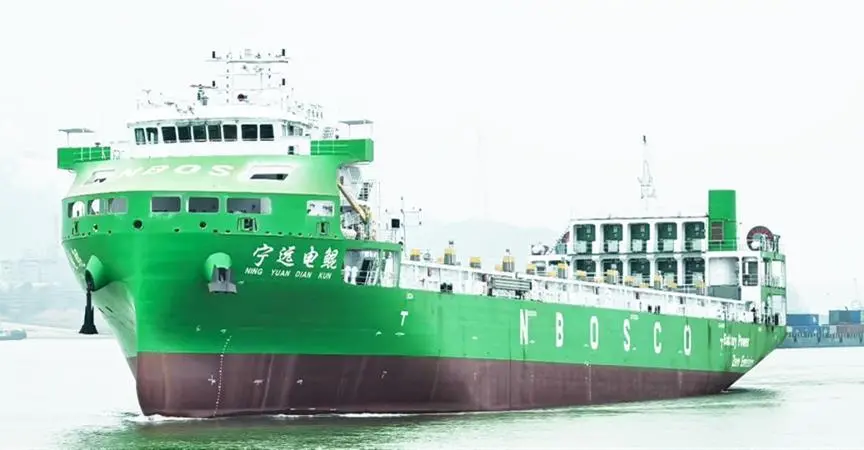
The China Classification Society (CCS) says it has finished the construction survey and certification of Ningyuan Diankun, which was built by the Jiangxi Shipbuilding Company and has been funded by the Ningbo Ocean Shipping Company, near Shanghai.
At 127.8 metres in length and with a capacity of 740TEU, it will need some battery heft to keep running – and this, it says, has been achieved with 10 containerised battery units, although it did not specify their storage capacity.
It did say the vessel was equipped for rapid charging and swift battery swapping.
Designed for short-sea and coastal container operations, the open-top container ship could signal a real technical milestone for battery-powered commercial shipping, which in Europe today is mainly consigned to ferries and coastal operations, although demand is growing.
The strongest adoption has been in Scandinavia, where short routes, predictable schedules and strong environmental policy have made electrification commercially viable. Norway remains the clear leader, having spent years developing battery and hybrid ferry networks, while Denmark, Sweden and Germany are now accelerating their own programmes.
Denmark’s Nerthus, for example, is a fully electric RoPax ferry operating between Samsø and Kalundborg using battery power alone and rapid shore charging. Germany’s Hamburg ferry network is also preparing to introduce fully electric passenger ferries, while Dutch shipbuilder Damen has launched fully electric public transport ferries for urban waterways.
The Chinese vessel has a twin-engine, twin-propeller configuration and is capable of speeds of up to 11.5 knots, the CCS says.
The system has been designed with operational flexibility in mind. According to CCS, the vessel supports both high-voltage shore charging and rapid battery swapping, enabling batteries to be exchanged in port rather than relying solely on lengthy charging cycles.
This dual charging-and-swapping capability is seen as a major technical advantage for coastal cargo services operating on fixed schedules, where port turnaround times are critical. The battery-container arrangement also allows energy modules to be handled in a format already familiar to container terminals and logistics operators.
Further strengthening its environmental credentials, the vessel is equipped with onboard solar panels to supplement onboard power generation and support zero-emission operations.
Intelligent vessel
Beyond propulsion, Ningyuan Diankun has also been developed as an intelligent vessel platform, CCS says.
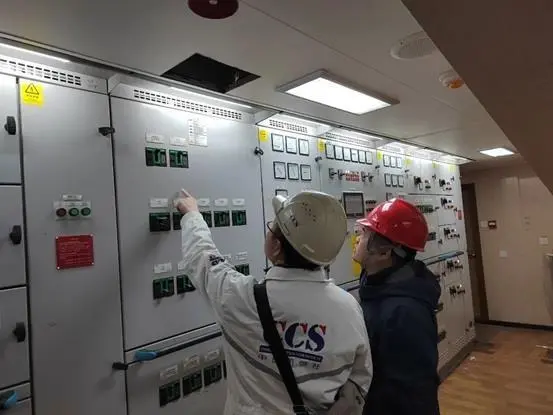
It has been awarded the CCS i-ship (M, No, I) intelligent ship notation, recognising the integration of advanced onboard digital systems that enable “precise situation awareness, real-time route optimization and comprehensive equipment monitoring,” improving both operational efficiency and vessel management.
CCS says it played an extensive technical role throughout the project, providing design review, survey services and support on key engineering and technical issues.
Sea trials for the vessel began earlier this year following outfitting and system testing in Jiangxi province. According to reports linked to the project, trials focused on validating hull performance, electric propulsion capability and the reliability of the battery-based power system under operational conditions.
Europe needs to play catch-up
Europe’s battery-powered ship sector is still dominated by coastal operations because battery energy density remains a major limitation.
Ferries work well because they operate fixed routes with regular charging opportunities, and there is a convincing argument for offshore wind vessels – if there is charging at the wind farm.
But long-haul cargo ships and tankers require far greater energy storage, making batteries alone impractical for most international voyages and in any case, Europe’s grids are not up to the task.
The pace of development is clearly accelerating, however, with EU-backed projects focused heavily on charging infrastructure, including multi-megawatt fast-charging systems for ports.
External influences
The geopolitical situation could further accelerate demand.
Conflict involving Iran raises concerns over oil supply disruption and fuel price volatility, both of which directly affect shipping economics.
Battery-powered vessels offer operators insulation from marine fuel price shocks, particularly in regions with strong renewable electricity generation. Rising fuel costs could therefore strengthen the commercial case for electrification in short-sea shipping and ferries, especially in northern Europe where shore power infrastructure is already developing.
Regulation could be another push factor: with rules like the EU ETS, FuelEU Maritime and port decarbonisation requirements, operators are being forced to find ways of powering their vessels, in port at the very least, on something other than diesel.
In what is becoming the norm, China appears to be leading the way and at the same time putting yet more pressure on Europeans to follow in its wake.
Related Articles
 OTHER NEWS
 ACCESSORIES & EQUIPMENT
 SPECIAL REPORTS