![MaritimeJournal[Seawork]](https://www.maritimejournal.com/wp-content/uploads/2026/09/MaritimeJournalSeawork.svg)






ClassNK adds Japan’s first H2-fuelled tug to register
Shipping giant ClassNK has added the first dual-fuel hydrogen-fuelled tug in Japan to its classification register.
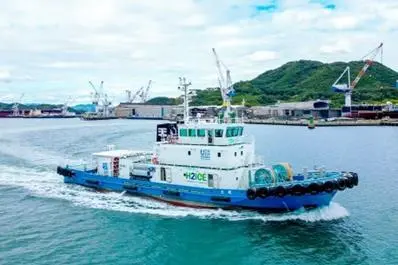
Built by the Tsuneishi Shipbuilding Company in Hiroshima, TEN-OH has been installed with a ’BEH2YDRO’ internal combustion engine and a high-pressure hydrogen gas storage system with large-capacity and supply system, Tsuneishi says, through a joint venture between the Tsuneishi Group and CMB.Tech called JPNH2YDRO.
Ten-OH will be owned and operated by the NYK Line and will used at the Port of Yokohama, one of Japan’s busiest harbours.
As part of the Nippon Foundation’s ‘Zero Emission Ships Project,’ the tug’s data will be collected to see how she performs on hydrogen with a view to commercialising the technology for other small and mid-sized workboats.
The tug, says Tsuneishi, is powered by twin 12-cylinder hydrogen-blended engines that store around 250kg of hydrogen in the high-pressure tanks to snsure ‘operational performance equivalent to conventional fuel use’.
“In the unlikely event of a hydrogen fuel system failure, the vessel can continue to operate solely on marine fuel, maintaining safety as the same standard as conventional vessels,” it says.
“It is a great honour to deliver Japan’s first hydrogen dual-fuelled tugboat,” said Okumara Sachio, Representative director, president & executive officer of Tsuneishi. “Across our domestic and overseas operations, we are developing vessels powered by next-generation fuels such as methanol and LNG. By building on the expertise gained through this project and leveraging the collective strength of the group, we will continue to drive innovation and contribute to a more sustainable future for the maritime industry.”
Safety concerns
Addressing safety concerns over hydrogen as a fuel, ClassNK says it has reviewed safety requirements and countermeasures for hydrogen-fuelled ships.
“Based on discussions among the parties involved during the planning stage of the vessel, ClassNK reviewed the safety requirements and countermeasures for hydrogen-fueled ships by applying Part GF of its “Rules and Guidance for the Survey and Construction of Steel Ships,” says ClassNK.
“These reviews focused on issues such as preventing explosions caused by the high ignitability of hydrogen and mitigating the potential impacts of hydrogen fuel leakage on crew members and the environment. On completion of the necessary surveys in line with the relevant class rules etc., ClassNK added the vessel to its register on 9 October 2025.
“Going forward, ClassNK will continuously support the safe operation of the vessel through surveys in service, and not only that, support industry’s effort toward decarbonisation through utilising the knowledge and experience gained from the surveys for keeping its guidelines up to date and contributing to establishment of the appropriate international standard.”
Related Articles
 OTHER NEWS
 ACCESSORIES & EQUIPMENT
 SPECIAL REPORTS