![MaritimeJournal[Seawork]](https://www.maritimejournal.com/wp-content/uploads/2026/09/MaritimeJournalSeawork.svg)



Different delivery methods for new tugs
Recent news from a Dutch vessel delivery company and a shipbuilder has illustrated two ways of delivering newbuild tugs to their owners, often on the other side of the world.
Tug owners used to turn to domestic shipyards for new vessels, often close to or even in the same port they will operate in. In today’s global industry, shipyards thousands of miles away offer cheaper solutions for their construction.
Delivering new vessels can be beyond the scope of their owner, and crews might be locally based and not always available for long oceanic passages.
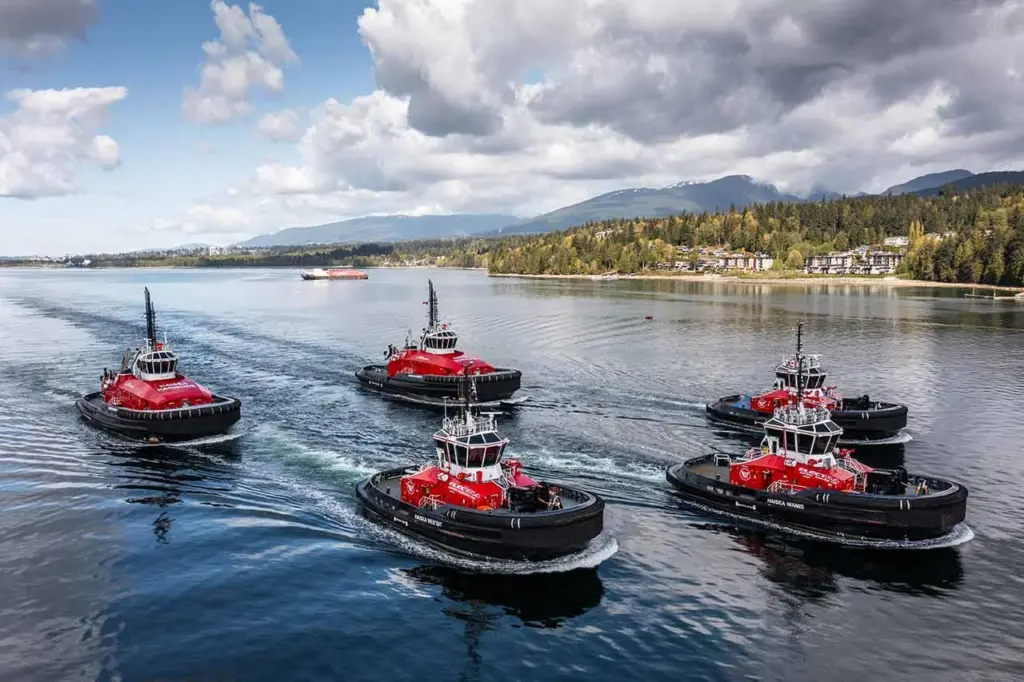
Ship delivery companies can be employed and recently Dutch company Redwise, whose first task involved delivering a steam tug from the Netherlands to Argentina in 1906, reported completing a five-vessel contract delivering terminal and escort tugs under their own power from Sanmar’s shipyard in Turkey to HaiSea Marine in Canada, a repeat customer for Redwise.
Two different types of tugs were involved: three RAL ElectRA battery-powered vessels Haisea Wamis, Wee’git and Brave; and two RAL dual-fuel terminal and escort tugs Haisea Warrior and Kermit.
Deliveries started with Haisea Wamis in May 2023, and it was handed over to its new owners concluding a period of exactly two months under Redwise care.
The delivery voyages spanned nearly 12 months, covering nearly 11,000 miles and lasting 55 days with multiple fuel stops and “meticulous voyage planning”.
The three battery tugs are diesel-electric, with one diesel engine connected to two generators, in turn powering two electric motors for the two thrusters.
To help with entry requirements at various stops along with navigational provisions, the vessels were equipped with Starlink communications systems, enabling updates en-route, in Redwise’s own words “a far cry from the days when little oil cans were still used on engines”.
One particularly long delivery by Redwise involved taking the RAstar 2800 tug Svitzer Santo Nino from Med Marine in Turkey to Batangas in the Philippines, a passage covering 14,000nm over 78 days via Cape of Good Hope. and trouble free with the same Redwise crew completing the entire voyage.
Hitching a lift
Another way of delivering newbuild tugs over long distances is on heavylift ships, a method chosen by Damen Shipyards recently with Dutch company BigLift Shipping.
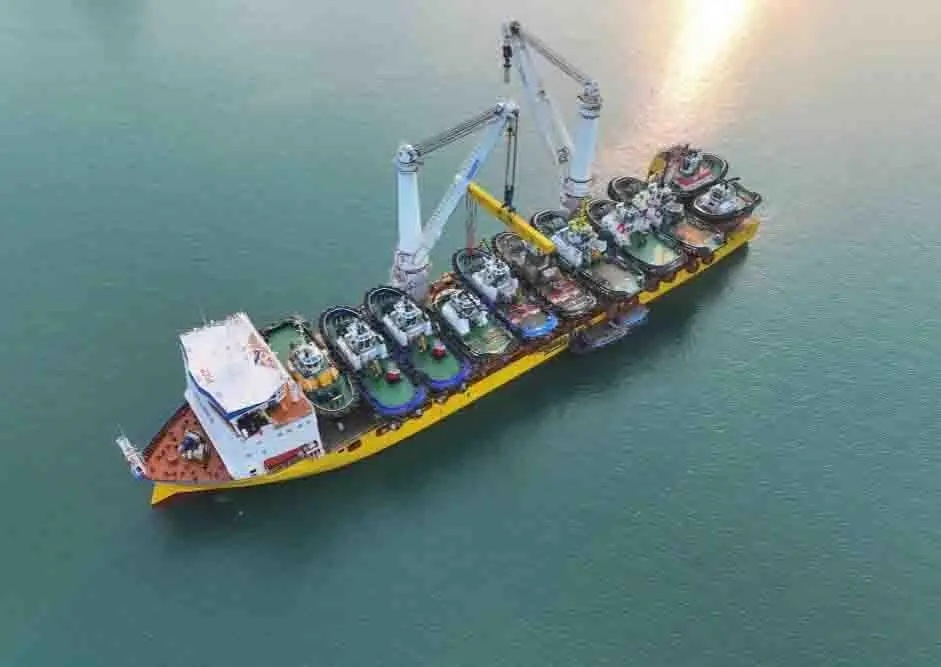
Damen was in the rare position of having 11 tugs ready for transport from its shipyards in Vietnam and China to Europe, which hadn’t happened since 2015, when 22 various vessels were transported over the same route in 2015, also by BigLift Shipping.
Both operations were carried out using 156m heavy-lift vessel Happy Star.
There are pros and cons for independent sailing or as deck cargo. Damen says the deck cargo route allows vessels and their equipment to “arrive in pristine condition”, the marine environment also benefiting from fewer emissions from one ship, albeit a larger one.
In the ‘under their own keel’ deliveries, the staggered delivery of the tugs over a year or so requires a different solution from having a large number ready for delivery at once.
Related Articles
 OTHER NEWS
 ACCESSORIES & EQUIPMENT
 SPECIAL REPORTS