![MaritimeJournal[Seawork]](https://www.maritimejournal.com/wp-content/uploads/2026/09/MaritimeJournalSeawork.svg)

Nexans launches record-breaking cable layer
Nexans chose WindEurope to launch its third iteration of cable-laying vessel, the Nexans Electra, which can lay subsea cable at a record-breaking 3,000 metres deep.
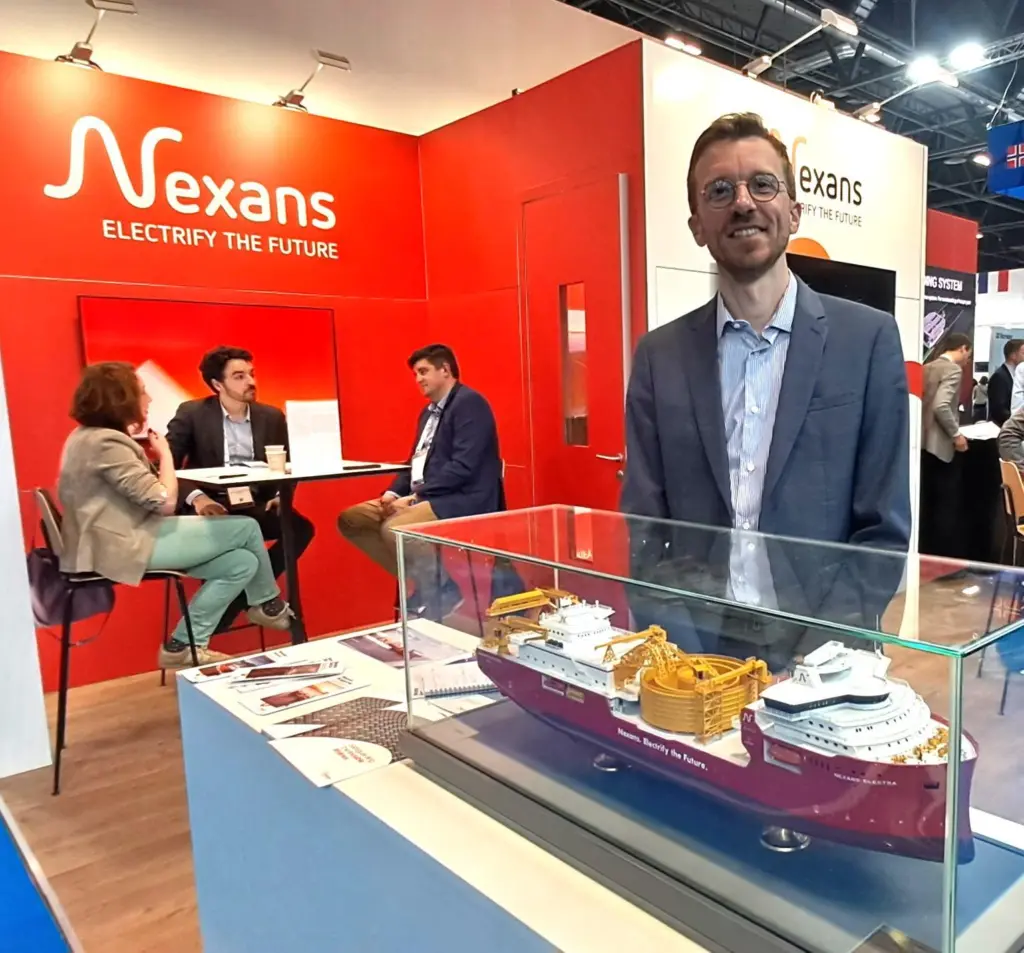
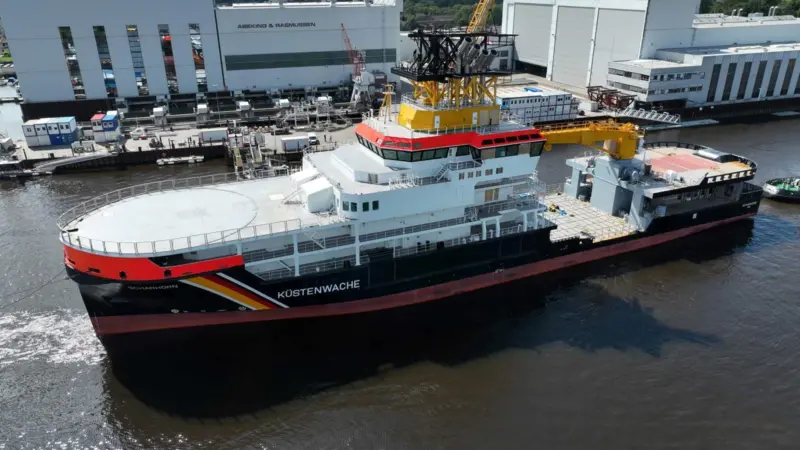
Electra, which is 149.9 metres in length and 31 metres wide, sleeps 90 persons and can lay up to four cables simultaneously, enabling parallel installation of export, inter-array or bundled systems in a single campaign.
The vessel has three main cable carousels, including a split-deck one at the centre of the vessel deck for 10,000t primary power cables and an under-deck carousel that can carry 3,500 tonnes for additional lengths or separate circuits.
She also has a dedicated static fibre-optic basket in the hull for fibre-optic cables that run alongside or are integrated with export cables.
The configuration allows flexible loading of multiple cable types (HVDC, HVAC, fibre) and supports complex lay campaigns with minimal port calls. Combined with subsea tooling (jetting and burial systems), Electra is engineered for large-scale offshore wind grid connections and deep-water interconnection projects.
Electra will be christened next week in Norway, said Nexans Markets & New Solutions Director Maxime Toulotte.
“Everything converges at the back of the vessel before being laid down,” he told Maritime Journal. ”Her carrying capacity means that she can carry very long lengths of cable – up to 300km. She can also install at record depths of up to 3,000 metres, which we will do in the Mediterranean.”
Toulotte says the vessel is destined to work for TenneT, which operates high-voltage electricity grids in the Netherlands and Germany, transmitting power, integrating renewables, and ensuring cross-border grid stability. Electra will install the inter-country interconnectors.
The vessel has already been put through her deep cable-laying paces, Toulette said, laying up to 2,200 metres between Christmas and New Year between Sardinia and Sicily. The Mediterranean has many deep-water areas.
She has an ROV on board that can monitor touchdown points, and has already surveyed the bottom, Toulotte said.
Electra’s older sisters are the Nexans Aurora, launched in 2021, and Nexans Skagerrak, launched in the 1970s and still laying.
Related Articles
 OTHER NEWS
 ACCESSORIES & EQUIPMENT
 SPECIAL REPORTS