![MaritimeJournal[Seawork]](https://www.maritimejournal.com/wp-content/uploads/2026/09/MaritimeJournalSeawork.svg)


Schottel steps in to supply e-ferry systems
German firm Schottel has won the contract to supply propulsion systems to the four double-ended electric ferries that will eventually run autonomously.
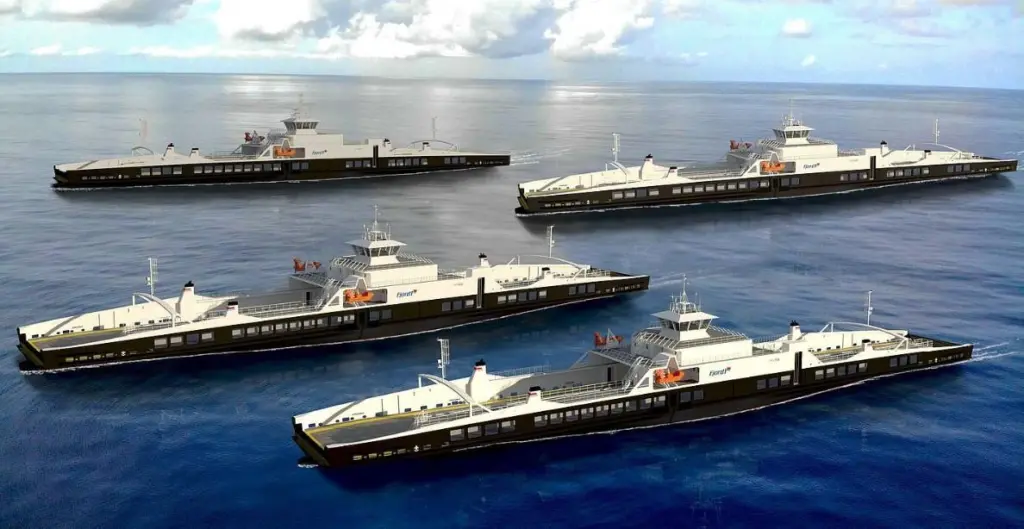
Propulsion system provider Schottel claims the vessels, which are being designed by Norwegian HAV Design, will be the first of their kind in the world.
Designed to ultimately be autonomous, the necessary installation of autocrossing, autodocking and other functions will be carried out ion 2027, with autonomous navigation to be implemented in 2028 – as reported in Maritime Journal in May.
Two electrically driven EcoPellers type SRE 340 will be installed in each of the 120m x 18.6m vessels, with the L-Drive variant, or embedded L-Drive, reducing the installation height of the thrusters, Schottel says.
“By eliminating the upper gearbox, mechanical losses are further reduced. Together with the high hydrodynamic efficiency, this results in significantly lower energy consumption and therefore lower battery capacity, which in turn reduces opex and capex,” the company says.
The elimination of the gearbox also means reduced vibration and noise levels.
The ferries will operate on Norway’s Lavik-Oppedal route across the Sognefjord, approximately 60 miles north of the city of Bergen on the west coast of Norway, from September 2026, carrying a maximum of 399 persons and 120 passenger cars.
They are being built at the Tersan shipyard in Turkey, and back in Norway, a land-based control centre will monitor and potentially remotely control the vessels.
Schottel recently announced a separate deal to supply the propulsion systems for an unnamed European firm’s Offshore Construction Vessels (OCVs).
Two Schottel Dynamic Rudder Propellers, with an input power of 2,700kW, have been ordered for each vessel, with the SRP 610 DL type containing azimuth thrusters in a compact design with integrated prime mover Embedded L-Drive and an eight-degree tilted propeller shaft, ‘resulting in less thruster-thruster and thruster-hull interation’.
Related Articles
 OTHER NEWS
 ACCESSORIES & EQUIPMENT
 SPECIAL REPORTS