![MaritimeJournal[Seawork]](https://www.maritimejournal.com/wp-content/uploads/2026/09/MaritimeJournalSeawork.svg)






SEA TRIAL: Thai royal police boat hits water after YouTube discovery
Tucked away by Chichester harbour on the south coast of England, a small young British boatbuilder has been answering calls from southeast Asian militaries after its high-speed craft were spotted on social media platform YouTube.
Arksen, founded eight years ago by entrepreneur Jasper Smith, began as a sustainability-led leisure brand making apparel and land vehicles as well as boats. Today, it finds itself supplying fast patrol vessels to police and naval forces in Asia after enquiries from YouTube, namely an order from the Indonesian Navy for its Vampire vessels, and from the Thai police for Royal protection vessels.
The company has spent most of its short life building a reputation for long-range explorer vessels – serious, sustainability-minded craft capable of reaching remote coastlines in comfort and with minimal environmental impact.
It is now making a play for the commercial and defence patrol boat market through its Arksen Pro division.
The trigger was Arksen’s acquisition, three and a half years ago, of Ring Powercraft, owned by Mike Ring, with 60 years’ experience with high-performance military and commercial craft. It is from that heritage that the Thai police boat order emerged.
“This project came along in a really random way. We got a phone call 18 months ago,” says Andrew Whittaker, general manager of Arksen’s Pro division.
The caller was a Thai police procurement official seeking a fast patrol vessel for Royal protection duties.
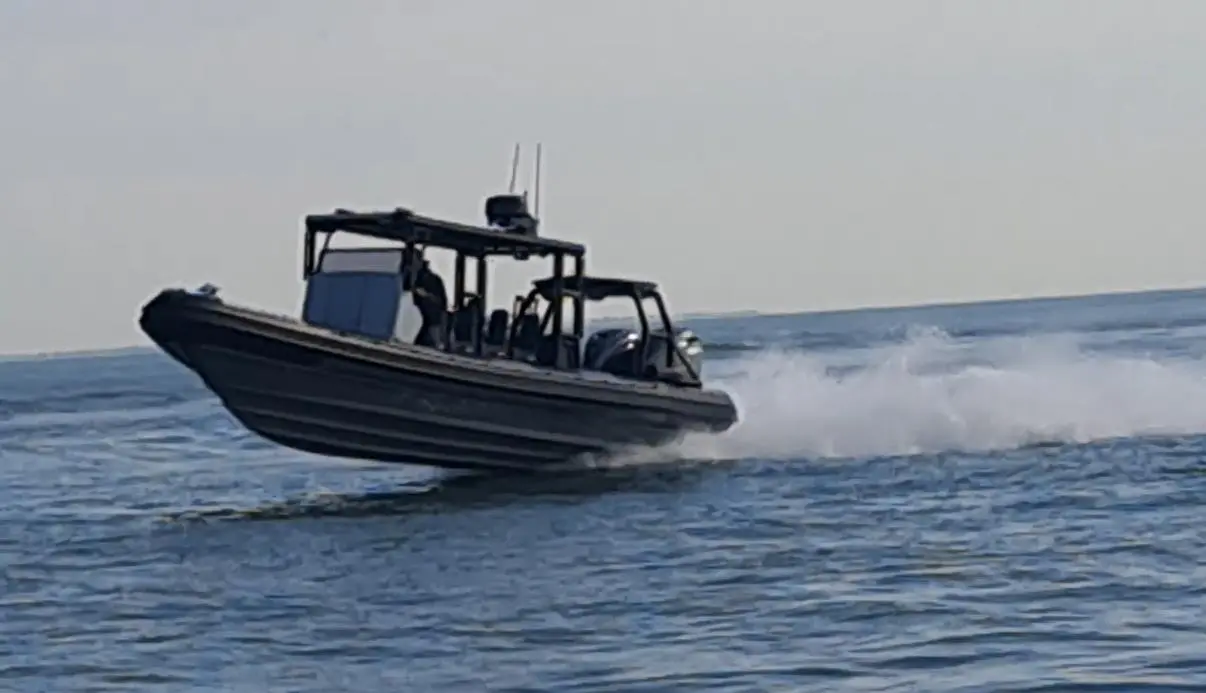
The Thai police had been evaluating the Royal Thai Navy’s latest vessel – a twin 350hp 10-metre patrol boat – and decided they wanted something a little different: specifically, a twin 450hp variant capable of exceeding 55 knots. In trials, Arksen’s police patrol boat has reached 60 knots.
Having built the demonstration vessel, Arksen is now hoping the project converts into a 15-boat order. The fact that they were chosen at all is an appreciation of quality, Whittaker believes.
“British manufacturing is still important to them,” he says.
The vessel: Pro Guardian 10m specification
The patrol boat is based on ArksenPro’s Guardian 10m platform, built on a Ring Powercraft hull – a narrow, deep-V design with a 24-degree deadrise angle chosen specifically because the client required a proven hull with at least 10 previous deployments. The result is a vessel that weighs approximately 4.5 tonnes and carries 1,000 litres of fuel, giving a range in excess of 250 nautical miles at cruising speed – a key operational requirement.
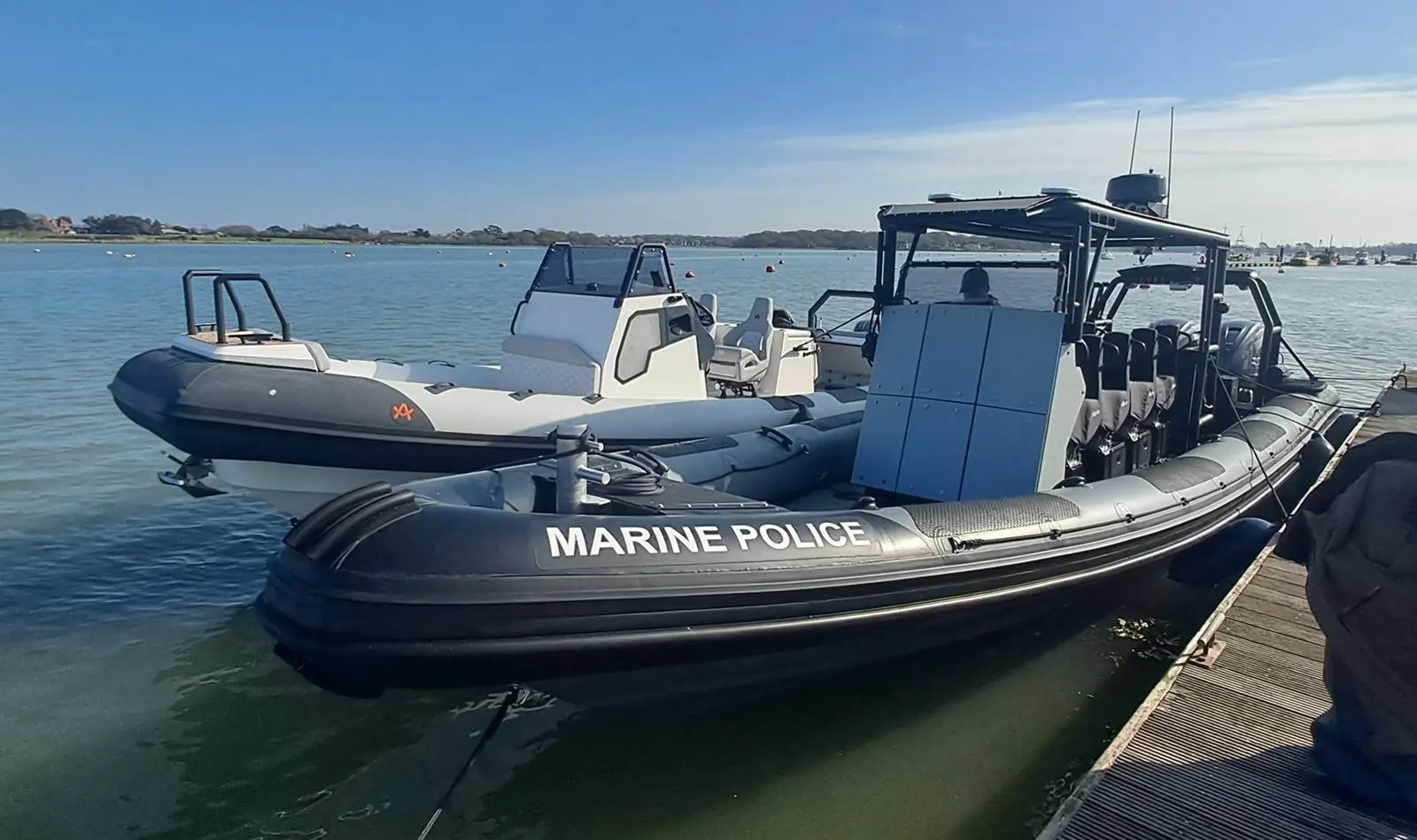
Power comes from twin Yamaha XTO 450hp engines mounted on jack plates, allowing the drives to be raised or lowered depending on conditions: fully raised for maximum speed, lowered for harbour manoeuvring.
At 20 knots the boat burns around 30 litres per hour; at 5,000rpm it achieves just under 50 knots, with the capability to push further.
The specification reflects the boat’s Royal protection role.
Key features include:
- NATO STANAG 4569 ballistic protection panels on the console
- Eight Ullman suspension seats on tracking, adjustable fore and aft
- Self-righting capability via self-inflation bags, similar to the RNLI Atlantic class lifeboat
- Garmin navigation suite with radar, PA system, horns, sirens and blue lights
- Dual radio fit, including a police secure radio installed in-country
- CCTV cameras, manual and automatic bilge pumps
- Four lifting points and a dive recovery ladder
- Reinforced deck area with tapping plates for additional equipment
- A substantial forward Samson post for towing operations
The forward console position – a specific client requirement – places the helm operator ahead of the crew, so the driver absorbs the motion of the sea before the passengers do. In a vessel used for protection duties, where the team must arrive ready to act, this is more than a comfort consideration.
The hull’s sustainability credentials are what, says Whittaker, Arksen is about: the PET core material, for example, is recycled from the actual green-tinged material of San Pellegrino water bottles.
Cost: Arksen’s Unique Selling Point
Perhaps the most striking aspect of the Thai contract, and what Whittaker believes will be Arksen’s USP, is the cost, with no loss of quality.
A vessel of equivalent specification procured through NATO supply channels would, he estimates, command a price of around £800,000 (€919,000). The Arksen boat was delivered for approximately £450,000.
“We don’t have massive overheads as an organisation,” Whittaker says. “We’re a fairly small, agile business – we’re able to do things at a far better rate because we’re not trying to support a business that has got thousands of employees and huge operational overheads.”
After-sales support is handled through a network of in-country agents – in Thailand’s case, a local representative who carries warranty responsibility for routine issues.
If something goes seriously wrong, Arksen’s production team is prepared to be on a plane within 48 hours.
Production manager Lee Hurst says logistical challenges in Southeast Asia are real but manageable.
”Touch wood, we haven’t had a warranty problem yet,” he says.
From explorer yachts to Vampires
Since Jasper Smith founded the company to build what he felt was missing in the market: a serious long-range cruising yacht with commercial-grade reliability and genuine sustainability credentials, the company has launched two 85ft explorer vessels, one a hybrid, with the latest 85ft vessel already having crossed the Atlantic to the Caribbean.
Vampires were inspired by the aircraft carrier HMS Ocean, which in 1945 landed the jet-powered de Havilland DH.100 Sea Vampire Mk.10 on its deck – the first time this had ever been done.
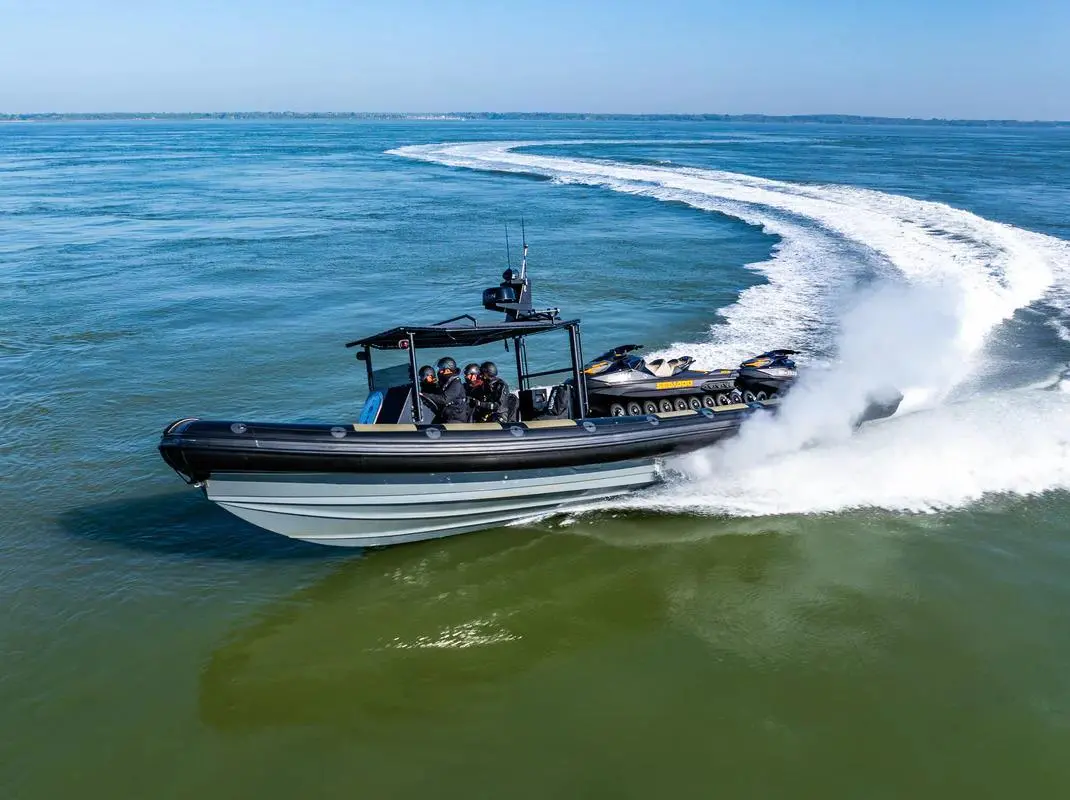
Arksen’s Vampires, as you can see in the video, are fast attack craft that can carry and deploy jet skis or drones from their stern to enable a pincer movement intervention.
Again, it was this YouTube video of the Vampire that first attracted the Indonesian Navy’s attention, and the same platform that the Thai police initially enquired about before budget constraints led them towards the more affordable patrol boat solution.
The electric propulsion question
The Thai boat runs on conventional petrol engines, and to the Thai police, fuel efficiency had not been a consideration and electric propulsion not even mentioned, Whittaker says.
“Everyone wants electric boats,” he says. “Everyone says that’s fantastic, that’s what we need in our life. And then you tell them for an eight-metre electric boat, you can do 40 knots no problem – but if you want to do that, you’ve got only 20 minutes of running time.”
The reality is that while the OpEx might win out ultimately, the upfront CapEx is so high for an electric boat that operators simply can’t afford to buy them in the first place.
“If there is investment to buy it, if there is a financial facility to allow you to do it, yes, it makes financial sense over a long period,” Whittaker says. “But people are constrained budgetally to buy the CapEx at the start. The OpEx saving is massive. The CapEx is super high.”
The charging infrastructure problem compounds this: without demand, infrastructure is not built; without infrastructure, demand does not materialise.
Arksen is nonetheless working with RAD Propulsion on an electric variant for a Chichester Harbour Conservancy tender, and has previously built two eight-metre boats with electric propulsion. The commercial case will arrive, Whittaker believes, but only when financing models catch up with the operational economics.
The Chichester advantage
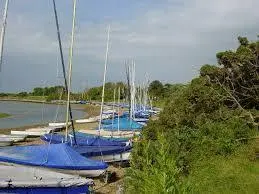
Chichester Harbour is in an Area of Outstanding Natural Beauty
One unexpected benefit of building boats in a designated Area of Outstanding Natural Beauty is access to genuinely testing sea conditions. The harbour entrance at Chichester reliably produces metre-and-a-half to two-metre waves on most tidal states, and during a recent trial, Whittaker found himself running the Thai patrol boat through three-metre breaking seas.
“It was the roughest I’ve ever seen it,” he says. “This boat was superb.”
The harbour also offers the discretion of a less industrialised environment, which is useful when sea-trialling vessels with sensitive specifications.
The company sources components locally where possible, and employs a cross-section of trades from skilled craftsmen to engineers and naval architects.
Whittaker himself trained in naval architecture and boat design, taught the same course at Southampton Solent University, and spent a decade as a structural engineer before moving into the industry full-time.
He now oversees the Arksen Pro range, spanning 5.5 to 10 metres, from Arksen’s Chichester facility. The yard is targeting output of 25 to 30 eight-metre boats a year, while continuing to develop new hull forms including a stepped and unstepped 10 and 12-metre range.
Related Articles
 OTHER NEWS
 ACCESSORIES & EQUIPMENT
 SPECIAL REPORTS