![MaritimeJournal[Seawork]](https://www.maritimejournal.com/wp-content/uploads/2026/09/MaritimeJournalSeawork.svg)


Vard wins record-breaking vessel order
Fincantieri subsidiary Vard has won its largest single-vessel order in the company’s history in a contract worth nearly €700 million, and says it’s also the largest ever awarded to a Norwegian shipbuilder.
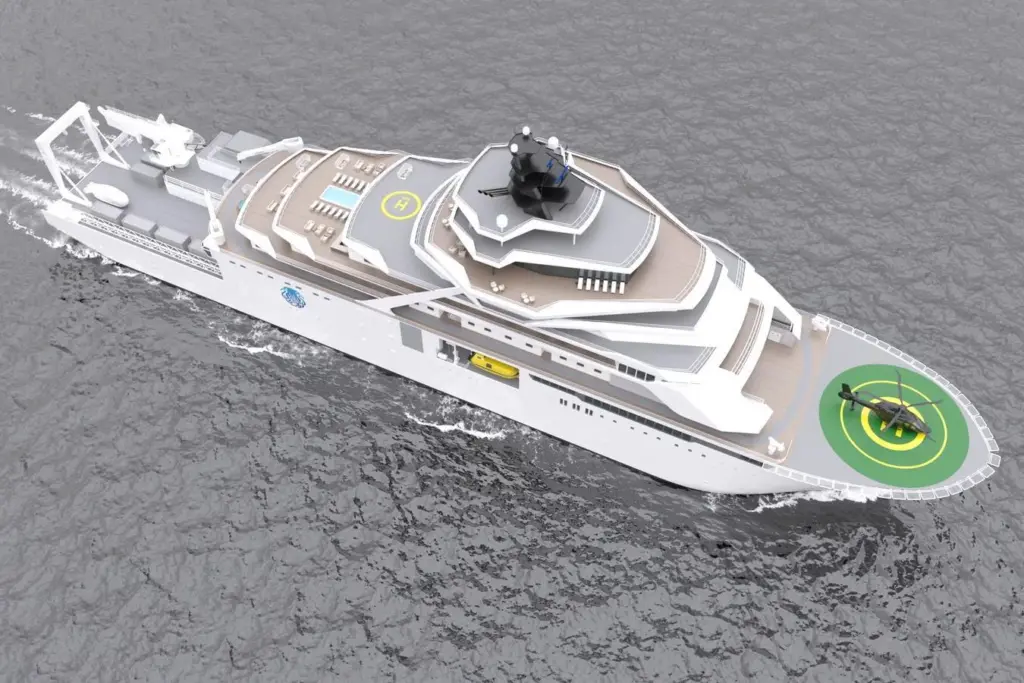
The vessel, project-named RV11000, will be built for US-based marine research organisation Inkfish, which will send it out on operations at depths of up to 11,000 metres to support deep-ocean research including seabed mapping, coring and sampling, submarine operations and remotely operated vehicle (ROV) deployment.
“The project combines scale, technological complexity and scientific ambition, reflecting our ability to design and deliver next-generation solutions for deep-sea exploration,” said Pierroberto Folgiero, CEO and managing director of Fincantieri. “It also underlines the strategic importance of the underwater domain for Fincantieri, where we continue to invest and innovate, leveraging our distinctive capabilities to support increasingly complex missions, from scientific research to the monitoring and protection of critical underwater infrastructure.”
Vard said the vessel was based on its VARD 9 42 design, measuring 162 metres in length with a 28-metre beam, and is scheduled for delivery in the first quarter of 2030.
RV11000 builds on engineering work undertaken for the RV6000, a smaller research vessel contracted in 2025 and currently under build for the organisation. Both vessels will join Inkfish’s expanding research fleet, contributing to marine science programmes and open-source scientific data repositories.
Designed as a highly specialised research platform, the vessel will support a range of subsea technologies, including submersibles, ROVs and autonomous underwater vehicles (AUVs), enabling complex scientific missions in some of the world’s deepest ocean environments.
Among its stand-out features will be one of the largest battery systems ever installed on a ship, allowing up to 12 hours of silent operations during scientific missions. The vessel will also feature a DC electrical system integrated with battery-hybrid propulsion technology aimed at improving efficiency and operational performance.
Vard says the hull has been optimised for high-performance seabed mapping and station-keeping, while advanced stabilisation systems are designed to minimise motion and onboard accelerations during operations.
The vessel will be certified to the latest IACS cybersecurity standards, reflecting growing industry focus on protecting critical onboard systems from digital threats.
Onboard facilities will include laboratories, workshops and scientific workspaces, alongside accommodation for up to 130 crew members and researchers.
Vard will oversee the full project lifecycle, including design, construction, outfitting and commissioning. The hull will be built at the company’s shipyard in Tulcea, Romania, with final outfitting and delivery taking place in Norway.
Related Articles
 OTHER NEWS
 ACCESSORIES & EQUIPMENT
 SPECIAL REPORTS