![MaritimeJournal[Seawork]](https://www.maritimejournal.com/wp-content/uploads/2026/09/MaritimeJournalSeawork.svg)


WATCH: 3D printing ‘in a box’ produces USV hull in 40 hours
Australian manufacturing and robotics firm Hyperion Systems has highlighted the ‘transformative potential’ of 3D printing in vessel building with an entire hull produced in 40 hours.
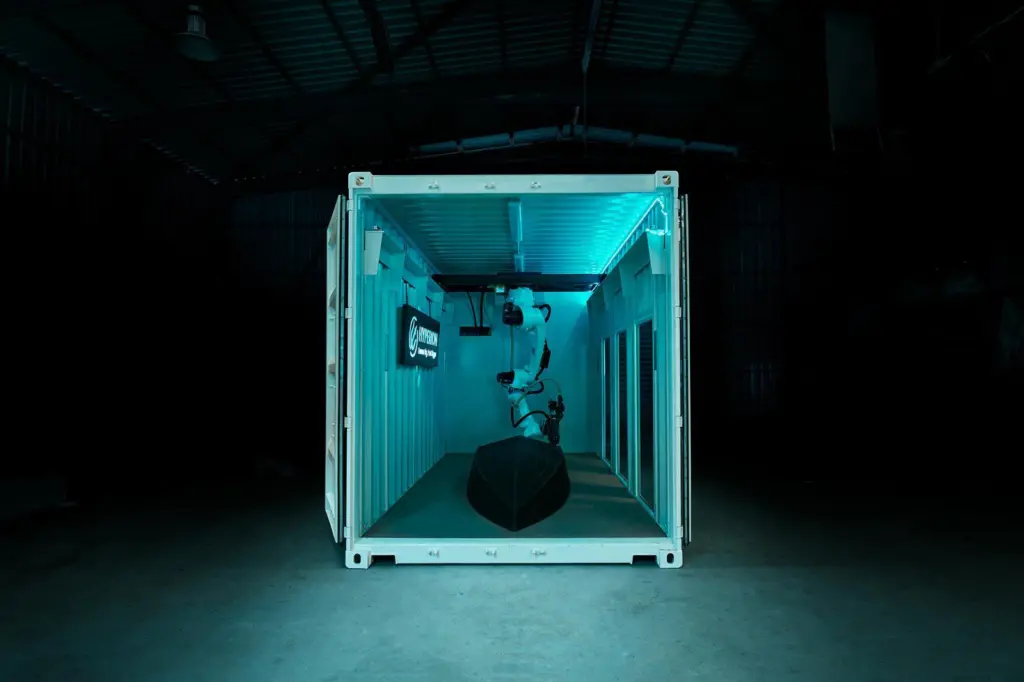
Designed by Western Australian naval architect Versatile Marine and powered by Greenroom Robotics’ AI and autonomy software, the Uncrewed Surface Vessels – named ASTRA 460 – will be 4.6 metres long, with a larger 8m version, currently at the prototype stage, ‘to be supplied to a European navy for use at a major naval exercise’ later this year.
Once sea trials have been completed, the ASTRA 460 will have a top speed of 40 knots and cruising speed of 20-30 knots; a range of up to 200km; ‘multi-mission’ capability, including ‘covert movement of small teams’; operation capability across a range of sea states; and modular payload flexibility for surveillance, security and defence roles, said Hyperion CEO Joshua Wigley.
“This dramatic reduction in production time highlights the transformative potential of additive manufacturing for rapid maritime capability and sovereign industrial resilience,” he said. “We are immediately provisioning to build 10 units a month and can scale to more than 100 as needed.”
’Factory in a box’
As well as unveiling the ASTRA 460, Hyperion presented its TitanCell, a deployable system that combines robotics, 3D printing and recycled polymer technology to make products inside it, such as marine infrastructure, pontoons and the vessel hulls.
Effectively a container with all the tech inside it, which can be moved to where the products it makes are needed, TitanCell was accelerated with funding from the Australian government.
“TitanCell supports sovereign manufacturing capability, reduces waste and carbon emissions and allows advanced manufacturing to be deployed directly to remote, regional or disaster-affected areas where traditional supply chains are limited,” said Hyperion.
ASTRA project manager Jacob Kleinmann said the geopolitical situations around the world currently highlighted the growing effectiveness of USVs as cost-efficient, low-risk platforms for delivering surveillance – and using the TitanCell, can be made almost anywhere.
“USVs provide strong force-multiplication advantages. They are significantly cheaper to build and operate than traditional crewed vessels, enable persistent maritime presence, and act as force multipliers for manned fleets,” he said.
“We see the ASTRA playing a key role supporting missions including intelligence, surveillance and reconnaissance, border protection and security operations. Its modular payload capability also allows rapid reconfiguration for mission-specific roles.”
Related Articles
 OTHER NEWS
 ACCESSORIES & EQUIPMENT
 SPECIAL REPORTS