



On site cutting of wind farm monopile
When one of the foundation piles at the Gunfleet Sands Wind Farm off the coast of Essex UK was unable to be driven into the seabed any further, the local firm of AJ Woods Engineering was contracted to fix the problem.
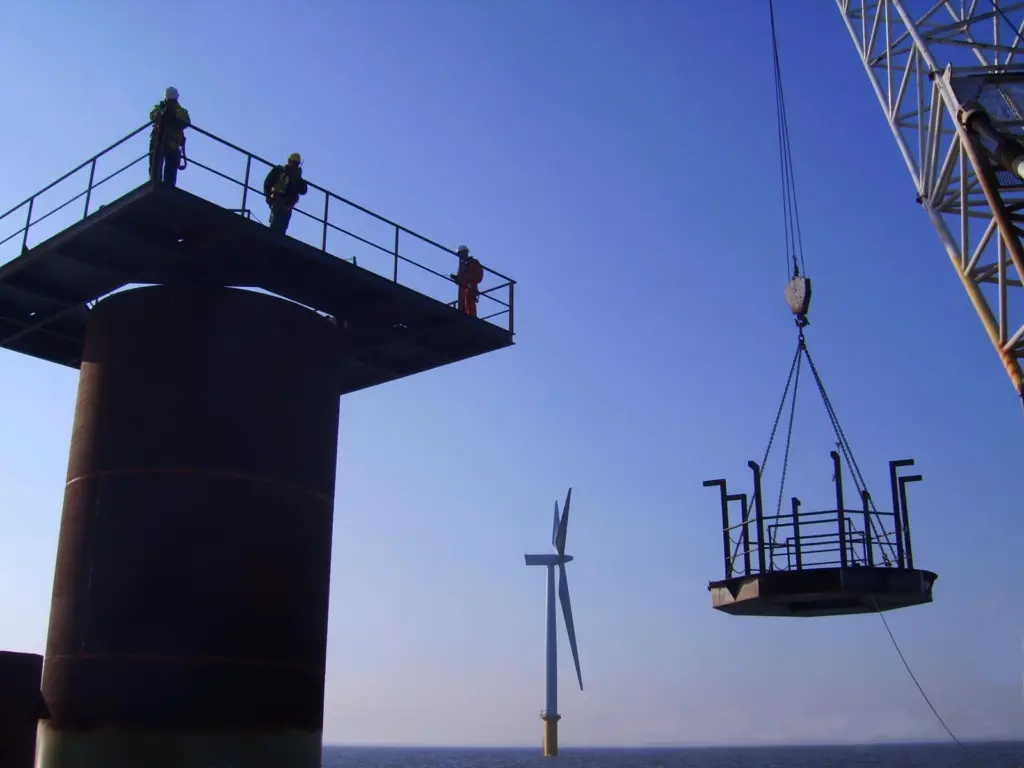
The foundation pile designated G8 was one of 48 such monopiles being installed at the wind farm site off the coast from Clacton. After the pile driving failed to reach the target depth, which was due to exceedingly hard subsea ground conditions being encountered, MTH Hojgaard put out a tender to cut down the over height monopile. First the 40m long, 400 ton pile had to be inspected to see what damage had been sustained while attempting to drive it before it could be cut down and the shortened structure reinforced with rock. This entailed the building of a working platform on the top of the pile along with a berthing platform and ladders for access.
Another platform was needed to lower inside the pile and a man cage was dropped to the bottom of the tube 13.5m below sea level for initial survey by weld examiners. It was found that the bottom edge of the pile had been bent inwards and that it would be impossible to drive it any further into the sea bed.
Tony Woods, MD and owner of AJ Woods Engineering said, ‘What was needed was an innovative engineering solution to access the outside and inside of the pile and use that access to cut the pile to its correct installed height.’
The pile was underdriven by 6m to 8m, which left the daunting task of removing an offcut weighing 42 to 45 tons. The outside diameter of the pile is 4.8m and the wall thickness is 61mm.
‘Initially, our design was sketched out on the back of a cigarette pack, then the project solution refined in our design department, and a tender submitted, continued Tony Woods. ‘Our proposal provided solutions to the range of engineering problems. The client liked our price and ideas and commissioned the build of access equipment and the platform.’
‘The works included a boat landing to wind farm industry standards which needed to be extended to the top of the pile. The lift platform inside the pile was floatable in case there was a rapid ingress of water, in which case it would have floated safely. To make the internal inspections we needed to work 2m to 3m below the sea bed level. We understand we were the first people to have been lowered to the bottom inside a pile and it was a strange experience to be inside that structure.’
The piles, which were fabricated in Denmark, had all been prepainted to a designated level and this coating had to be stripped back to the new level with pneumatic jet pressure washers to enable grout to be applied for joining the transition piece to the top of the monopile.
For environmental reasons protection was needed to prevent the paint falling into the sea and a semi-permeable screen was set up around the working platform. Throughout the project health and safety issues were overseen by the main contractor DONG Energy, which also monitored the necessary gas detectors, extractors and breathing equipment. There were three different access and evacuation places.
One of the additional problems facing AJ Woods was training and certificating the workforce to offshore industry standards. The sea survival course was held in Middlesborough and involved multiple simulations of the helicopter escape exercise at a total cost to the firm of some £10,000.
The timing of the job was further restricted by weather safety concerns which restrict working when there is a sea swell in excess of 0.3metres. Installation of the working platforms and crane was enabled by the 400 ton sheerlegs crane ‘GPS Atlas’, which also removed the 40 plus ton offcut.
Following the removal of the section, the pile subsequently needed reinforcing with the addition of several thousand tons of rock to stabilise the foundation.
By Graeme Ewens
Related Articles
 OTHER NEWS
 MARINE CIVILS
 MARINE CONSTRUCTION