Container spill prompts new VTS area in Netherlands
The loss of up to 350 containers from the MSC Zoe in 2019 has prompted the Dutch Rijkwaterstaat to implement a new Vessel Traffic Services (VTS) area to provide guidance to captains.

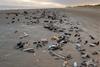
Contents of containers washed up on the Wadden Island's beaches (Bron Marjan Veenendaal Staatsbosbeheer)

The 19,224TEU vessel was on passage from China to Bremerhaven and changed course on the approach to the Dutch island of Texel to enter the southern (inshore) track of the German Bight Traffic Separation Scheme.

A severe north-westerly gale and heavy seas led to rolling angles estimated between 20o and 30o in beam seas over a period of several hours, and in darkness a number of container stacks were seen to collapse.

The ship reduced speed and altered course into the wind to reduce the rolling but with containers hanging over the ship’s side, some containing hazardous cargo and with concern for the crew’s safety, it was difficult to establish the number of boxes actually lost.

Toys, hazardous materials and other contents washed up on the beaches of the Wadden Islands in northwest Europe and an extensive clean-up had to be made.

Coastal pollution

The containers and their contents (estimated at around 3,257 tons) were lost north of the Dutch and German Wadden Islands with nearby shorelines soon affected.

While large items were recovered from the sea and shoreline, millions of small plastic particles and a container carrying 22.5 tons of tiny expendable polymeric beads were lost, which due to their small size and being dispersed by wind and waves were difficult to pick up.

A large-scale coastal clean-up and salvage operation followed and considered successful with 87% of the containers and 75% of the cargo found and removed, the majority of the remaining lost contents considered no longer able to be traced and recovered.

Plastic pollution of the oceans (not all container loss-related) is a worldwide problem, it estimated that 13 to 35 thousand tons of plastic disappear in the sea every day, four to 10 times the lost cargo of MSC Zoe.

When just a relatively small amount of lost cargo is deposited on pristine beaches, in this case at a special nature reserve listed on the World Heritage List by the United Nations it focused people’s attention and the resultant investigations called for action including wider consideration of navigation practice in this particularly congested, and vulnerable part of the North Sea.

Investigations

Investigations inevitably follow such accidents and as the flag country for MSC Zoe, Panama took the lead in looking at the causes in a collaborative international investigation also involving the Netherlands and Germany, the two countries suffering coastal pollution.

The Dutch Safety Board also launched its own investigation into the risks involved from shipping routes north of the Wadden Islands.

There are two recognised shipping routes off the Wadden Islands (Rijkwaterstaat)

Source: Rijkwaterstaat

There are two recognised shipping routes off the Wadden Islands 

There are two internationally designated routes to the north west of the islands, a northern and southern route, and the Dutch investigation concluded that a combination of circumstances presents risks to ships losing containers on both routes.

During storm force north-westerly winds, vessels including large, wide container ships are faced with large waves acting on their beam leading to extreme rolling moments.

Additional risks include the relatively shallow southern, inshore route, presenting a combination of vertical and horizontal ship movements that increase the risk of grounding.

The investigation also found that the slamming of waves against the ship and seawater travelling at high speed along the ship’s side can be forced upwards against the containers.

Attention then turned to the lashings that secure the container stacks to the ship itself, and a factor examined by the Panama accident report and separate from the Dutch Safety Board’s work looked at the routes shipping takes in the country’s coastal waters.

A number of recommendations were made to various government departments and industry representative bodies, including that the Netherland Coastguard be provided with the authority and resources to monitor container ships in the area.

It also recommended that traffic control of container ships be established including a VTS area, actively passing on warnings to shipping about prevailing weather and wave conditions in the Dutch part of the North Sea.

The Netherlands Coastguard and Rijkwaterstaat, with cooperation from Germany, should be involved in defining the role and responsibility associated with the intended task, according to the Dutch Safety Board report.

VTS area

As a consequence of the recommendations, Rijkwaterstaat has now introduced the new VTS area ‘Off Texel’ to provide active traffic guidance on the northern and southern shipping routes above the Wadden Islands, describing it as ‘an important step to improve shipping safety and better protect the vulnerable Wadden area’.

'MSC Zoe' is now employed on the Far East to Mediterranean routes (Peter Barker)

Source: Peter Barker

MSC Zoe is now employed on the Far East to Mediterranean routes

Traffic controllers will actively advise ships in unfavourable weather conditions to take the northern rather than the southern route, which is just 20 to 30km off the coast and holds greater risks for cargo loss during particular wave conditions.

“Establishing a new VTS area is a rare decision; it has only happened once before in recent years,” according to Rijkwaterstaat.

Every ship entering the VTS area is now required to report to controllers, a provision similar to the VTS area operated in the approaches to the port of Rotterdam.