

Regal opening for IHO Assembly in Monaco
Proclaiming the familiar lament that there’s more and better high-resolution mapping of Venus and Mars than there is of Earth’s deep oceans, Prince Albert II of Monaco, a noted marine science devotee, also reminded a packed audience at the opening of the International Hydrographic Organization’s inaugural three-year Assembly from 24-28 April at the local Rainier III auditorium that even bathymetry of navigable coastal waters could do with some improvement.
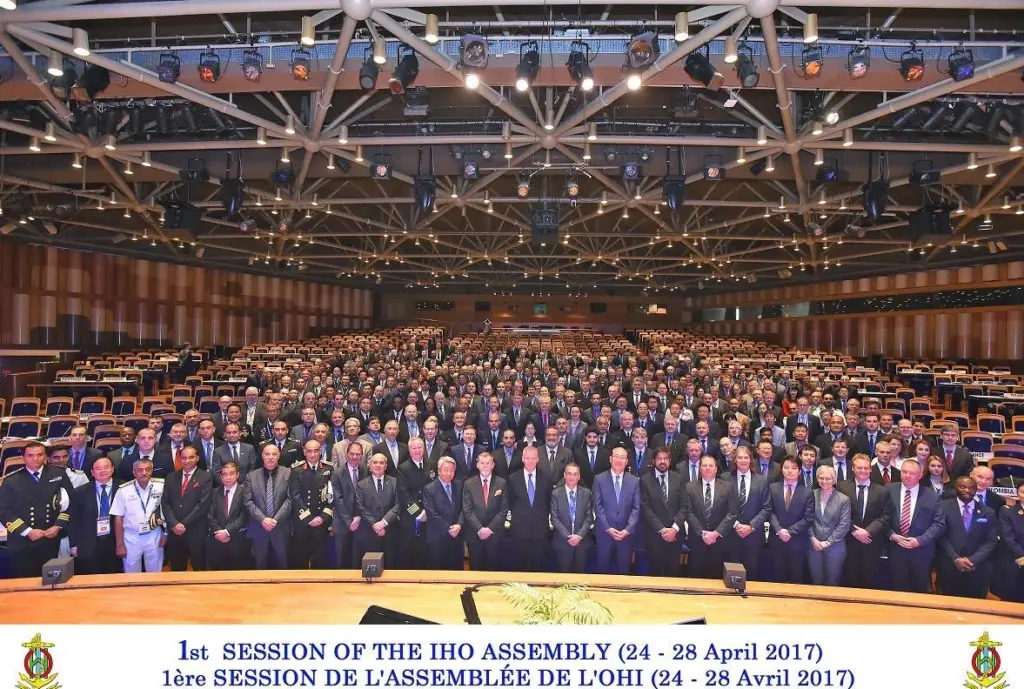
It’s a concern which will need more progressive acquisition methods using satellite-derived bathymetry and crowdsourcing with data also made available for wider purposes such as environmental monitoring and disaster response, he added at the beginning of a week-long conference convened by the inter-governmental IHO on behalf of its 87 member states. Supported by a major exhibition of equipment and services along with a number of visiting survey vessels, it was also attended by heads of leading world maritime authorities, among them IMO Secretary-General Kitack Lim who noted that hydrography has much more to offer beyond merely providing data for the safety of navigation. The whole world relies on hydrographers, he enthused.
Similarly, multiple use of hydrographic data and the importance of bathymetric science is essential for continuing exploration development of deep sea minerals, added Michael Lodge, Secretary General of the International Seabed Association. Observing that more than 30 years of research have led to the beginning of activities in the Pacific, Indian and Atlantic Oceans, the production and sharing of bathymetric knowledge and knowhow with developing countries would be particularly important.
On the main conference floor Member State representatives considered their respective roles within national spatial data infrastructures as suppliers and servers of authoritative national hydrographic datasets as distinct from being mere providers of official nautical charts. Also under detailed consideration were ways to improve currently less than satisfactory hydrographic knowledge of the seas and oceans from the deepest trenches to the high water line. This implied considerable improvements to harnessing of data as well as the publicly available bathymetric dataset covering the world’s seas, oceans and coastal waters in an era of so-called Big Data for which modern equipment is now capable of generating over 100GB of information per hour.
Also under general consideration was continuing development of one of the IHO’s principal remits, its ever-expanding capacity building programme that aims to assist developing hydrographic countries to be become much more self-sufficient in meeting their own requirements and obligations.
Council established
Among new organisational developments to be announced was the establishment of a Council comprising representatives of 30 member states. Its membership yet to be determined, an inaugural meeting will be held in Monaco in September.
New Directorate
Assembly proceedings concluded with the formal election of new officials who will assume office on 1 October for a period of three years. Mathias Jonas, National Hydrographer and Vice-President of the German Maritime & Hydrographic Agency and Chairman of IHO’s Hydrographic Standards & Services Committee, is to be the IHO’s next Secretary-General in succession to the present incumbent, Capt Robert Ward of Australia.
Fellow directors are Capt Abraham Kampfer, Hydrographer of the South African Navy since 2004 and current Chairman of the IHO’s Regional Hydrographic Commission, Souhern Africa & Islands Hydrographic Commission. His companion is Mustafa Iptes, former Hydrographer of Turkey from 2006-2010 and an IHO director since 2012 with responsibility for management of its Inter-Regional Coordination & Support Programme, including promotion of the organisation’s Capacity Building Programme.
Inaugural Prince Albert Medal for Finnish Hydrographer
Juha Korhonen, recently retired from the Finnish Transport Hydrographic Office and an active participant in IHO affairs since 1980, was declared the first winner of Prince Albert of Monaco’s newly-minted Medal for Hydrography. The award ceremony, presided over by His Serene Highness during the course of the IHO Assembly, was in recognition of Juha Korhonen’s prominent role in the very first ENC/ECDIS testing programmes. Among his many other notable contributions to wider issues was establishment of a common hydrographic survey plan for the whole of the Baltic Sea, which was subsequently adopted by the Helsinki Commission prior to EU co-financing.
By David Goodfellow