
Belgium’ s Jan De Nul Group has the biggest dredging vessels in the world in its fleet. The very large self-propelled seagoing rock cutter dredgers JFJ De Nul, Leonardo da Vinci and Marco Polo can tackle the hardest and most difficult soil conditions during shore approach dredging works.
Furthermore, these dredgers are equipped with a system for loading barges alongside, so as to work in accordance with strict environmental requirements. Four self propelled cutter suction dredgers of a size similar to Leonardo da Vinci are presently under construction.
Jan De Nul’s trailing hopper dredger Vasco da Gama is equipped for dredging in water depths up to 130m, which is deeper than any other vessel. With the ‘active’ dragheads of this vessel, more cohesive soils which were previously impossible to be trenched can now be excavated. The dynamic tracking system ensures the draghead follows a predefined trench at better tolerances, resulting in minimum quantities being trenched at a lesser cost. For backfilling of trenches with sand and gravel the dredge pipe can be used as a fall pipe. Two even larger trailing suction hopper dredgers, Cristóbal Colón and Leiv Eiriksson, are presently under construction and will be capable of dredging in water depths of up to 155 m, which is far deeper than any other vessel.
The Group also has the new 6,000 ton dynamic positioned side dumping vessel Willem de Vlamingh under construction. This vessel is many times larger than similar side dumping vessels on the market, which allows the execution of rockdumping at lower unit costs. This vessel will be equipped with a fallpipe for placement to 200m water depth.
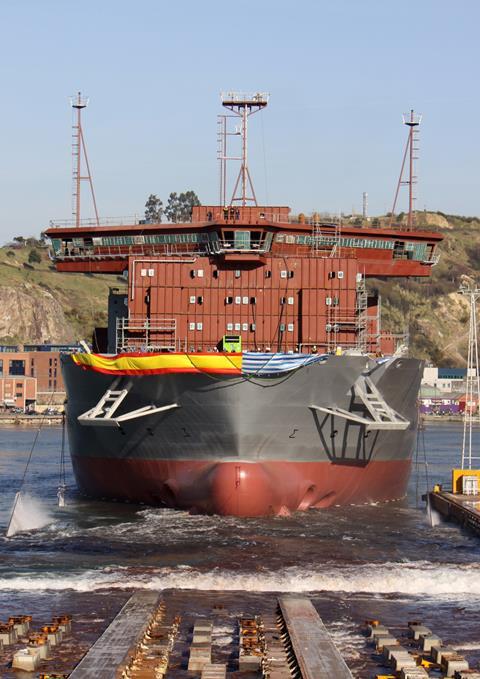
The subject of this month’s ShipShot, the new 37,500 dwt fall pipe vessel Simon Stevin, will be equipped for rockdumping on pipelines and seabed preparation in 2,000m water depths and will be the largest of its kind available on the world market. Beside the very large operational depth, a unique feature of the vessel’s feeding system to the fallpipe is that it will be capable to deal with a rock size of 400mm, which is more than any other fallpipe vessel. Where the stability of the rock is defined by seabed currents, this will allow the reduction of the rock volume and resulting costs.
For rockdumping in shallow areas, the Group mobilises the smaller dynamic positioned side dumping vessel Pompeï, and the 6,310 dwt DP vessel La Boudeuse, which is equipped for dynamic positioned rockdumping through an inclined fallpipe for placement underneath platforms and fixed structures. Services for the offshore oil and gas industry
Offshore services the Group can provide include re-trenching, pre-sweeping, backfilling and span correction for offshore pipelines in water depths up to 155m; landfall dredging and shore approaches in difficult soils and under strict environmental conditions; cofferdam installation and pipe pulling; rock dumping and seabed preparation in water depths up to 2,000m; ballasting of offshore structures; and the excavation of seabed ‘glory holes’.
For further information contact Jan De Nul NV: Tragel 60, B-9308 Hofstade-Aalst (Belgium) Tel: International Division: +32.53.73.17.11, Fax: +32.53.77.28.55 email: info@jandenul.com, web: www.jandenul.com