

Just days after reaching another major milestone on Genoa’s new offshore breakwater, Italian construction group Webuild has secured an €803 million contract to build the most technically demanding section of the city’s long-awaited undersea road tunnel.
The company has been hired by Autostrade per l’Italia in what is one of Europe’s most ambitious programmes of maritime infrastructure.
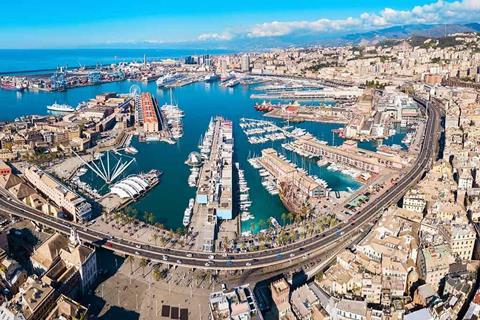
The contract covers Lot B of the Genoa Undersea Road Tunnel, the central section passing beneath the commercial port and the city itself. Built by Webuild (90%) and subsidiary SELI Overseas (10%), it represents the engineering heart of a project designed to separate freight traffic from urban vehicles while improving access to one of the Mediterranean’s busiest ports.
“From a technical standpoint, the project presents major challenges: construction below the seabed, tunnelling through complex geological conditions, and operating inside a busy urban and port environment,” says Webuild.
“The overall route will extend approximately 4.2 kilometres, including 3.4 kilometres in tunnels, with two separate parallel tubes, one for each direction of travel. The tunnel will connect San Benigno, to the west, with Viale Brigate Partigiane in the Foce district, passing beneath the port basin, where it will reach a minimum depth of more than 40 metres before rising again beneath the hill of the Carignano district.
“Excavation will be carried out using a tunnel-boring machine (TBM) with a diameter of nearly 16 metres, one of the largest to be used in Italy, excavating approximately seven kilometres.”
The works are expected to create more than 700 jobs and include extensive regeneration around the tunnel portals, including the creation of Lanterna Park using excavated material in line with circular economy principles. Webuild said the new road link would separate urban traffic from port and logistics flows, reducing congestion, emissions and noise while improving connections between neighbourhoods.
Genoa Breakwater
The award comes as construction accelerates on the New Genoa Breakwater, another Webuild-led project that has now reached approximately 1,350m in length following the installation of three additional caissons in just 10 days.
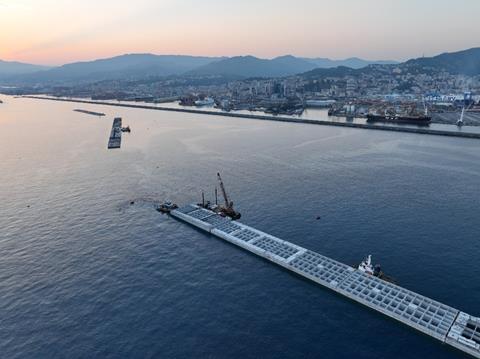
“The installation of three caissons in just ten days highlights the pace of construction on a project being carried out in one of the Mediterranean’s most challenging maritime environments,” the company says. “The new breakwater is being built in waters up to 50 metres deep, where every installation phase requires highly precise engineering operations and careful coordination at sea.
“The most recently installed caisson measures 67 metres in length, stands more than 33 metres high, and weighs approximately 15,000 tonnes. Its installation involved a complex sequence of operations, from transport by sea to placement on the seabed, supported by specialised marine vessels and technical teams responsible for monitoring, inspection, and assistance at sea, on land, and underwater.”
Previous phases of the project have involved a large fleet of dredgers, tugs, barges, pontoons and other specialist marine assets to prepare the seabed and position the massive concrete structures.
When the breakwater is finished, Genoa will be able to handle larger generations of container ships more efficiently. Webuild said the structure was designed to provide safer access and greater manoeuvrability for the latest generation of vessels, including the large container ships that account for an increasing share of global maritime trade, while also improving the port’s resilience to adverse weather and sea conditions.
Together with the Terzo Valico dei Giovi high-capacity railway, the undersea tunnel and the breakwater form the three pillars of Genoa’s transport transformation.
The projects will integrate the port, rail and road networks into a more efficient logistics system along the Rhine-Alpine TEN-T Corridor, strengthening Genoa’s position as one of southern Europe’s principal maritime gateways.