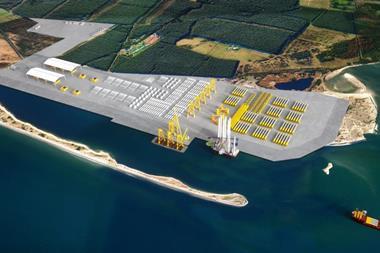


A Greek industrial port is to be transformed into one of the Mediterranean’s largest mega-yacht marinas, previously unseen planning documents reveal.
The €524 million Nautilus Project to redevelop the Port of Platygiali-Astakos has been designated a ‘Strategic Investment’ by the Greek government and is planned on a site of approximately 1.8 million m². It will create a 350-berth marina, including 105 berths for mega-yachts over 40 metres, alongside hotels, tourism facilities, commercial development and residential accommodation.
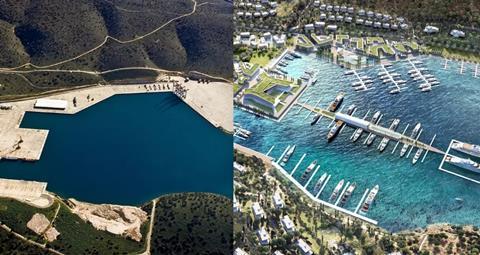
The Special Spatial Development Plan (ESCHASE) masterplan positions the harbour as the centrepiece of the entire project. It says the new Port Zone ‘will form the principal spatial infrastructure for the development of the tourist harbour (mega-yacht marina), which constitutes the central core of the investment around which all other activities and land uses are organised’.
The documents show that the project will repurpose the existing deep-water commercial port rather than build an entirely new harbour, combining the use of existing port infrastructure with significant new marine works.
Among the most notable proposals is the ‘creation of two additional yacht berthing piers in front of the shoreline to meet the needs of mega-yachts and to enable the rational planning of the port area’.
The development also establishes a dedicated Port Zone covering 75,244 m², creating a substantial marine services hub rather than a conventional leisure marina.
According to the planning documents, the zone will accommodate yacht repair and maintenance facilities, dry storage areas, logistics operations, warehouses and associated port services.
Supporting infrastructure will include bunkering facilities, waste reception, engineering and electromechanical installations, security systems, internal roads, parking, pedestrian and cycle routes and landscaped public areas, illustrating the breadth of civil engineering works required to convert the industrial port into a modern marina complex.
Although the masterplan identifies the broad marine infrastructure required, it does not specify engineering quantities such as quay lengths, dredging volumes, breakwater construction or harbour deepening. Those details are expected to be contained within the project’s technical studies, including the Port Zone Study and supporting engineering documentation referenced by the ESCHASE.
Nevertheless, the planning documents make clear that the project is far more ambitious than a marina expansion, outlining the wholesale conversion of an industrial port into a purpose-built superyacht destination supported by extensive marine service facilities, new berthing infrastructure and associated civil engineering works that will form the operational heart of the wider development.
Financing and timescale
The €524 million Nautilus Project is intended to be financed by the private developers behind the scheme rather than the Greek government. The planning documents identify Astakos Terminal S.A. as leading the investment, while MYMAR Nautilus Investments, based in Cyprus, is leading the development.
The project’s Strategic Investment status means it will benefit from fast-track planning and permitting procedures, as well as the legal framework to redevelop the site and use the adjacent coastal and marine areas.
The Nautilus Project has been designed to bring its marine infrastructure into operation at the earliest stage of development, with the conversion of the existing industrial port into a mega-yacht marina front-loaded in the construction programme.
According to the project’s ESCHASE, Phase A, covering the first seven years of the development, includes the conversion of the port into a marina together with the construction of the vast majority of the marina’s core infrastructure and the site’s essential infrastructure.
The first phase represents 58% of the total development, equivalent to 200,000m², and also includes three hotels, offices, retail facilities and the first residential properties. The report estimates a construction period of around three years for this phase.
By prioritising the marina and its supporting infrastructure, the developers plan to have the port operational while later phases are still under construction. Phase B begins in Year 8 with the Phase A facilities already in service, while the final phase starts in Year 14 to complete the remaining 23% of the scheme.