


Six more tugs for fast growing Smit Rebras
One of the mostrapidly developing tug fleets in the world is that of Brazilian company Smit Rebras, a joint venture company formed by Smitand a Brazilian partner in March 2006.
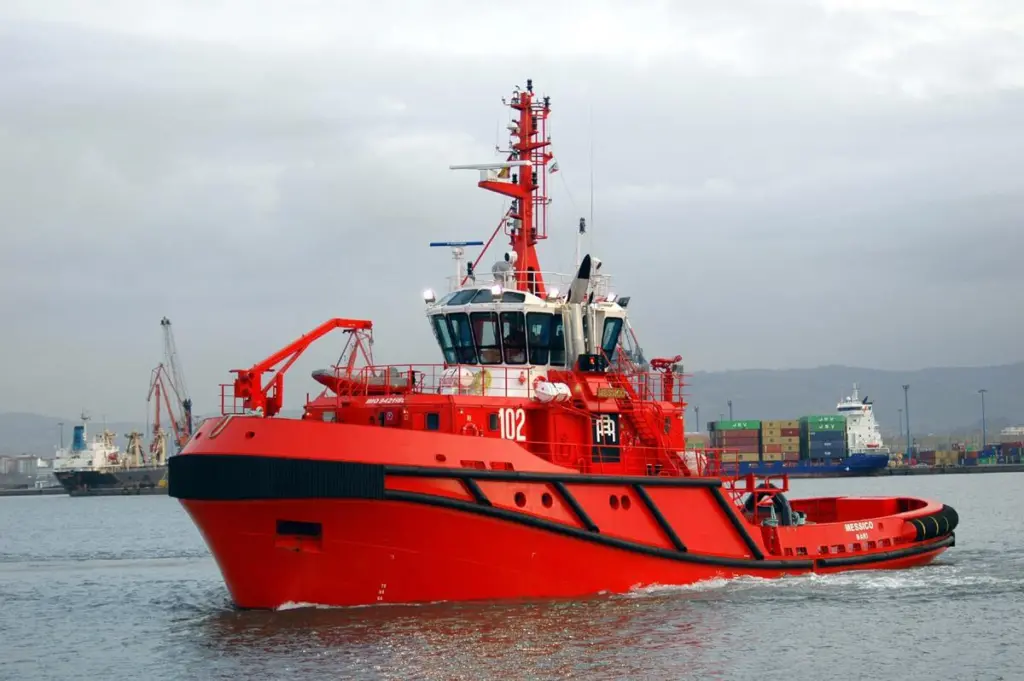
Soon after its formation the company commenced an ambitious construction programme with an initial order for eighteen new azimuthing stern drive (ASD) tugs to well established Robert Allan ‘RAmparts’ designs.The Detroit Brasil yard in Itajaí was entrusted with the construction project, comprising a batch of twelve compact RAmpart 2500 class and six RAmpart 3000 class vessels of 45 and 65 tons respectively. All twelve of the 24.40m long RAmpart 2500 tugs were delivered between December 2007 and October 2008 at a rate of one tug per month. Each vessel has two Caterpillar 3512B HD main engines coupled to fully steerable Schottel propulsion units.
The first of the remaining six larger vessels, the ‘Smit Canindé’, was delivered in January 2009 and this latest batch will be completed by the third quarter of the year. All six of these larger 30.50m tugs are powered by Caterpillar 3516B HD diesels generating a total of 5,360bhp to power Schottel 1515 FP propulsion units. This propulsion system has given Smit Canindé a bollard pull of well over the predicted 65 tons. All six tugs will be fitted a fire fighting system of 300 m3/hr capacity, with the possibility of upgrading to FiFi 1.
The new Smit Rebras fleet started work in earnest in February 2008 with four RAmparts 2500 tugs deployed to Santos. Four went to Sao Luis in May, two to Paranagua in September and a further pair to Sepetiba in October. The company say that the amount of ship assistance work has increased rapidly and the fleet have performed several salvage operations. Four tugs will also enter service at the Iron ore port of Vitória during the first half of this year.
Smit Rebras has announced its intention to build a further twelve tugs of the same RAmparts 2500 design. By 2011, five years from the start of the new business, the company will operate in between eight and ten of the main Brazilian ports with at least 30 new ASD tugs.
Related Articles
 TUGS & SALVAGE
 EQUIPMENT
 MARINE CONSTRUCTION