

The hidden dangers of the HS-OSC Code
According to Naval Architect, John Kecsmar, HS-OSC Code CTVs could run into difficulties with out-of-range passenger accelerations.
With the ever increasing demands for more technicians to be taken out to the turbines it was clear that statutory rules lagged behind the current state of the industry. With CTVs being limited by the 24m loadline rule, and the ability to carry more than 12 passengers the only route was the full HSC code or big ship rules. Hence the sub 24m CTV becoming more and more compact and more weight added to an existing sub 24m platform. Then came the introduction of the HS-OSC Code, a “Light” version of the HSC 2000 Code, which allows up to 36 persons in the sub 24m size or up to 60 persons beyond providing the vessel is less than 500GT.
NEW CODE, NEW CHALLENGES
With this new code came a sense of “normality”, in the sense that CTVs were being supported by new legislation to allow them to carry out their tasks without driving up initial capital and running costs, by using a different set of statutory rules.
One of the biggest issues of remaining below 24m is that the seakeeping remains pretty much the same. All vessel of circa 24m exhibit extremely similar seakeeping characteristics, it is simple hydrodynamics! So this lead to a new issue facing these sub 24m CTVs, the transfer phase of the operation. Then followed a series of R&D conducted by the Carbon Trust which provided guidance – and hence a way forward – for these sub 24m CTVs that experienced difficulties in transferring personnel from the vessel to the tower. The easy solution – increase freeboard – especially at the bow. This allows larger amplitude waves to pass under the hull rather than slamming on the low wet deck freeboards of the existing vessels.
As noted in the report: “….For small vessels, their freeboard was generally the limiting factor and their roll characteristics often limited transfer performance in beam sea conditions…”. And went on further to add: “…freeboard was found to be a primary driver in terms of parameters affecting the ability of the craft to remain pushed onto the docking poles in rough weather…”.
So, the solution, whist keeping vessels below the 24m loadline rule and the ability to carry 24 technicians (passengers), to improve the higher sea state transfers is obvious, just increase the freeboard. If we look at many new sub 24m CTVs today, they have a pronounced increase in their freeboard compared to the same CTVs of several years ago.
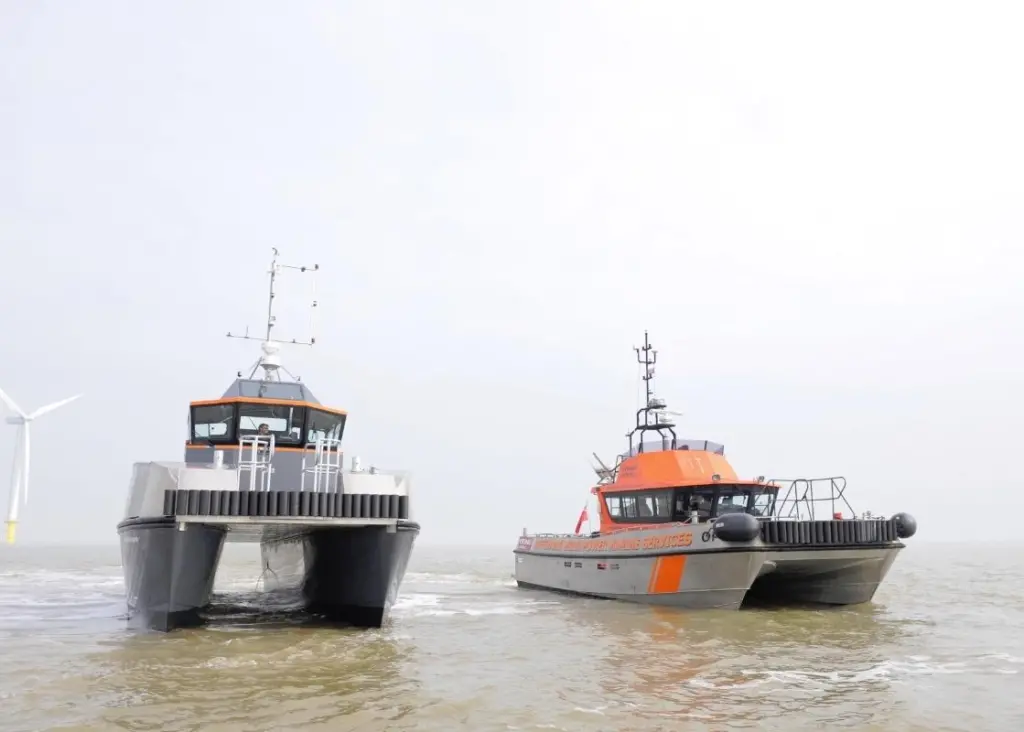
The effect of this can be seen several years before such R&D become known. When we designed the CTV Ashera for C.Truk we incorporated all the same type of R&D based upon our fast ferry design experience over the previous 20 years. Increasing freeboard moves the threshold and propensity for bow diving to be more manageable and a much lower probability, as seen in the image below of Ashera compared to a similar size but lower freeboard South Boats CTV of the time as shown in the accompanying photo.
GOING UP A LEVEL
So, increasing the freeboard is now becoming an industry norm, and you’ll also note the additional space for the technicians is adding an additional tier too. And yet whilst the new HS-OSC code solves the increasing number of passengers and the P-Plots guidance for increasing sea state transfers, there are hidden dangers in the HSC-OSC code that are yet to be fully realised.
The HS-OSC code uses the full HSC 2000 code as its basis. In the HSC 2000 code Annex 9 states in 3.3.1: “…in normal operation at maximum operational speed the accelerations shall not exceed safety level 1 in annex 3..” , where Level 1 has a limit of 0.20g horizontally.
We can calculate the loads imposed on a person from basic static and dynamic equations of a vessel in roll; which includes the summation of heave horizontally. So, making several assumptions of typical sub 24m loadline vessel, running in a Hs = 1.0m having a roll and pitch period which are very similar, circa 2.50 seconds, and a heave of 0.50m and assuming an instantaneous roll angle of 5 degrees, then knowing the levers, the distance from the centre of roll (the Centre of Gravity) to the person, we can calculate these effects.
Notwithstanding that these are very rough calculations based upon several assumptions, we could conclude that those in tier 1 location are borderline pass/fail for level 1 compliance. However tier’s 2 and 3 would most certainly be failure to comply with 0.20g. If these are also compared against Level 2 of 0.35g limits, the situation is not much better.
All HSC code vessels that currently operate within the UK have operating limits imposed by the MCA. This relates to the prevailing significant wave heights. Redjet 3 that ran between Cowes on the Isle of Wight to Southampton, despite being a 30m catamaran, had a limit of Hs=1.20m applied and the smaller Redjet 1 and 2 Hs=0.80m. Fortunately such sea states are rare in the Solent. However, today Energy companies are applying more and more strict regulations that each vessel design and operator must comply with when operating in the fields. With the introduction of new telemetry technology from companies such as Reyar, if such real-time measurements become another requirement, then it is not clear how these high freeboard vessels shall be compliant with the HSOSC code when running in more exposed seas and what response such energy companies shall take to being non-compliant.
ABOUT THE AUTHOR
John Kecsmar co-founded Ad Hoc Marine Designs Ltd in 2005, he was previously the Chairman of the RINA’s High Speed Craft committee and is a Fellow member of RINA and is currently a member of the editorial board of RINAs IJSCT publication, a member of LR’s Technical Committee, RINA’s High Speed Vessels and Safety committees, MCA’s High Speed Advisory Group, and SNAME’s O-50 Marine Quality Culture Group and SD-5 Advanced Ships and Craft Panel. He has designed high-speed vessels such as: crew transfer vessels, patrol boats, fast ferries and SWATHs over the past 30 years and is the author of many technical papers on high-speed hydrodynamics, structural design, and fatigue. He lives in Japan.
Related Articles
 ELECTRICAL SYSTEMS
 VESSELS
 INDUSTRY NEWS