


Trinity House celebrates 500 years of serving the mariner
Celebrating a 500th anniversary is a bigger event than most organisations could ever aspire to, but for the Corporation of Trinity House, the organisation that looks after maritime safety infrastructure, that time has come.
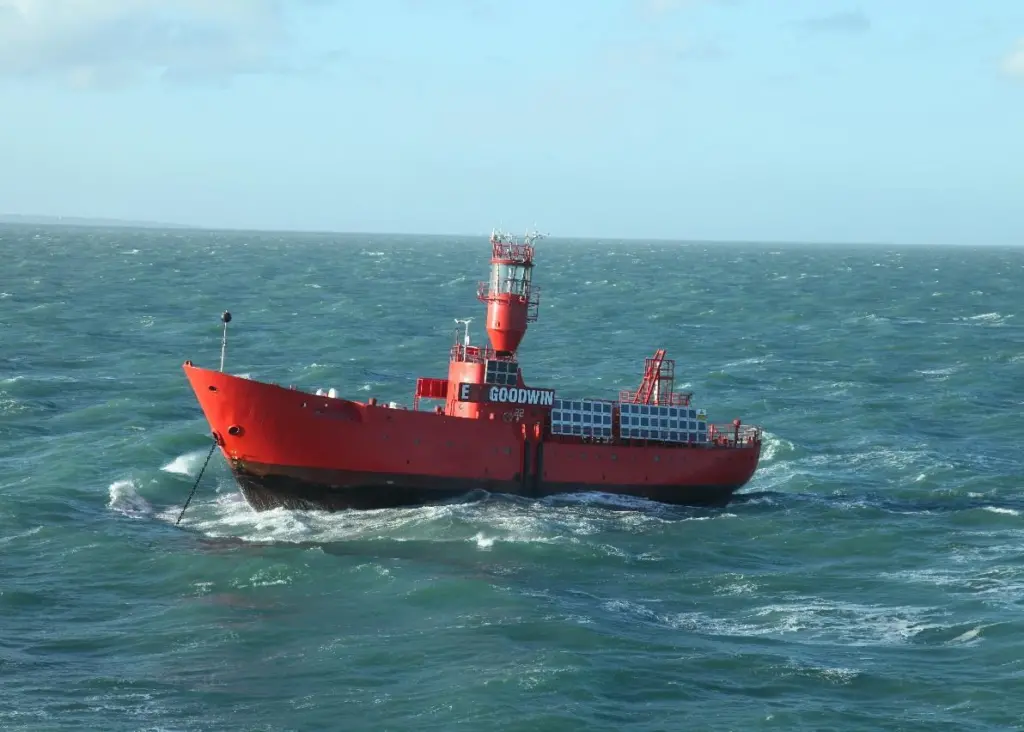
Founded in the reign of Henry VIII, the Corporation’s core function, as the General Lighthouse Authority for England, Wales, the Channel Islands and Gibraltar, is responsibility for the provision and maintenance of navigational aids, including 65 lighthouses, eight light vessels and up to 500 navigation buoys. These are funded by light dues levied on commercial vessels calling at British ports, which are calculated on the net registered tonnage of the vessel. The rate is set by the Department of Transport, and annually reviewed.
Trinity House also manages maritime radio and satellite communications systems for the public and private sectors and provides services to several commercial organisations, including the laying of navigation buoys for various harbour authorities, offshore installations and windfarms as well as marker buoys for scientific data gathering projects.
The Corporation’s fleet of specialised vessels, the ‘lighthouse tenders’ THV Patricia (1982/2,639gt) and THV Galatea (2007/3,672 gt) are used to inspect and maintain these assets and tow the Corporation’s remaining lightships between their stations in the shipping lanes off the south coast of England, from the Sunk to the Sevenstones in the Isles of Scilly, and the maintenance depots at Harwich and Swansea. There is also a helicopter named Satellite which is operated by the Police Aviation Service on behalf of TH for accessing isolated lighthouses in the South West.
Along with the ‘rapid intervention vessel’ THV Alert (2006/302gt) the ships are designed for a range of duties from buoy handling to towing and surveying and are on call to respond to maritime emergencies such as collisions at sea and shipwrecks, whether by laying marker buoys, assisting with salvage or taking disabled vessels in tow. The recent collision between a container ship and a tug and tow off Newhaven was a case in point, as Galatea was tasked to assist the recovery of the tug and its barge in the absence of an Emergency Towing Vessel.
On a different tack, last year the multi-purpose Galatea used its DP capability and 30 tonne SWL Leibherr crane to install a tower crane on the Nab Tower, which the Corporation has partly dismantled prior to a total refurbishment of the crumbling structure (see MJ August 2013).
There is another commercial arm to the Corporation’s business as well; the flagship THV Patricia takes paying guests on short working voyages around the British coast, providing a unique cruising experience.
Although it no longer provides pilots for local harbour authorities, Trinity House is still an official deep sea pilotage authority for ships trading in Northern European waters, which includes issuing Pilot Exemption Certificates. It is also a maritime charity, dispersing funds for the welfare of retired seamen, the training of cadets and the promotion of safety at sea. For the last financial year ending in March 2013 TH spent approximately £6.5m on these and other charitable objectives.
The ‘Corporation of Trinity House of Deptford Strond’, was founded in 1514 by Royal Charter granted by Henry VIII under the title ‘The Master, Wardens, and Assistants of the Guild, Fraternity, or Brotherhood of the most glorious and undivided Trinity, and of St. Clement in the Parish of Deptford-Strond in the County of Kent.’
Although TH’s remit now covers the coastline of England and Wales, as well as the Channel Islands and Gibraltar, its charter was granted as a result of a petition presented to the King in 1513 by a guild of Deptford-based mariners who were concerned about the poor standard of pilotage on the River Thames. Their request for a licence to regulate pilotage was granted the following year and the first Master was Thomas Spert, the sailing master of Henry’s flagship Mary Rose and the Henry Grace a Dieu. The name of the guild derives from the Holy Trinity and St. Clement, the patron saint of mariners.
As John Whormby, a Clerk to the Corporation, wrote in 1746, their general business was: ‘to improve the art and science of mariners; to examine into the qualifications, and regulate the conduct of those who take upon them the charge of conducting ships; to preserve good order, and (when desired) to compose differences in marine affairs, and, in general, to consult the conservation, good estate, wholesome government, maintenance and increase of navigation and seafaring men; and to relieve decayed seamen and their relatives.’’
In 1566 Queen Elizabeth I’s Seamarks Act enabled Trinity House to:’at their wills and pleasures, and at their costs, [to] make, erect, and set up such, and so many beacons, marks, and signs for the sea…whereby the dangers may be avoided and escaped, and ships the better come into their ports without peril.’
There is a still a Royal connection with Trinity House, as the current Master of the Corporation (now an honorary title) is HRH The Princess Royal. Previous Masters have included Samuel Pepys, William Pitt the Younger, the Duke of Wellington, Admiral William Penn and the current Duke of Edinburgh. The Master presides over a court of 31 Elder Brethren. These are appointed from 300 Younger Brethren, drawn from people with maritime experience who can act as advisors.
To mark this anniversary year, The Royal Mint has honoured TH with the production of a £2 coin. The reverse of the coin features a design by Joe Whitlock Blundell, production director of The Folio Society, and the illustrator and printer David Eccles, that shows a stylised image of a lighthouse lens. The Specimen Uncirculated version, presented in an informative Royal Mint folder aimed at collectors, retails at around £10. The Ordinary circulation version should be available from banks and post offices during the year. There is also a Silver Proof version, a Piedfort proof version, made double weight and a Gold Proof Version produced in 22 carat red gold, with the centre ‘gold sprayed’ according to the Royal Mint, before striking.
Among this year’s celebratory events, a Trinity House exhibition, ‘Guiding Lights’, will open in April at the National Maritime Museum, Greenwich, to run until January 2016. This intimate exhibition displays some 70 objects from the Museum’s collection, telling the history of Britain’s lighthouses through films, models and the personal effects of lighthouse keepers. Light vessels, buoys and yachts are depicted in a selection of rarely seen watercolours by the marine artist William Lionel Wyllie, and a series of prints illustrates the story of Grace Darling, the lighthouse keeper’s daughter who became famous in the 1830s for the daring rescue of a group of survivors after she spotted the shipwrecked Forfarshire on nearby rocks.
The corporation has published a 300 page, large format, llustrated book, Light upon the Waters. This definitive history of Trinity House is written jointly by Captain Andrew Adams and Captain Richard Woodman. ‘Andy’ Adams was a boy seaman when he joined Trinity House in 1963. Over 40 years he gained wide experience afloat, eventually becoming Chief Pilot in the Port of Harwich and an RNR Captain and Nautical Adviser. His contribution to this book derives from his interest in, and knowledge of, the history of pilotage. He is a Younger Brother of Trinity House.
Captain Woodman went to sea aged 16 and served in cargo-liners and Ocean Weather Ships before spending more than 30 years with Trinity House, several in command afloat and ashore. He was elected an Elder Brother in 2006. He is a keen yachtsman and an award winning author with over 50 published works to his credit, including novels and a History of the Merchant Navy. The book is available in hardback from Trinity House offices in London and Harwich, price £29.95, or £19.95 in paperback, plus p&p. Another photographic book is due to be published later this year.
Projects and events organised by the self funded TH charity include the donation of more than £2m to create a community hub at Mariner Park, Wallasey, which is being officially opened in April. This is a not for profit care home for ex-mariners and their dependants in the Wirral, which is owned by Nautilus, the maritime union. The home provides palliative care, respite care, convalescent care and physiotherapy for up to 32 residents.
Trinity House has also donated funds to refurbish the RNLI Lifeboat Boat House at Ramsgate, Kent, and is organising abseiling events from three lighthouses to generate funds for the charity, which goes to support projects such as those above and diverse maritime charities. These events will be open to members of the public who would like to participate.
Later in the year, Trinity House is organising further sporting events, including a charity endurance cycle race and a Dragon Boat Race, both raising funds for the TH charity. The Corporation also supports the annual Sea Festival at Harwich, the home of TH’s operational headquarters and buoy yard. And, as in previous years, there will be a Trinity House float in the Lord Mayor’s Show in the City of London on Saturday, 8 November.
by Graeme Ewens
Related Articles
 VESSELS
 MARINE CONSTRUCTION
 VESSELS