


USV research venture
The University of Plymouth in association with locally based Atlantic Inertial Systems is to lead research into a new form of navigation system, enabling unmanned surface vessels (USVs) to operate in areas without satellite coverage.
The three and a half year project is being funded by a £350,000 grant from the UK Engineering & Physical Science Council.
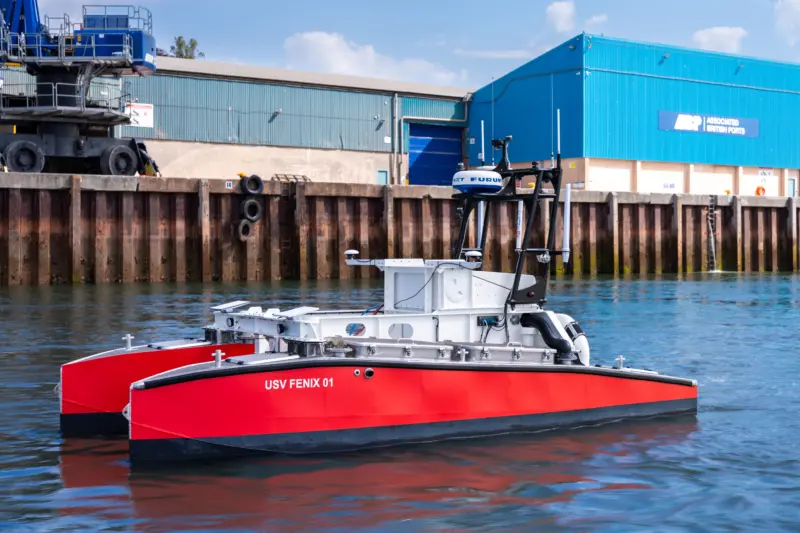
Remote controlled USVs generally have a key role in hydrographic survey operations, particularly in dangerous conditions. They are also commonly used for military applications in danger zones or on surveillance missions. But difficulties can arise in confined areas such as mountainous regions or close to canyons, where satellite positioning is prone to interference and breakdown.
Together with Atlantic Inertial Systems’ Dr Sanjay Sharma, Professor Bob Sutton of the University of Plymouth’s School of Marine Science & Engineering plans to work on the design of an intelligent adaptive autopilot system, while the University’s School of Computing & Mathematics will be responsible for the design of a navigation sub-system based on visual simultaneous localisation and mapping techniques.
The combined approach is expected to result in a new advanced intelligent system which will be tested and trialed aboard the University’s own USV, Springer, which apart from use as a test bed platform, is also designed for environmental and hydrographic surveys in rivers, reservoirs, and coastal waters.