![MaritimeJournal[Seawork]](https://www.maritimejournal.com/wp-content/uploads/2026/09/MaritimeJournalSeawork.svg)


BOA expands its heavy-lift barge fleet
BOA Offshore AS has announced plans to expand its fleet of semi-submersible barges with two 75,000dwt newbuilds, bringing the combined lifting capacity of its 18-vessel fleet to a daunting 384,852 tonnes.
Trondheim, Norway-based BOA Offshore started out around 40 years ago providing harbour and coastal towage services, the family-owned company gradually expanding to include in particular a fleet of both semi-submersible and flattop barges, offering transport solutions for various maritime service sectors. The growing demands for such niche services illustrate how BOA has responded to keep pace.
Wet tow vs dry tow
The history of ocean towing was partly founded on the requirement to tow ungainly floating objects, such as drydocks and dredging equipment, over long distances. Experience gained as the industry developed resulted in a generally reliable, albeit slow, means to an end for transporting objects too large to be considered general deck cargo.
For objects not designed to float, barges were used and towed as normal. Over time this method was complemented by self-propelled heavy-lift vessels, and in turn vessels that could be semi-submerged for the loading of floating objects then deballasted to become in effect similar to any other cargo vessel. They were more expensive to build and operate but provided the advantage of speed and a degree of protection for the cargo, which was typically aft of the vessel’s accommodation block.
BOA’s fleet of semi-submersible barges are all non-propelled, most with various configurations of flotation tanks positioned on the main deck, housing machinery and accommodation. The heavy deck cargo flattop barges by contrast are comparatively simple, the earliest delivered in BOA’s current fleet list, the 33m long Boabarge 15 being built in Russia in 1994 and able to transport a cargo of just 940t.
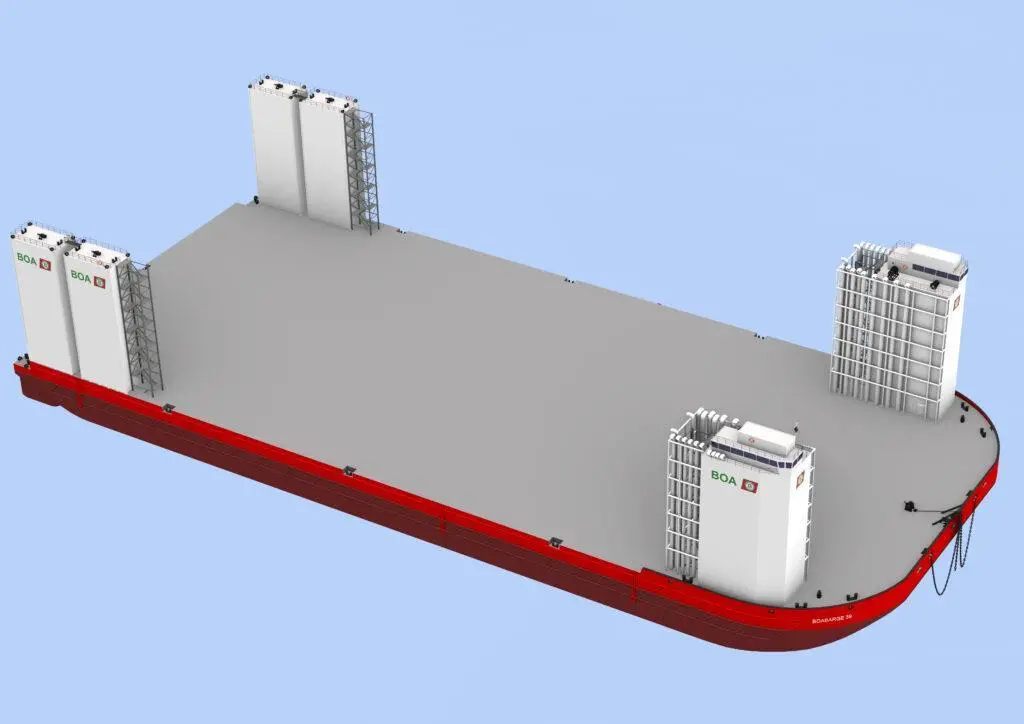
The comparison with the plans for the latest (semi-submersible) barges of 166m length and 75,000t capacity provides an indication of how the demand in capacity has grown since. The company lists six flattop barges in its fleet, ranging from the 940t capacity example mentioned to the 10,866dwt, 91m long Boabarge 43 and 44 built in China in 2013.
The semi-submersible fleet listed currently stands at 12 vessels, starting with the 2001-delivered Boabarge 21 and 22, 92m long examples of 11,000t capacity and gradually increasing in size to the 140m long, 30,200dwt Boabarge 33 built in China in 2011. This features a hull partially sponsoned over its length. The semi-submersible barges can be submerged to depths ranging from 6m to 21m and with its fleet including combinations of identical vessels, barges can work in tandem to spread the load of outsized cargoes.
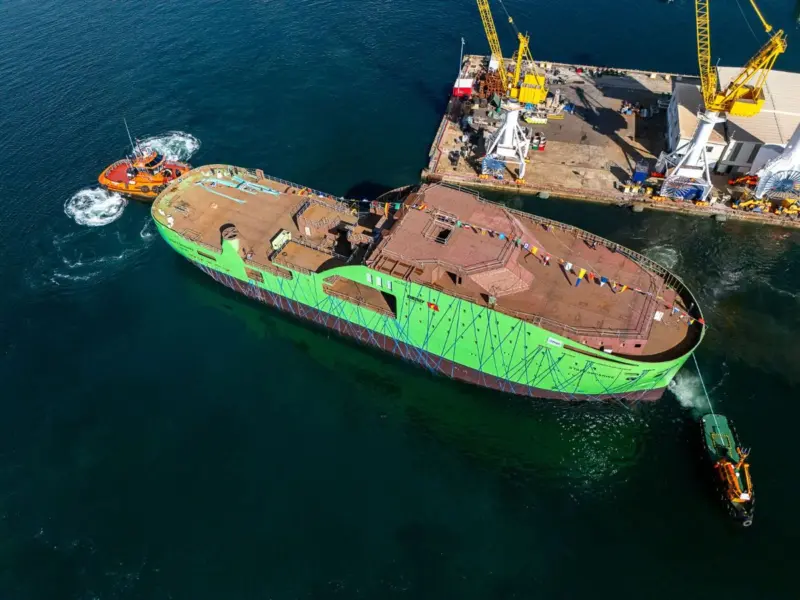
The “next generation” barges will measure 166m by 73m with a deadweight of around 75,000t, 32t/m2 deck strength, 20,000m3/hr ballasting capacity and four removable flotation towers. Designated Boabarge 39 and 40 the pair will be capable of hybrid battery/generator/shore power operation and BOA is targeting 2024 for shipyard selection with the first barge in operation in 2026.
Tug support
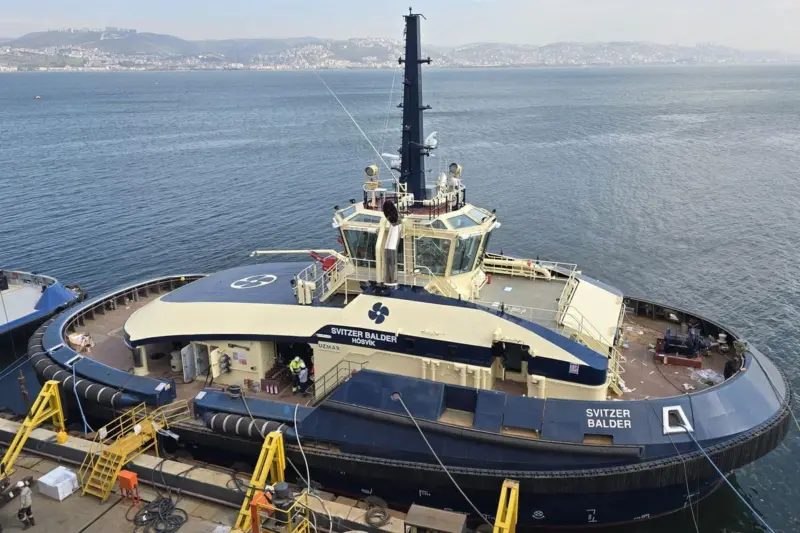
As mentioned, the barge fleet is non-propelled, providing clients with the flexibility of selecting a towed operation vs a manned and self-propelled ‘ship’-type semi-submersible barge. BOA has seven harbour/coastal tugs at its disposal. Most notable in the fleet are the three Robert Allan-designed, 2009-delivered RAmparts 3200 ASD tugs Boa Brage, Boa Heimdal and Boa Balder, each offering a bollard pull of 65t.
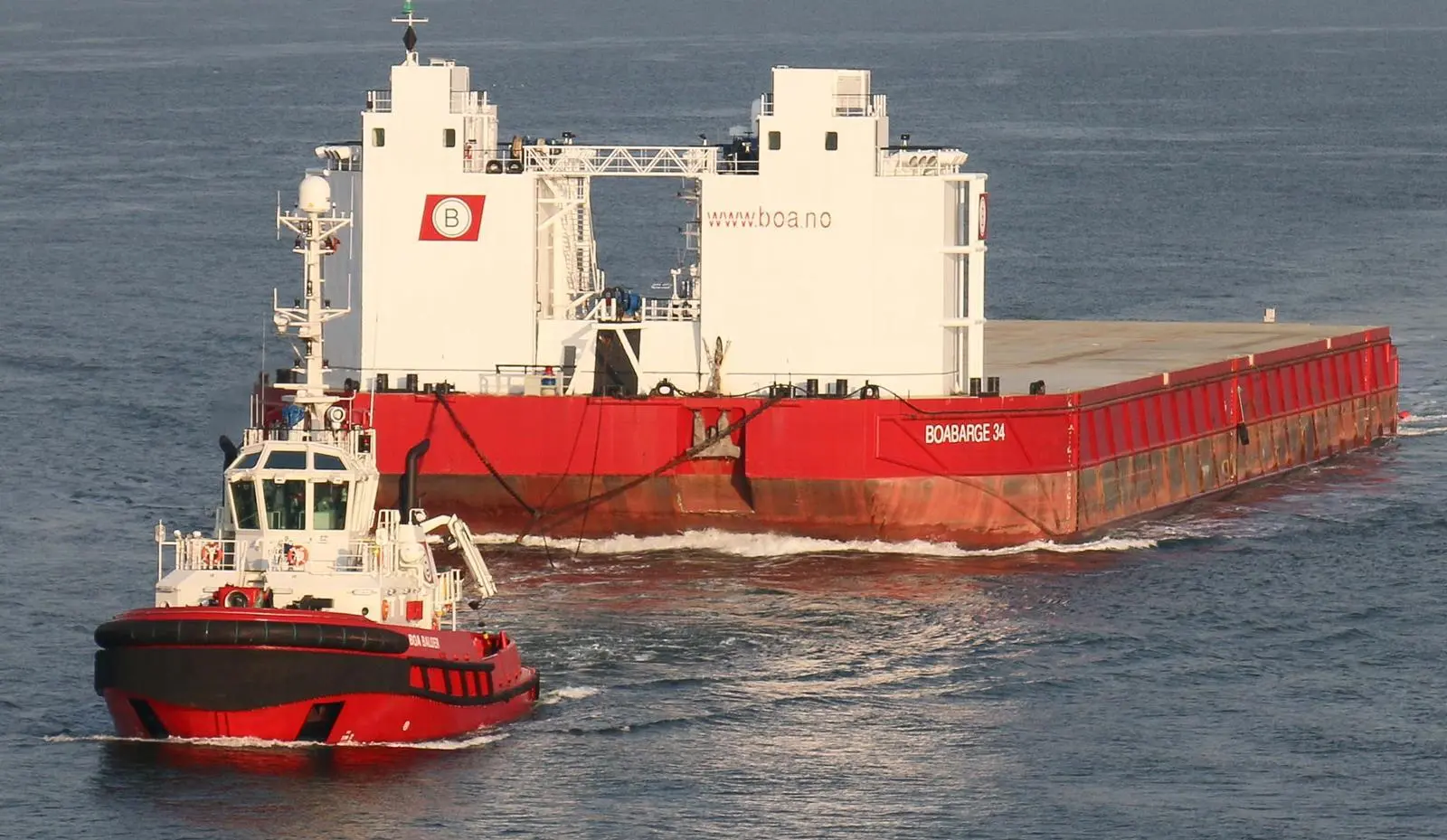
Other vessels of interest are the ‘conventional’ tug Chief built in Norway in 1979 providing 17tbp, the Ulupinar-class 41tbp tug Boa Birk and 1976-built Boa Sund, a vessel with German and British previous owners. The 7m multipurpose workboat Kark completes BOA’s non-barge fleet list.
Mention must be made however of Boa Jarl and Boa Bison, two vessels which fall well outside the area of barges and associated tugs.
Currently operated by the Norwegian Coast Guard as KV Jarl and KV Bison,this pair of powerful VS 491 CD anchor-handling tug supply vessels (AHTSs) provide 275tbp, the design proving to be a popular choice for coastal states looking for high-specification powerful tugs capable of providing emergency towing response services, along with other duties.
Two other VS 491 CD AHTSs, built in Norway in 2010 as Siem Garnet and Siem Diamond, are now owned and operated by Les Abeille and as Abeille Normandie and Abeille Mediterranee are working for the French Navy, including as Emergency Towing Vessels based at Boulogne in the English Channel/Dover Strait region and the French Mediterranean.