![MaritimeJournal[Seawork]](https://www.maritimejournal.com/wp-content/uploads/2026/09/MaritimeJournalSeawork.svg)






Ice-class tugs’ equipment goes to extremes
With a total bollard pull of 100 tonnes and a reinforced hull, the TunDRA 100 tugs have been designed by Vancouver’s Robert Allan Ltd to meet the growing need for both increased power and ice navigation in extreme northern climates.
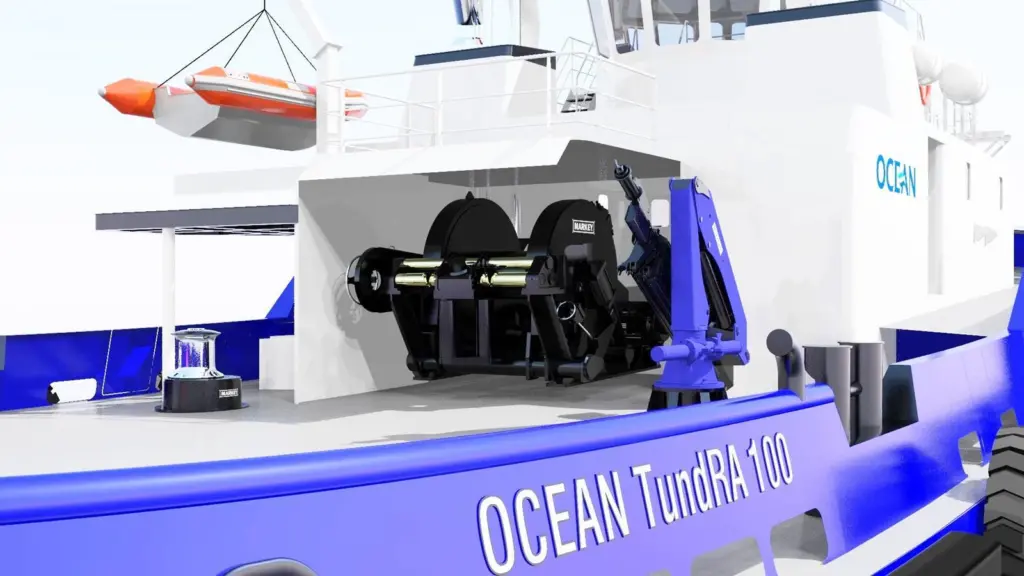
Needless to say the tugs, which will be operated by Group Ocean of Quebec, Canada, require deck equipment that meets the same parameters.
The deck machinery from Nearby Seattle will include a Markey DESDF-48-200HP electric Class III hawser winch which has a split-drum sized to store up to 300m of 80mm diameter soft line on each side. It also has an extra heavy duty level-wind featuring two rope guides to service each drum and a maximum speed of around 262m per minute.
Markey’s project leader Scott Kreis told MJ that the hawser winch has been specifically designed for tethered escort, and lends itself particularly well to these Arctic tugs. The electric motor, water cooled slip brake and controls are all housed within the winch’s enclosure and are warmed with heated air.
Further, it features Markey’s constant tension hands free render-recover system, which is capable of operating even if the winch is being used at the top end of its line speed and tension.
There is also a load shedding feature. “Electric drives allow enough sophistication to talk to the gensets, so if the genset is lugging down from power demand, the load shedding feature will cut in. Usually this takes it down to half of normal power although the limits can be chosen to suit operations,” explained Mr Kreis.
The winch can be operated from a handheld remote as well as from the wheelhouse and the instrumentation displays complete line tension, scope and line speed information. “There are actually very few on-deck controls, but we augment these with handheld wireless units. It helps keep both controls and people out of the freeze,” he added.
Another ‘clever’ part to the design is that you can ‘dial in’ to the winch via a mobile phone signal. “The drive has a remote monitoring option which means the winch can have its parameters ‘tweaked’ remotely,” said Mr Kreis, adding that it also helps develop ‘retirement criteria’, taking items out of service before they break.
There are also two Markey VEP-16-40 electric vertical capstan windlasses, sized for 26mm stud link chain, and controlled via the on deck station. These vertical capstan windlasses and the aft capstan have drives and motors installed under the deck for protection.
Finally, all this is accompanied by a Markey TES-40UL-125HP electric single-drum towing winch sized for up to 800m of 64mm wire rope. Instrumentation and remote control is similar to the hawser winch, plus there is an enclosed chain and diamond screw automatic level-wind with the spooling gear placed in an oil bath.
This aft winch is enclosed in an extension of the wheelhouse. “The design meant working very closely with naval architect Robert Allen to make sure the equipment was properly integrated, added Mr Kreis, pointing out that Markey makes a point of getting closely involved with any project. “Deck equipment is not just an add-on, it is really important to incorporate it effectively.”
Mr Kreis added that the extensive collaborative effort between Group Ocean, Markey, Robert Allan Ltd and Lloyd’s Register all pushed the project forward. He said: “When we were first approached by Group Ocean over two years ago, the development and coordination of ‘Ice Class’ standards by the world’s marine rating agencies were in their earliest stages.”
Cross pollination followed. Markey’s engineers went out on Group Ocean tugs to get a feel for the challenges. Their experience of supplying deck equipment for service in Alaska and oceanographic winches for use in Antarctica helped satisfy both Group Ocean and Lloyd’s Register.
What has resulted from this collaboration is a much needed breakthrough. This exposed Northern region may soon be seeing ‘Chinamax’ class ships searching for more direct, Arctic routes, with all that entails.
Related Articles
 ACCESSORIES & EQUIPMENT
 ACCESSORIES & EQUIPMENT
 ACCESSORIES & EQUIPMENT