![MaritimeJournal[Seawork]](https://www.maritimejournal.com/wp-content/uploads/2026/09/MaritimeJournalSeawork.svg)




Concrete gravity foundations, the future for windfarms?
A recent conference has looked at concrete gravity based foundations (CGBF) for the UK offshore wind programme as the industry prepares for the challenges of projects in deeper, more hostile waters further offshore.
Organised in London by MPA The Concrete Centre, Concrete Offshore Wind 2012 brought together speakers representing regulators, solution providers, developers and technical experts. The conference had UK’s Round 3 programme in mind: CGBF advocates clearly believe their time has come and claim a number of advantages over more traditional foundation types for this market.
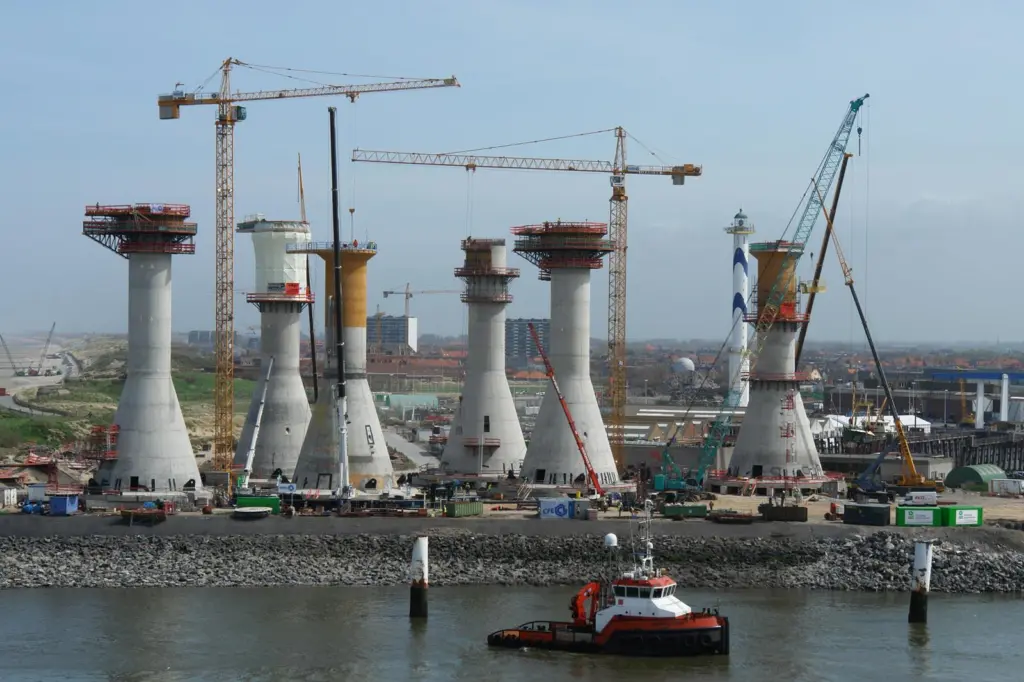
The predominant choice for windfarm foundations to date has been steel monopiles and jackets. One notable exception is C-Power’s Thornton Bank windfarm off the Belgium coast where the six, 5MW turbines of Phase 1 use 3,000 tonne concrete gravity based foundations. The 6.15MW Phases 2 and 3 turbines, 48 in total, have steel jacket foundations.
Market changes
Dr David Curran from the Department of Energy and Climate Change touched on the recent Electricity Market Reform announcement stating the existing energy market model (based on two decades of the UK being an energy exporter) was no longer best suited in meeting the £110 billion cost of replacing the 20% of UK baseload supply plant due to be phased out by 2020. New forms of finance and investment from EMR are aimed at meeting this challenge.
Ian Bryan of The Crown Estate compared the scale of Round 3 (32.2GW in total) with the 7.7GW of Rounds 1 and 2 and 4.8GW in Scottish Territorial Waters. He pointed out the relevant aspects are the gradual increases in water depths and distances offshore. The advantages of CGBFs were summarised by Alan Bromage of The Concrete Centre; these include tried and tested construction techniques, mass production delivering economies, low carbon solutions through materials choice, durability providing the opportunity to re-power, local labour and materials minimising price fluctuations, environmental benefits (low noise impact on sea mammals) and multiple solutions from major contractors providing choice for clients. Proposals from various interest group members were also outlined.
Big players
A number of well-established names now promoting CGBFs were represented. Skanska, SMIT Marine Projects and Grontmij are promoting gravity foundations featuring the advantages of integration of design, construction and installation, thus minimising risk through collaboration. Two other heavyweights, BAM and Van Oord GBF have teamed up to design and manufacture gravity based foundations. Along with Deltares, they are engaged in a demonstration project featuring a simple hybrid design involving a 30m diameter, sand ballasted, concrete caisson for 30-60m water depths. Designed for larger turbines, a circular central ‘slot’ will house a traditional foundation and tower.
Xanthus Energy, Interserve and Shepherd Offshore Ltd are seeking funding for a demonstrator of their SeaBreeze Gravity Buoyant System, a design involving three circular concrete caissons combined into a triangular shape. A standard central flange can accept any design of wind turbine.
Gravitas Offshore (Hochtief, Costain and Arup) is well established in windfarm foundation manufacturing with 1,500 now installed. It has produced over 30 designs, capable of accommodating turbines up to 10MW. Gravitas is committed to installing a demonstrator gravity foundation by 2014.
Strabag Offshore Wind produces a range of turbine foundations and is focusing on gravity base designs for projects greater than 3MW and 25m depth. A fabrication yard at Cuxhaven (for German North Sea) is envisaged with negotiations and pre-agreements with ports in UK and Ireland also being explored. Strabag is also developing a self-propelled, semi-submersible DP2 transport and installation vessel for installing complete foundation and turbines assemblies.
Further presentations from RenewableUK, Royal Haskoning DHV, Marinespace, Natural England, and The Planning Inspectorate ensured the case for CGBFs received the airing it rightly deserves.
By Peter Barker
Related Articles
 OTHER NEWS
 FEATURES & VIDEOS
 MARINE CIVILS