![MaritimeJournal[Seawork]](https://www.maritimejournal.com/wp-content/uploads/2026/09/MaritimeJournalSeawork.svg)






The importance of communication
Mal Stein of UK based marine electrical engineering specialists SeaKing knows the importance of communications.
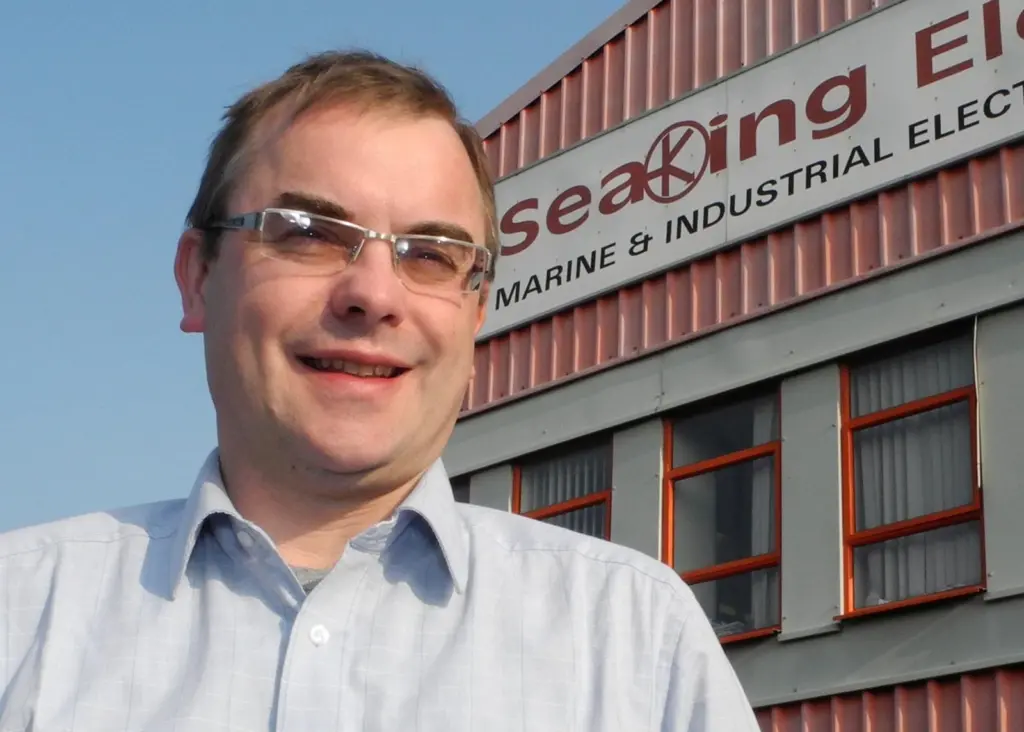
He’s a telephony specialist but he admits that the hardest part of the job can be convincing a very conservative industry to try something new.
“People still like the security of seeing the cables, he said, “They sometimes don’t trust a seemingly flimsy IP line to do everything, voice, internet, even TV. They don’t realise how robust it is.”
In some ways it’s a different world to the one he came from. After graduating with a BSc in Electronic Systems and Microcomputer Engineering, he went on to work for Marconi and then Liverpool John Moores University.
However, the shift to the marine sector meant rather more physical activity than he had originally envisaged, even though it came about through a collaboration between the University and the Merseyside based Cammell Laird shipyard. He remembers his first site visit, which entailed climbing 40m up to the top of the masts installed on the RFA Gold Rover. “Ostensibly this was necessary to check the aerials, in reality it was a kind of perverse initiation ceremony, he said, “Luckily I have a head for heights.”
Working in the yards comes with its own issues, he continued, “Sometimes they can be engaged in cutting a ship in half while we are scheduled to be putting in the telephone lines which can be a strain.”
By now he has visited most of the shipyards in the UK plus some in Dubai, saying, “It’s certainly a long way from the air conditioned offices I had been used to.”
In 2010 this Cammell Laird connection blossomed into a role with the yard’s main electrical and telephony contractor SeaKing, leading to a number of interesting challenges, including a project to bring radar and AIS together for the Suez Canal and the updating of systems onboard a number of Royal Fleet Auxiliary vessels.
However the most productive project might have seemed like a dead end as the vessel was ditched rather than refurbished. “Despite the ship being scrapped, it showed us that we could fit a sophisticated, single wire IP system for less money than a conventional one, plus it’s both cheaper and easier to run.
“What’s more, you don’t have to learn a strange language to operate the telephone, you can skim the mouse over a menu to configure it. Older systems are easier to mis-configure, but it might not show up until you have to deal with something unusual.”
As for the future? He concluded, “Some changes will be forced by obsolescence. After all, the kit we are replacing can be twenty or even thirty years old.” However, he also knows that it is an industry driven by costs, “and this will win in the end”.
Related Articles
 ACCESSORIES & EQUIPMENT
 ACCESSORIES & EQUIPMENT
 ACCESSORIES & EQUIPMENT