![MaritimeJournal[Seawork]](https://www.maritimejournal.com/wp-content/uploads/2026/09/MaritimeJournalSeawork.svg)






Turbine test facility deal for Denmark
GEs Power Conversion business has signed a turnkey contract with the Lindoe Offshore Renewables Center (LORC), a Danish center for test of renewable energy technology.
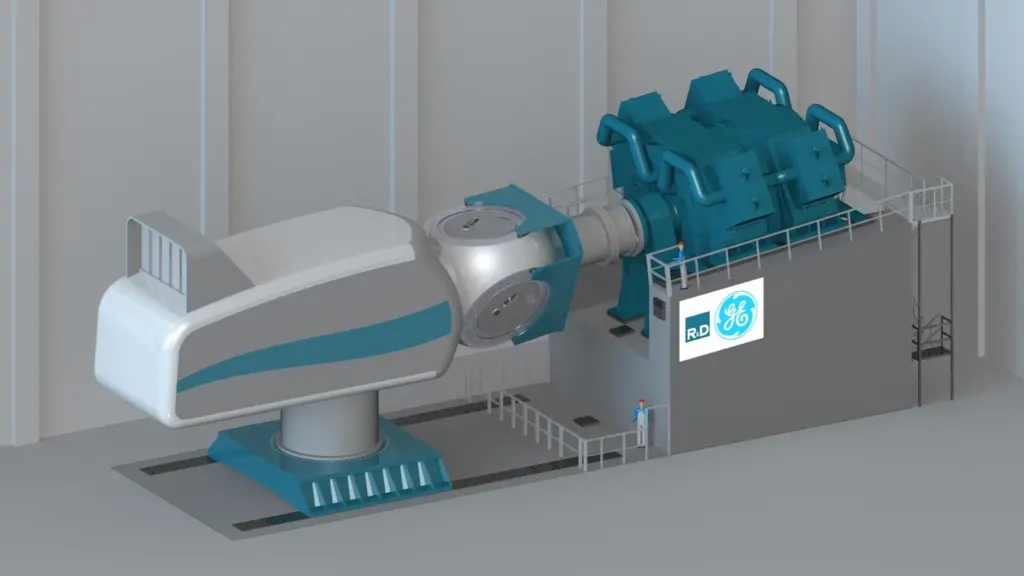
It is for the construction, commissioning and handover of one of the world’s most advanced facilities to test wind turbine nacelles with an output power of up to 10MW. The Lindoe Nacelle Testing project (LNT) will be located in the Lindø Industrial Park on Funen, Denmark’s fourth-largest island. It will be ready for first tests in 2014.
The function tester will incorporate GE’s drivetrain, grid simulation, control systems and foundation work. It is comprised of: medium voltage switch gear, transformers, inverter system DDPM (direct drive permanent magnet) motor, HMI (human-machine interface) and foundation. GE will carry out the installation, commissioning, and remote service for the project. The medium voltage inverter system is a further development of GE’s existing MV7000 series, and is one of the most compact medium voltage inverters on the market. The MV7000 is based on tried and tested GE technology using dynamic control properties and low grid interference.
The new nacelle tester will enable LORC to test the functionality and performance of wind turbine nacelles by using a specially designed adapter that enables the turbine hub and all field operational software and hardware—including pitch control—to be included in the test. It will open up a wide range of opportunities to test wind turbine controllers inside the nacelle, using highly realistic test conditions at 33kV level, which is unique in the test system business.
The test bench has a modular design that will enable it to be adapted to future needs. For example, its grid simulator power can be increased at a later date and thereby increase its functionality to carry out extended FRT (Fault Ride Through) tests – simulations of wind turbine systems to remain connected to the supply during grid malfunctions and to help stabilize it.
LNT will be able to meet the demands for testing of tomorrow’s offshore wind turbines in a facility where national grid codes can be tested in combination with loads caused by rapidly changing wind speed conditions. Electrical malfunctions and turbine protection systems have historically led to unforeseen excessive loadings of mechanical components and thereby reduced expected lifetime. At LNT it will be possible to verify the stress levels under numerous different load cases, thereby helping to improve long term reliability.
Related Articles
 OTHER NEWS
 FEATURES & VIDEOS
 MARINE CIVILS