![MaritimeJournal[Seawork]](https://www.maritimejournal.com/wp-content/uploads/2026/09/MaritimeJournalSeawork.svg)






Lifting in tandem: two is better than one
A team of eight worked for five hours to load the 25m Damen Shoalbuster ‘Marineco Akela’ onto the deck of a transportation vessel at Jebel Ali Port in Dubai. Simon O’Neill of PSP talks to MJ about the details.
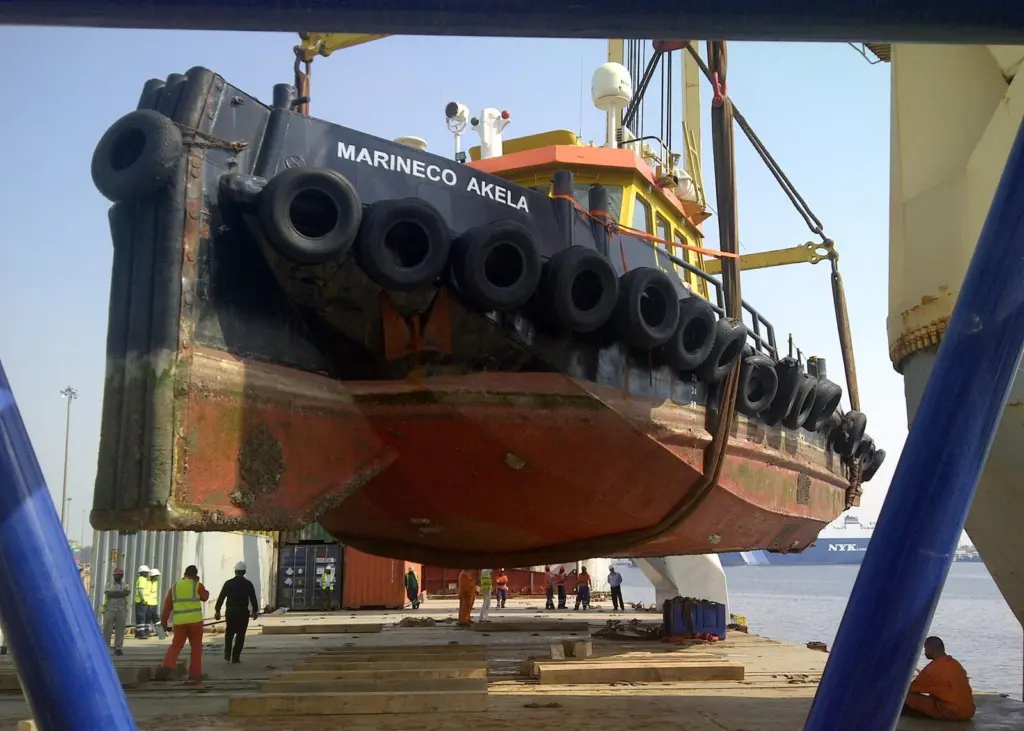
This very durable workboat needed a drydock visit to a Turkish yard before going on to its new home in Russia. “It was a water-to-water lift,” explains Mr O’Neill. The workboat was lowered back into the water at Aliaga in Turkey and, after its refurbishment, is making way under its own steam out through the Bosphorus and on to Russia.
However, Mr O’Neill adds that the twin cranes of the mothership Atlant Frauke came in very useful, firstly as a tandem lift is “much preferable” to a single crane lift. “On a tandem lift you have the spreaders going across the ship with the slings attached, and very little chance for the slings to shift toward each other. With a single crane lift you need two spreaders going athwart ships and then a third fore and aft spreader higher up, just to keep the lower two in position.”
Secondly, the twin crane setup onboard the Atlant Frauke also helped in dealing with the sturdy Shoalbuster’s weight. This came in rather unexpectedly at around 220 tonnes. Although Damen had given the correct weights and centre of gravity for the original build, an absolute necessity to get the right position for the lifting belts, what had not been foreseen was that the vessel had been blessed at some point with a new wheelhouse. “So a single 250 tonne crane wouldn’t have had enough of a margin to spare,” says Mr O’Neill.
After the Marineco Akela had positioned itself alongside the Atlant Frauke the divers went to work to check the positioning of the lifting belts. When secure, the transportation vessel’s two cranes worked together to perform the tandem lift. “You can get moments where it’s obvious that something isn’t sitting right, and with two cranes together you can make an adjustment for that, something that’s not so easy to do with just one crane,” says Mr O’Neill. However, this lift went off without a hitch.
Once headed for the deck, the tug was held by guide lines until it was settled down on the dunnage positioned underneath. One useful aspect of the Damen design is its nearly flat bottom, which made the usual cradles unnecessary: “We simply added extra chocs or dunnage in around the hull to support it,” says Mr O’Neill.
Interestingly, the loading of Marineco Akela took place at around the same time that PSP loaded a 40m Sunseeker in Southampton, one headed away from, the other headed toward Dubai. Coincidentally, they were also unloaded on the same day.
Related Articles
 ACCESSORIES & EQUIPMENT
 ACCESSORIES & EQUIPMENT
 ACCESSORIES & EQUIPMENT