![MaritimeJournal[Seawork]](https://www.maritimejournal.com/wp-content/uploads/2026/09/MaritimeJournalSeawork.svg)



In-house training for River Bus BML Masters
Commercial traffic on the Thames in Central London continues to grow, with new passenger, cargo and engineering movements on the increase.
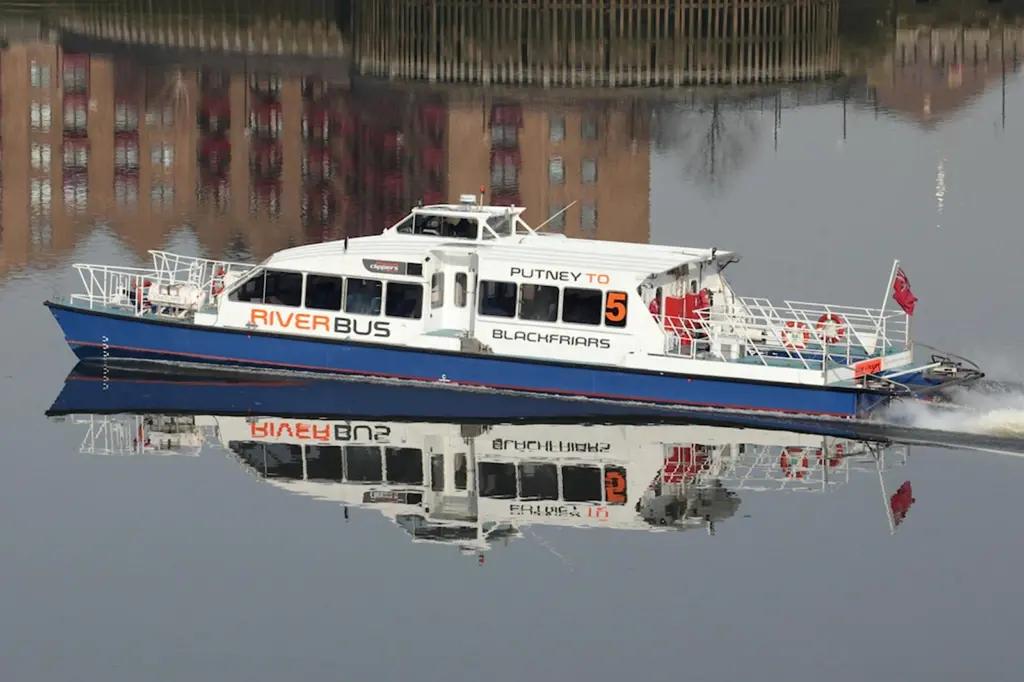
In April, three high-speed passenger vessels were redeployed on a new River Bus service, operated by Thames Clippers, which already runs a fleet of larger vessels farther downstream.
It was not until the Milennium and later Olympic fever that national and local government started to take river transport seriously and, with the support of London River Services, water buses have become part of a more integrated transport system.
This increase in river traffic has opened up employment opportunities for those who wish to work afloat. Thames Clippers alone employs 100 boat crew. The company’s larger vessels have three crew members, plus a bar tender. The smaller vessels used upstream have two crew plus a bar tender/ticket person.
A company spokesperson says: “Of the 34 Masters we employ, 20 started in the company as Deckhands or Mates and received training from us to achieve promotion. All recruitment into Fleet Operations occurs at entry level. In the last 12 months we have promoted 11 crew members into command positions, or further promoted Class V Masters to become Masters of our high-speed vessels.
“When we looked to recruit Masters externally we had difficulty recruiting the required calibre of mariner. Some had boat handling skills but not the interpersonal or leadership skills required. It was partly this that drove us to look at an entirely in-house training scheme to obtain Boatmaster Licences.
“Recruiting the right calibre of person at entry level has also been challenging . A lot of self motivation and a willingness to learn is required. These are skills in short supply in the current labour market. We have found that often the best staff to recruit are those with an existing interest in river operations, of which there are relatively few.”
Anyone aspiring to obtain a BML at Thames Clippers must be over 21 years of age, having worked for the company for two years with at least 240 days afloat. The in-house training regime consists of classroom sessions sandwiched between existing work patterns. To obtain a BML with the necessary endorsements takes around 12 months.
The contract for the Thames Training Alliance (TTA) has recently been awarded to 64th Group and two careers events have already taken place, in Tower Hamlets and in Gravesend, with a further event scheduled for July. These events give students an understanding of the careers and apprenticeship programmes available on a variety of vessels. The events are held on board a Thames Clippers boat and include a detailed show round of both this vessel and a tug.
For the last 10 years there has been a dedicated commuter run from Chelsea Harbour to Blackfriars, originally served by the ex-police launch John Harriott, which carried 24 passengers during the rush hours. At various times this has been augmented by larger vessels under the auspices of Thames Executive Charters and the route was extended more recently to Wansdworth and Putney. For the past year the ex-steam vessels Henley and Viscount carried the commuters but the operators lost out in the latest round of bidding for a new seven year contract.
The route was an obvious attraction to KPMG Thames Clippers, the company set up in 1999 by Sean Collins as Collins River Enterprises, which now runs fast ferries throughout the day, from the West End via Canary Wharf to the o2 Dome at Greenwich and as far as Woolwich during peak times.
All the vessels in the Clipper fleet are catamarans with twin jet drives. The first ones were acquired around the turn of the millennium. The 25 knot Storm, Star, and Sky Clipper are the smallest, with a 62 seat capacity. These Hydrocats were built for P&O in 1991/1992 by FBM Marine on the Isle of Wight to work on the Thames. They were later purchased from the MoD by Collins and have now been deployed on the upriver run. They are joined by one of the second generation vessels, the 138 seater Moon and Sun Clippers, introduced in 2005, which also work the Tate to Tate service between the two riversie art galleries. Sun and Moon Clippers are River Runner 150 series built in Australia by NQEA.
Although the Thames, flowing through London, would appear to be a natural thoroughfare, previous attempts to run bus style services have floundered. Passenger steamers started working the River in 1815 but the biggest development came in 1905 when the newly founded London County Council introduced a fleet of 30 paddle steamers to complement the new tram system.
Piers were constructed along the river and a river bus ran between Hammersmith and Greenwich. In those days there was so much river traffic that a steam tug was positioned at each bridge ready to assist broken down or wayward vessels. However, the river bus service failed and was shut down after only two years, mostly due to the problems of maintaining schedules amid the difficult tidal conditions.
With the river’s tidal range of 7m, many piers dried out at low water. Contemporary pier design means they can now be built farther out into the tideway and several new piers have been constructed to serve the thousands of riverside apartments that are still being built.
The new service terminates at Putney pier, which is one of the last remaining structures built by the LCC. It is to be hoped that the new River Bus lasts longer than its predecessors.
By Graeme Ewens
Related Articles
 ACCESSORIES & EQUIPMENT
 ACCESSORIES & EQUIPMENT
 ACCESSORIES & EQUIPMENT