![MaritimeJournal[Seawork]](https://www.maritimejournal.com/wp-content/uploads/2026/09/MaritimeJournalSeawork.svg)






New technology for new scale turbines
“Five years ago people were saying that 700 tonne monopiles were the limit, now we are seeing requests for equipment that can handle monopiles in excess of 1,000 tonnes”, says Arjan Boezeman of Ulstein Idea.
“Five years ago people were saying that 700 tonne monopiles were the limit, now we are seeing requests for equipment that can handle monopiles in excess of 1,000 tonnes”, says Arjan Boezeman of Ulstein Idea.
“So the monopile is hanging in there”, he adds. He points out that one attractive aspect to this kind of base is that it’s a simple single pile, unlike jacket foundations which require four piles and a lot of welding or even tripods which still need three piles. The challenge is that developers are looking at bigger, heavier pieces required to withstand the forces involved in the 5MW plus and upward nacelles.
However, the growth in scale is forcing a rethink on deployment technology. As Mr Boezeman points out: “Installation vessels are facing an increasingly tricky situation” as current equipment is being outpaced. One solution about to be launched is Ulstein Idea’s upending tool.
“At the moment operations have a dynamic instability to contend with. When you upend a pile with a conventional crane set up there comes a point in the tilt where the centre of gravity moves away from the support point of the pile and you get a ‘side lead impact’ on the crane. What this means is that as gravity takes over, the crane gets suddenly jerked sideways, not something that is good for operations or the crane itself”, he explains.
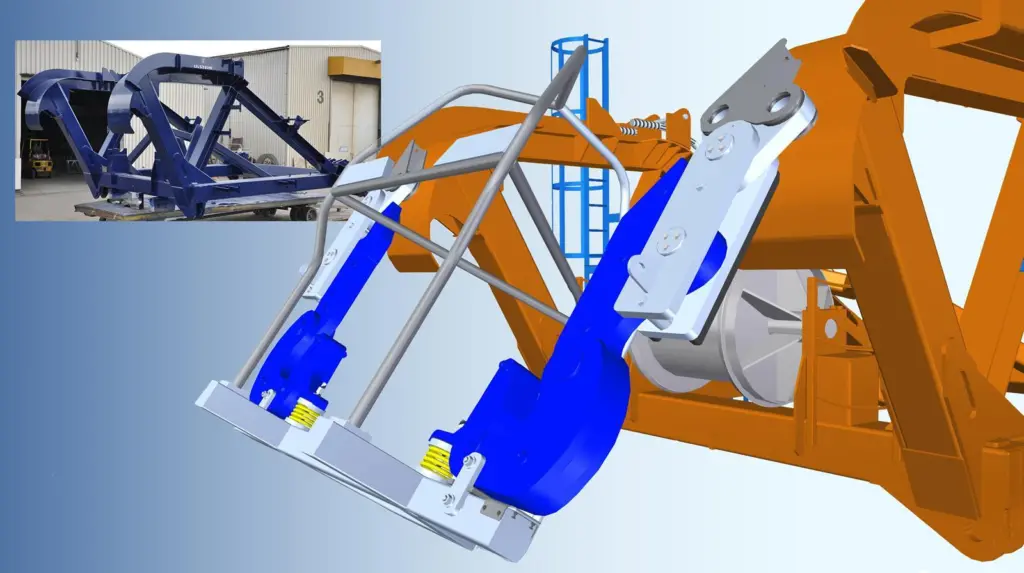
The new gear is actually derived from a saddle and hook setup, but the important point is that it’s a safer version which keeps the crane in control, and even allows bringing the pile safely back down onto the deck from virtually any point on the way to vertical, unlike most of the equipment presently in use.
This upending tool is not the only new release from the company that aims to help efficiency. A new type of pile gripper could massively reduce the time on jack-up barge operations. At present the jack-up has to move in close for the pile deployment, and then reposition and jack up again for placing the transition piece, as this has a rather large platform attached and needs more room.
The customised pile gripper frames have been designed to have a holding point that keeps the piles securely in place further from the vessel while they are being hammered in. After this they retract, folding up and out of the way onto the deck and allowing the jack-up to get straight on with putting in the transition piece. It means there’s no lengthy repositioning required and this potentially saves a whole day in deployment costs. “It’s a really good, simple idea to make life easier”, says Mr Boezeman.
By Stevie Knight
Related Articles
 ACCESSORIES & EQUIPMENT
 ACCESSORIES & EQUIPMENT
 ACCESSORIES & EQUIPMENT