![MaritimeJournal[Seawork]](https://www.maritimejournal.com/wp-content/uploads/2026/09/MaritimeJournalSeawork.svg)





SharpEye for world’s fastest ferry
Kelvin Hughes SharpEye radar is now in continuous use on the world’s fastest ferry, operating between Argentina and Uruguay.
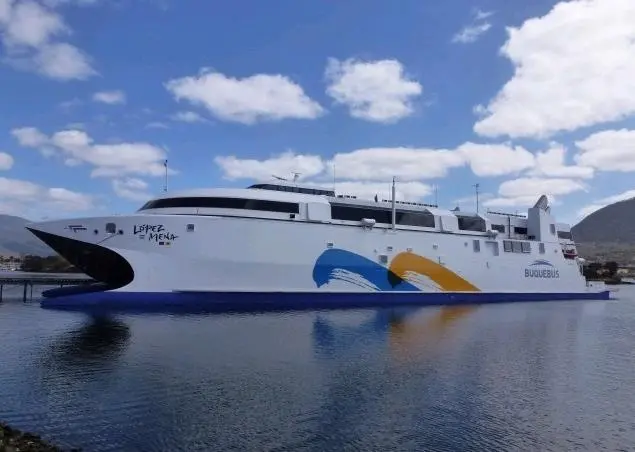
The ferry, named Francisco after the Argentinian born Pope Francis, carries up to 1,024 passengers and crew together with 150 cars on a daily basis between Buenos Aires and Montevideo. It makes the 116 nautical mile journey along the River Plate estuary in a record breaking 2 hours and 12 minutes.
Built by Australian shipbuilders, Incat, Francisco is 99m in length and features Incat’s wave piercing catamaran technology. Powered by gas turbine engines using LNG as the primary fuel, the vessel has a service speed in excess of 50 knots.
In addition to the unique S-Band SharpEye solid state, upmast radar, the Francisco is also equipped with an X-Band radar, a MantaDigital radar processor, MantaDigital ECDIS and console mounted displays with control interface as well as a voyage data recorder, all manufactured by Kelvin Hughes.
SharpEye brings many benefits to commercial marine applications. Being located upmast and with no magnetron or maintenance requirements, it brings both high reliability and low lifecycle costs. Only cables, not radar waveguide, are routed from the antenna to the downmast equipment area of the vessel. Most importantly, however, is safety. With a ferry travelling at speeds of up to 58 knots in a busy marine traffic area such as an estuary, the ability of the captain to see small yachts and large vessels alike at the earliest possible opportunity is critical.
As Spike Hughes of Kelvin Hughes said: “SharpEye in a Sea State 4 can detect a small yacht at 11 nautical miles where an equivalent magnetron radar wouldn’t typically pick it up until it was about 6 nautical miles away. That makes a big difference when you’re travelling at nearly 60 knots.”
Related Articles
 ACCESSORIES & EQUIPMENT
 ACCESSORIES & EQUIPMENT
 ACCESSORIES & EQUIPMENT