![MaritimeJournal[Seawork]](https://www.maritimejournal.com/wp-content/uploads/2026/09/MaritimeJournalSeawork.svg)






Six RAmparts 2500 tugs for Smit Rebras
SMIT Rebocadores do Brasil (Rebras) of Rio de Janeiro has taken delivery of the first two, of a series of six RAmparts 2500 tugs designed by Robert Allan Ltd (RAL) and built by Keppel Singmarine Brasil Ltd (KSMB), of Navegantes in Brazil.
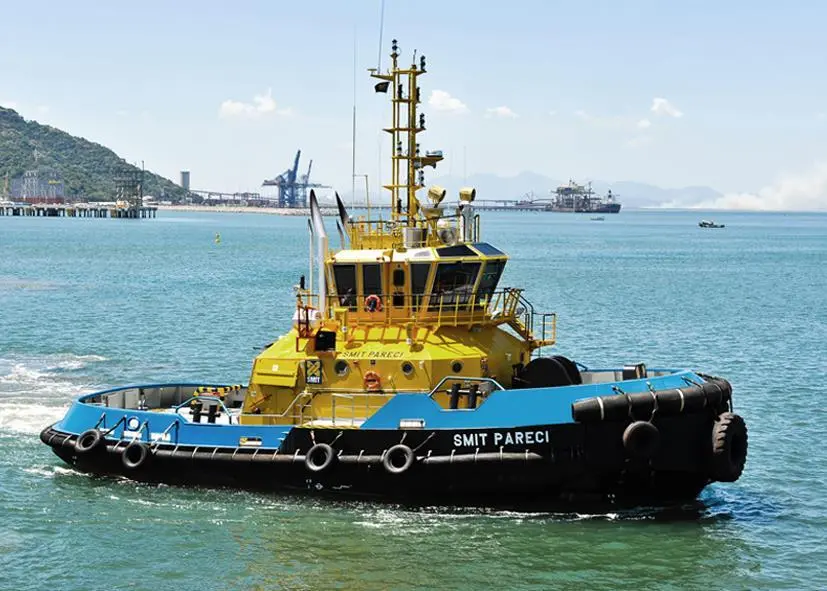
The first tug SMITPataxó was delivered in June 2013 and the second, SMIT Pareci, joined the Rebras fleet at the end of the year.
The RAmparts Class vessels are a series of proven, standardised azimuthing stern drive (ASD) designs. Each of those designs has been developed from a successful prototype vessel or series of vessels, and refined to enable the ease of construction and to embody the owner’s specific requirements.
This particular series of RAmparts2500 tugs follows the successful delivery of 12 similar tugs for SMIT Rebras, the last of which was completed inTupinamba in 2008.
RAL worked closely with SMIT Rebras to develop this latest series, incorporating significant improvements, including new engines to comply with the latest IMO emissions standards, a new double drum towing winch and staple, a larger wheelhouse, a new streamlined skeg, updated fendering, increased fresh water capacity, and new auxiliary generators. The design retains the characteristic ‘half-height’ raised forecastle to increase the height of the bow, for improved operations in exposed waters, and the same hull form providing maximum performance ahead and astern.
SMIT Pareci measures 24m in length overall, with a maximum (moulded) beam of 10.25m, a depth of 4.07m, a maximum draft of 4.50m and a gross tonnage of 271 tonnes.
The vessel has been designed and built to comply with the American Bureau of Shipping notation ABS X A1 Towing Service, X AMS and Brazilian NORMAM requirements.
A pair of Caterpillar 3512C HD main engines are installed each developing 1379 kW at 1600 rev/min (approx. 3670 bhp). The engines comply with the IMO Tier 2 emissions requirements. Power is transmitted via a straight line shafting system to a pair of Schottel SRP 1012 fixed pitch azimuthing propulsion units with 2,100mm diameter propellers and nozzles.
On trials, both SMIT Pareci and SMIT Pataxó met or exceeded all performance expectations with a bollard pull of 46 tonnes and a free running speed of 12.2 knots.
The decks on this version of the RAmparts 2500 have been kept as clear and free of obstructions as possible. A towing winch, with a single ‘split’ drum, is fitted on the foredeck and deploys the towlines via a conventional staple. The bow is heavily fendered to deal with the rigours of ‘push-pull’ shiphandling operations. A single towing bollard, equipped with a quick release towhook is installed aft, for use in an emergency or if its necessary to tow over the stern.
A typical ‘RAL style’ wheelhouse provides maximum all-round visibility, with overhead viewing windows, and a split control console forward.
Accommodation includes a well-appointed cabin with private facilities for two officers within the deckhouse, along with a mess-room/lounge with comfortable seating and a galley. Situated below deck are two four-berth cabins, with shared lavatory facilities, a laundry, a bosun’s store and additional cold storage facilities.
By Jack Gaston
Related Articles
 SPECIAL REPORTS
 TUGS & SALVAGE
 EQUIPMENT