![MaritimeJournal[Seawork]](https://www.maritimejournal.com/wp-content/uploads/2026/09/MaritimeJournalSeawork.svg)






River rail bridge refurb rolls on
The refurbishment of Battersea Rail Bridge over the Thames has overrun due to several unforeseen factors, writes Graeme Ewens
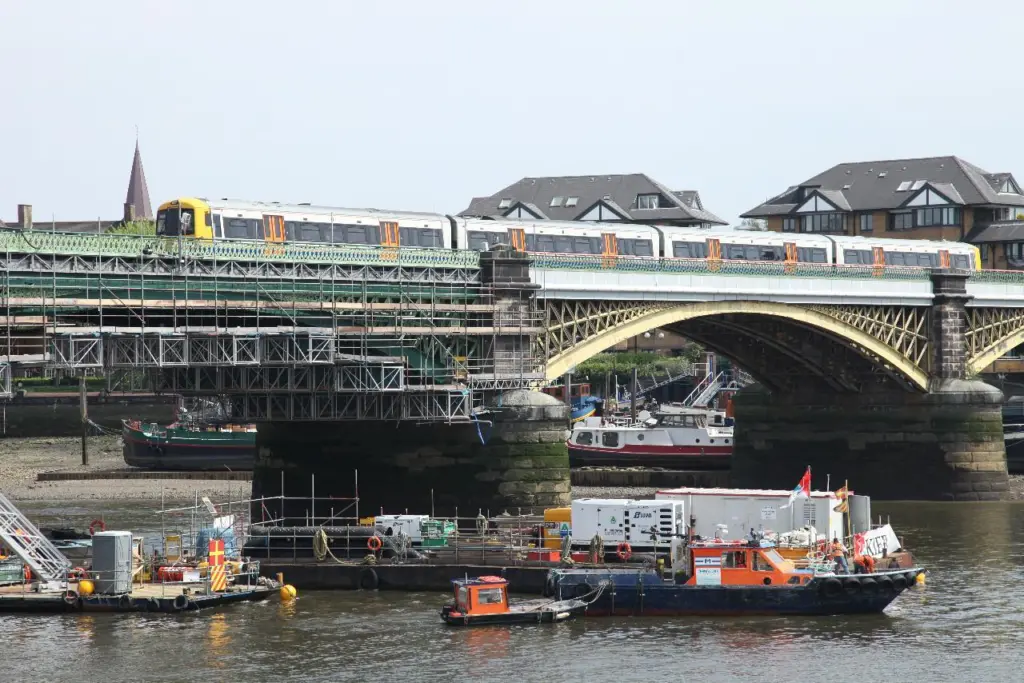
The major refurbishment of the 150-year-old Battersea Rail Bridge (covered in MJ June 2013) is still underway after several difficulties delayed the job’s completion in the scheduled time.
When the central, No 3 arch was first inspected the initial survey showed some 300-odd defects to metal brackets and rivets but, after shot blasting everything back to bare metal, more than 900 faults were revealed on this one arch alone. That obviously added more time to the planned schedule and the arch was due to be re-opened in early May.
According the Gordon McCann, MD of Thames Link Marine (TLM), which provides the marine services to main contractors Kier, another factor which brought delays has been the weather. Although the winter was reasonably mild, the requirements for applying the 25-year paint demanded 85 degree humidity (or below) and the difference between the steel temperature and the dew temperature to have been no more than three degrees.
The damp climatic conditions meant there were several delays to this part of the finishing process. The wind during the midwinter storms also stopped work on several occasions. With virtual hurricanes whipping up the river, plastic sheeting was blown away, sometimes covering the rail tracks. At times there were waves breaking over the access pontoon. Although nothing was moved or dislodged on the marine side, the conditions were unsafe to work in.
While the original timescale called for the complete job to be finished by this May, the anniversary of the start saw work about to begin on arches 2, 4 and 5.
A Notice to Mariners, M29 of 2014 gives further details: “Due to ongoing project delays on the Battersea Rail Refurbishment Works, the proposed closure of No.2 arch has been further delayed. This notice replaces Notice to Mariners M23 of 2014, which is hereby cancelled.
No 1 & 3 arches of Battersea Railway Bridge are currently closed to navigation with No 1 arch scheduled to remain closed until Autumn 2014.
On or about the 19th May; No 3 arch will be re-opened to navigation following the completion of works within that arch. No 2 arch will then be closed to navigation for a period of approximately six weeks to allow for the erection of scaffolding within the bridge structure.
To support the engineering works, barges have been positioned just upstream of both No 1 and No 3 arches requiring the installation of additional moorings. Mooring anchors have been positioned in the vicinity of No.1 arch to facilitate the mooring of barges directly upstream of No 1 arch.
On completion of the works in No 3 arch; the current moorings will be removed and a new mooring installed in No.2 arch. This mooring will consist of two yellow unlit buoys. It should be noted that the sinkers for these moorings will protrude above the river bed by up to 0.7m and persons in charge of vessels should take care in the area.”
The next arch to be worked on is No 2, which will be short-scaffolded, meaning the boards are fixed directly to the steel arches making a solid floor inside the bridge structure, and once that flooring is installed the arch will be opened to navigation. There will then be access from the shore for workers, although all services will still be provided from barges.
Once No 2 is settled, work will begin on arches 4 and 5. These will also be short-scaffolded and when it comes to No 5, the southernmost arch, houseboats at Albion Quay will need to be moved from their moorings. Gordon McCann believes the job will overrun until the end of this year at least.
A further complication, which cannot be addressed until the final stages of the job, concerns scouring blocks beneath the bridge abutments. Divers discovered 26 large scouring blocks, each weighing 1/4 to 1/2 tonne, scattered across the river bed. The divers have since drilled and fitted ring bolts to each of these blocks to facilitate lifting. Hydrographic scans have shown large items of scattered debris, which Mr McCann suspects might possibly be the result of WW2 bomb damage to the bridge. One of the final jobs on the project will be to remove any damaged blocks and replace and reposition them for scour protection.
Because the job has overrun, TLM has needed to expand its fleet of workboats. They have lost the use of Hurlingham Wharf, which is supposed to be safeguarded for river usage, and have been obliged to tow refuse and spoils downriver to Silvertown, which is a 2 to 3 hour voyage at the best of times. As a tug must be on site at all times Gordon McCann has purchased the Plassey, an ex-PLA tosher, built in 1951 for use in the Royal Docks. Along with this, TLM has also acquired a versatile crane barge powered by an Iveco 360hp engine driving twin jet drives. The 57 ft x 17ft barge has incredibly low draft of 18 inches, and is equipped with a cherry picker with 43ft reach, and a 4.5 tonne Hiab crane. An additional crew boat has also been bought from operators in the Lake District.
With these additions Mr McCann has taken the opportunity to rename all the vessels in his fleet, which have previously been numbered. At the time of writing these were being variously renamed after historic Thames lighterage firms, as TLM Atlas, Union, Orient etc.
By Graeme Ewens
Related Articles
 FEATURES & VIDEOS
 MARINE CIVILS
 OTHER NEWS