![MaritimeJournal[Seawork]](https://www.maritimejournal.com/wp-content/uploads/2026/09/MaritimeJournalSeawork.svg)






September start for Kiel Canal lock project
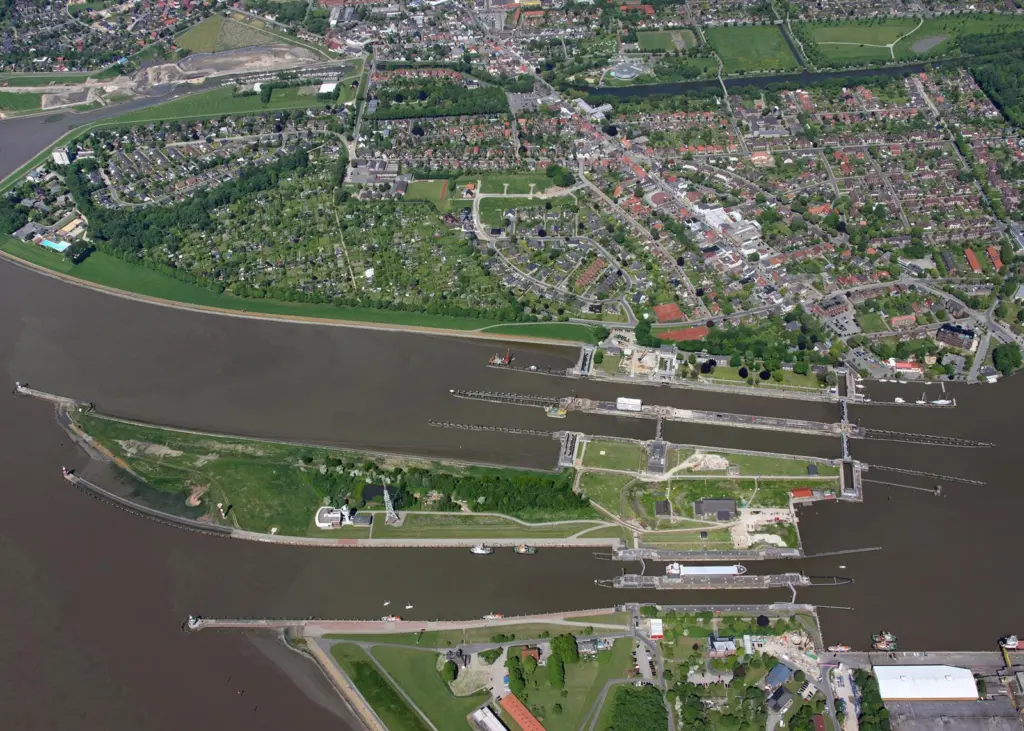
Construction of the badly needed fifth lock in Brunsbuettel on the Kiel Canal is expected to start in earnest in September after Berlin Government approval was given for costs totalling €485 million.
Gesa Voelkl, head of the federal waterways and shipping office (WSA) in Brunsbuettel said the main contract worth €411.8 million had gone to a consortium grouping three subsidiaries of Holland’s Royal BAM, one of Europe’s biggest construction companies.
They are Hamburg-based Wayss & Freytag Ingenieurbau, Wayss & Freytag Spezialtiefbau in Duesseldorf and BAM Civiel in Gouda, Netherlands. Many other subcontractors, predominantly German, are also expected to be involved in the work.
The contract covers the building of the 360m long, ca. 45m wide lock and adapting its River Elbe approaches. Thomas Fischer of the WSA in Brunsbuettel, at the southwestern end of the canal, told Maritime Journal “actual construction work is expected to begin at the start of September”.
Mr Fischer noted that construction of three lock gates – one a reserve gate and each of 1300 tons – was a separate contract not awarded as of late April.
The award of the main contract to Royal BAM comes nearly a year after tenders for construction of the fifth lock were first invited. Estimated total costs have risen from €273 million in 2008 to about €540 million when all preliminary expenses are included. Despite earlier criticism that the expense was not economically justifiable, new Transport Minister Dobrindt decided the lock would be built and said he was convinced it would pay its way. Dobrindt wants it open in the second half of 2020 but the construction consortium spoke of seven years.
When the new lock has been completed, renovation of Brunsbuettel’s two existing 310m long and 42m wide old locks is planned. Their breakdown in 2013 caused the closure of the canal and detours by hundreds of ships some 460 kms around Skagerakk.
Construction of the fifth lock is part of plans for a much more extensive revamp of the 100 year old Kiel Canal and its facilities. Also planned are comprehensive revamps of the existing locks not only in Brunsbuettel but also in Kiel at its northeastern end.
Although parts of the canal itself have already been revamped, its 20 kms eastern stretch near Kiel still needs extensive upgrading to take bigger ships. Currently vessels of maximum 235m length and 32m width can sail on the waterway. In the case of container ships that means a maximum size of about 1,700 teus.
The 98.26 kms long Kiel Canal links the North Sea with the Baltic and is the busiest artificial waterway in the world, used by about 35,000 ships a year carrying some 100 million tons of cargo.
BY TOM TODD
Related Articles
 FEATURES & VIDEOS
 MARINE CIVILS
 OTHER NEWS