![MaritimeJournal[Seawork]](https://www.maritimejournal.com/wp-content/uploads/2026/09/MaritimeJournalSeawork.svg)






Thirty years of weight issues
Launch and recovery units have to be considered when the submersibles they serve get an upgrade, especially as the weight always seems to go up, never down.
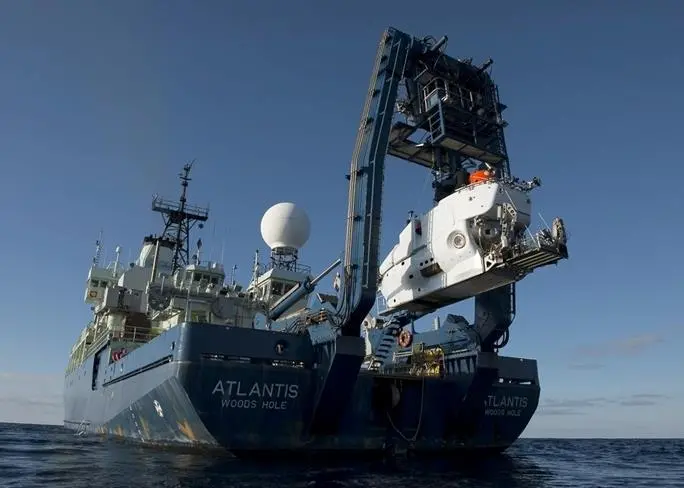
Take, for example, the A-frame launching the deep-sea research vessel Alvin, famous for taking scientists from the US Woods Hole Oceanographic Institution (WHOI) down to the ocean’s floor. The submersible, homed on the RV Atlantis (AGOR-25), has made over 4,400 dives carrying two scientists and a pilot: while probably most famous for exploring the wreck of the Titanic, most of its time is spent observing the life forms that exist in the super-pressured darkness on the seabed.
Less in the limelight but crucial to the whole operation is the launch and recovery system; in fact the ‘original’ incarnation of Alvin (original in the sense that all the equipment has been replaced more than once) was involved in a launch accident back in 1968 when the wires holding it snapped as it was being lowered from a twin-hulled pontoon vessel. The hatch was still open and the three crew members were lucky to escape with their lives: the sub itself lay on the seabed at 1,500m for almost a year before being recovered.
With these requirements in mind the gargantuan 7.6m A-frame, designed and engineered by UK-based Caley, was originally installed in 1983 to launch and recover Alvin from its home onboard the RV Atlantis II. On the heavy side even then, the submersible weighed 15,909kg, but 1996 saw this go up to 18,182kg when both sub and A-frame were moved to the latest RV Atlantis.
The sub’s most recent US$42-million overhaul has given it a stronger and slightly larger titanium personnel sphere along with a general upgrade of support systems, instruments and materials. While this has allowed Alvin to go beyond its old 4,500m limit to reach depths of 6,000m it has meant the weight has also risen significantly.
So, the A-frame itself has once more subject to a significant overhaul, allowing it to cope with Alvin’s new 22,727kg mass. Part of the project also involved the installation of a larger winch, high performance synthetic ropes and light tension control system to provide accurate handling control of the submersible. Both Alvin and its A-frame were then involved in verification testing in the Gulf of Mexico while the sub explored the site of the 2010 Deepwater Horizon spill.
However, Caley points out that unlike Alvin itself, the A-frame remains essentially the same unit that started out its life 30 years ago.
By Stevie Knight
Related Articles
 ACCESSORIES & EQUIPMENT
 ACCESSORIES & EQUIPMENT
 ACCESSORIES & EQUIPMENT