![MaritimeJournal[Seawork]](https://www.maritimejournal.com/wp-content/uploads/2026/09/MaritimeJournalSeawork.svg)




ML 1387 ‘Medusa’
In the UK and France, the recent commemorative and memorial events to mark the 70th anniversary of D-day proved a reminder of the many sacrifices that mariners have made. But quite apart from this, D-day was also a massive navigational and organisational task considering the technology available at the time. Thanks to an opportunity arranged by UK marine electronics specialist Raymarine, Maritime Journal recently got to experience some of the electronics of 70 years ago, on one of the remaining seaworthy vessels that made that legendary trip.
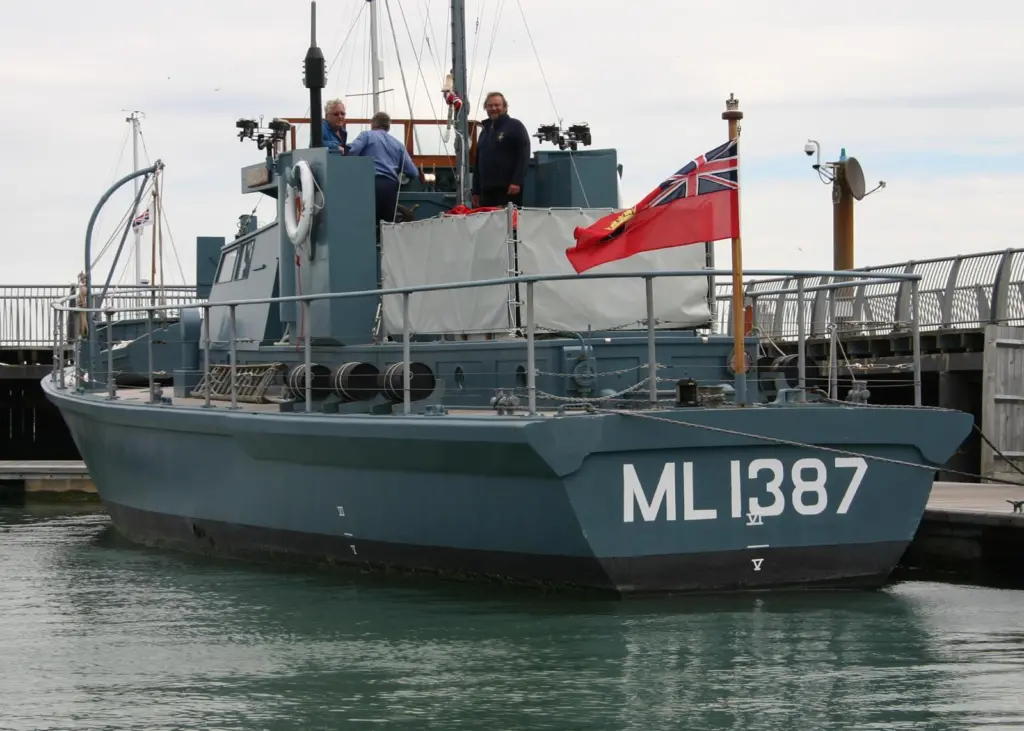
Medusa, is a harbour defence motor launch (HDML), and the last remaining example of her type that can still take to the water under her own power. Stepping aboard her and firing up the twin Gardner diesels to head out of Portsmouth Harbour was a memorable experience. She’s a narrow beamed vessel with no aspirations to come close to planing, and even in the relative confines of a (windy) Solent she rolled and wallowed. With the scent of diesel and hot oil above and below decks, it was not a massive leap of the imagination to imagine the trepidation of the young men who made the cross Channel trip in her all those years ago.
The enemy had laid a minefield barrier along the channel and to invade, passages had to be cut through this. This could only be done at the last moment otherwise the location of the invasion would have been given away. The role of ML1387 was to go to a precise location on the edge of the minefield the night before D Day and act as a marker for the minesweepers to home on to cut the passage. Each invasion beach had 2 passages, each having one of Medusa’s sisters to mark the entrance. Once the minesweepers had gone ahead, Medusa had to stay on station to mark the entrance to the swept channel. The role was critical; any error would have resulted in the invasion fleet sailing into a minefield. The vessel spent 30 hours on station, within both sight and range of enemy guns.
Small craft of Medusa’s design were used for this role as they are seaworthy, small and therefore relatively difficult to spot by both eye and radar.
Position fixing
A week before D day, ultrasonic beacons were laid on the seabed by the Royal Navy at the 10 positions on the edge of the minefield for the swept channels. These could be heard on the ASDIC (Sonar) sets carried by the HDMLs. In modern parlance this is known as passive sonar and is not used in non naval craft.
Traditionally position fixing was done by chart work, dead reckoning and the sextant. This was suitable for normal navigation but the RAF had found early on it was not precise enough for their needs and so electronic systems had been developed.
Medusa carried a system called “Gee” (referred to as QH by the Navy) which was the first hyperbolic navigation system. Three shore stations send a precisely timed pulse and on the ship (or aircraft) the time differences between them arriving was measured which allowed a position to be plotted on a chart overprinted with a grid. The system was very accurate but was known to the Germans so it was expected that it would be jammed almost immediately D day started.
A second system had been developed in secret in Canada then trialled in Scotland. It was so new that only 30 hand built sets existed at D day. These were placed on the vessels with the key roles and included Medusa. The equipment was known as QM and post war became the widely used Decca Navigator. Again it produced a set of readings which were plotted onto a gridded chart.
Radar
In the 1940s radar was in its infancy and sets were large and unreliable. Amazingly for such a small vessel, Medusa had radar, type 286. This radar set was the very first one to be used in small craft and so is the father of all small boat radars today. It did not have a rotating antenna but looked in the forward direction; to find a target you had to point the ship at it. The display was a screen with a vertical line; a target would cause the line to deflect to the left and right of the line and the range would be read off. It would detect a destroyer at about 6 miles and an aircraft up to 20.
IFF
Identification Friend or Foe (IFF) was a technique introduced in WW2 in order to be able to distinguish which blips on the radar was friend or enemy. This was achieved by sending an interrogating signal to the target and if friendly it would send back a signal which would then be used to modify the radar blip on the screen. Medusa could both interrogate other targets and identify herself to friendly forces. As time went on the system became more sophisticated with codes used for interrogation and response to prevent the enemy fooling the system. The military still use this technique as do civilian aircraft where it is called secondary radar.
ASDIC (Sonar)
Medusa was fitted with a type 134C asdic which would search ahead of the ship for submarines. It operated on a much lower frequency than today’s fish finding sonars, typically 14-22KHz. This gave good range but it took a very skilled operator to distinguish by ear what the target might be. The display was on a printed paper roll and a very basic mechanical computer determined the right time to drop a depth charge. The set could be used in a passive mode to listen to pings from submarines and the beacons used for D day.
Radar reflector
Medusa being all wood has a very low radar signature which was ideal for her wartime role but for D day she wanted to be seen on ten radars of the invading force. She carried a radar transponder type 78T which was triggered by the radars of other ships and sent back the letter D in Morse. This system is the precursor to the familiar Racon beacons. Today Medusa carries an active radar reflector as being radar invisible is no longer an advantage!
Communications
The vessel has a small wireless office which was manned by the “sparks”. Communication was by morse on shortwave although later on intership voice on VHF started to appear.
Now Medusa, as well as the vintage navigation equipment, for MCA coding reasons, has to also carry modern Raymarine kit, unobtrusively mounted with a single touch screen in the wheelhouse.
The old and new kit is obviously a world apart in terms of usability, reliability and compactness, but the most dramatic point of difference is that some of the wartime kit was so secret it had a self-destruct feature not likely to appear on modern marine electronics. If the worst should happen and one’s vessel be going down or be about to be captured, the removal of a safety cap and the pushing of one button on the bridge would set off explosive charges in some of the more technologically advanced equipment. It was designed to stop these high tech developments falling into the hands of the enemy, although one of Medusa’s trust volunteers bashfully admitted setting a charge off by mistake when fiddling with one of the sets. The results were disastrous to the equipment and the roof of a garden shed, but nobody was hurt.
By Jake Frith
Related Articles
 ACCESSORIES & EQUIPMENT
 ACCESSORIES & EQUIPMENT
 ACCESSORIES & EQUIPMENT