![MaritimeJournal[Seawork]](https://www.maritimejournal.com/wp-content/uploads/2026/09/MaritimeJournalSeawork.svg)






Surgery for ‘big lift’ operation
Preparing a drillship for a 9,000 mile lift from Singapore to Gabon, Africa came complete with a few challenges caused by the sheer scale of the cargo explains Peter Wilson, naval architect and engineering manager of UK-based MAC.
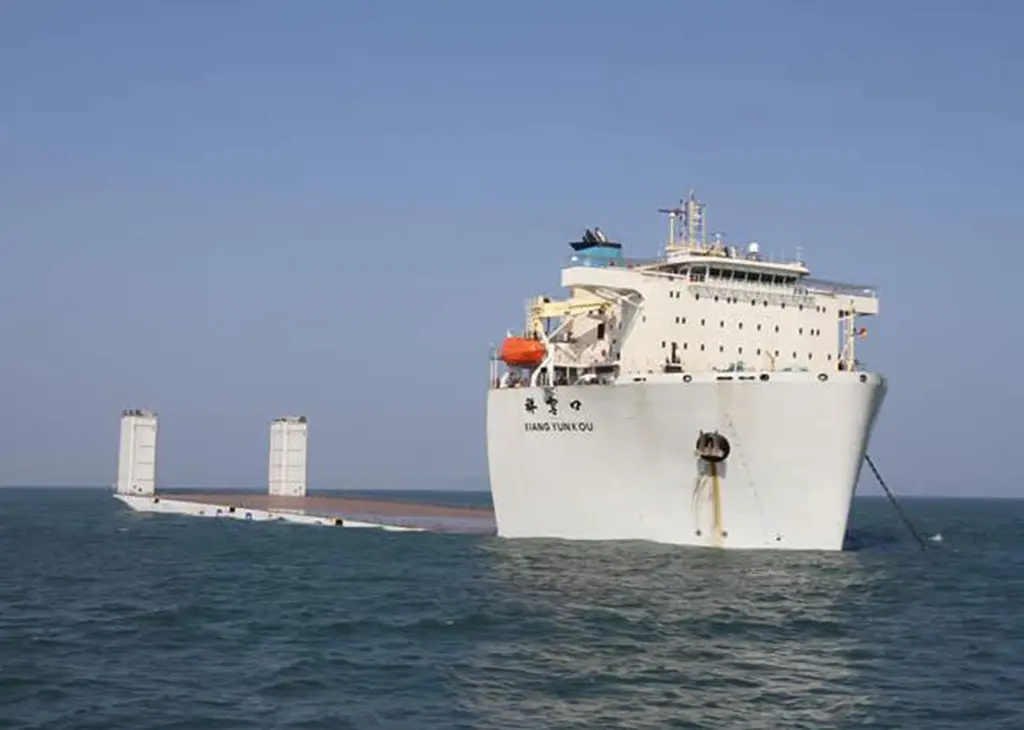
The 217m Xiang Yun Kou heavy lift vessel has a free deck area of 165m by 43m, capacious enough for most cargo. However, when that cargo is a drill ship measuring 186m it results in a very tight fit indeed.
“The size of the drillship meant it was slightly too big to be positioned straight along the deck, so everything had to be skewed to fit and even then it had a bit of an overhang,” says Mr Wilson. “The biggest issue was that the Xiang Yun Kou has two aft towers, so one of them had to be moved forward to allow for the angle.”
Asking questions is part of the safety brief for MAC: “At the start we were a little concerned about the simple lug welds holding the newly moved tower in place. The ship was going to ballast right down, so what about the inherent buoyancy of the tower? After all, the volume of air it holds meant it could simply rip the structure from its base given the water pressure.” Reassuringly, the crew already had an answer: pump around 300 tonnes of water into the tower itself to counteract the buoyancy issue.
On the day of the operation, the Xiang Yun Kou arrived at the open water site outside Singapore at around 4.00am and ballasted down till the deck was more than 8m below the surface. This allows the drillship to be floated over the top by a team of tugs with positioning aided by several winch lines, ready to be raised onto the back of the lift as it reballasts.
However, Mr Wilson points out that the process is delicate. “Firstly you have to avoid contact between the two vessels, there was less than a metre’s clearance when we drew the drillship into place.”
Secondly, “stability can be a little strange” under these circumstances. When the lift vessel is ballasted down like this, it simply can’t rely on its usual self-righting tendency. “There’s a period where the heavy lift vessel is still submerged but the deck meets the floating hull and starts to bring it up; this inevitably results in a few tense moments,” he says. “The trick is to ensure there’s a smooth gradient to any change, making the reballasting as controlled as possible and keeping out any step changes. A lot comes down to planning.”
Once the drillship was on the deck with the Xiang Yun Kou completely ballasted up, the deck fastenings went on. “Actually it was a very quick turnaround, the lift vessel put the anchor down overnight, started to ballast down at around 4.00am, and that afternoon we were applying the seafastenings ready for the long haul to Gabon,” says Mr Wilson.
Happily that part of the lift was uneventful: getting everything done in just a few weeks meant meeting a good weather window and an easy delivery took place just under a month later.
One last point: Mr Wilson concludes that above all, the sheer professionalism of the Chinese lift vessel’s crew was “extremely reassuring”, adding that he has a healthy regard for the lift superintendents “who never, ever get the easy, straightforward jobs”.
By Stevie Knight
Related Articles
 ACCESSORIES & EQUIPMENT
 ACCESSORIES & EQUIPMENT
 ACCESSORIES & EQUIPMENT