![MaritimeJournal[Seawork]](https://www.maritimejournal.com/wp-content/uploads/2026/09/MaritimeJournalSeawork.svg)






Fibre is the future
“Fibre rope has been the missing link in deepwater installation,” says Erik Van der Woude of Royal IHC.
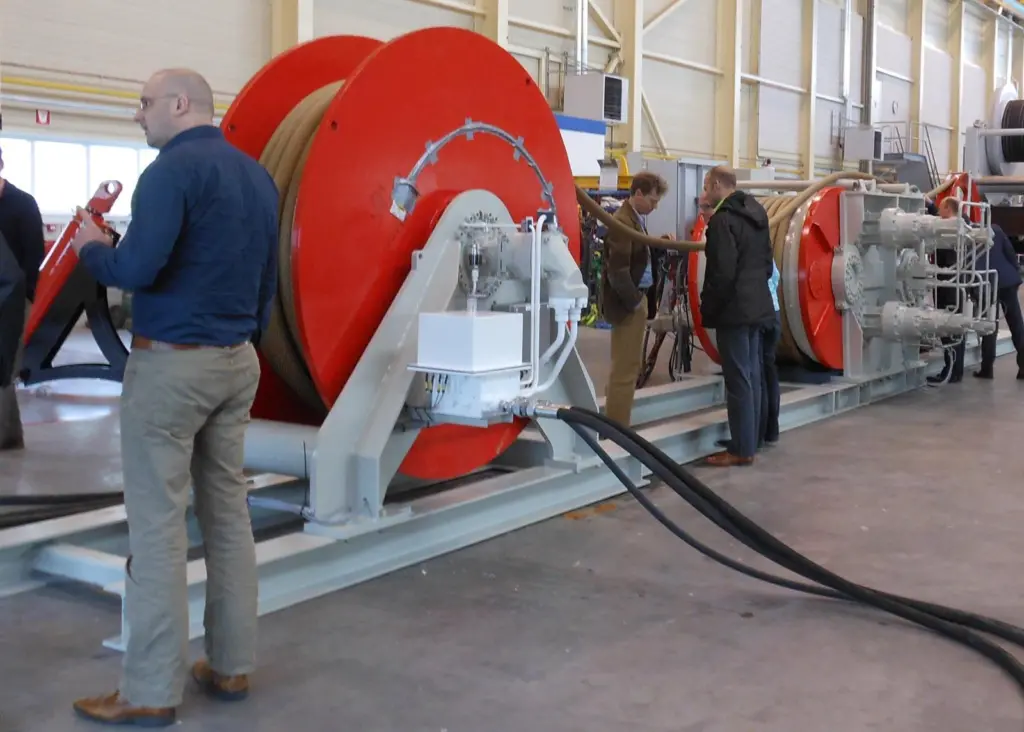
There is, as most know, an exponential increase of equipment weight with deeper water “but steel cable gets to the point where it really isn’t feasible somewhere around the 2,000m depth,” explains Mr Van der Woude.
For example, lifting 125 tonnes@1m/s in 2,500m water depth means you actually have to have 240 tonnes of pull and around 3,000 kW of installed power to cope with the line. “This power ratio reaches a staggering 1:3 at 3,500m water depth,” explains Mr Van der Woude. On the other hand, as fibre rope is near to the weight of the surrounding water, the winch only has to have the capacity to deal with the payload and would just need 1,600 kW of power.
However, fibre rope comes with its own issues, including a lower heat resistance, is also more likely to abrade and has high creep properties which limits application on the kind of double drum traction winches common to installation vessels.
The trouble is caused by what Mr Van der Woude calls the “Three T’s” of time, tension and temperature, this last being potentially the biggest issue, being created by friction from both outside the rope, and internally from fibre on fibre contact. Not only does fibre rope tend to lose its capacity as low as 65°C, it can suffer catastrophic failure at 130°C, much lower than metal cable. This of course goes up if Active Heave Compensation (AHC) technology is used as the same piece of rope runs over the winch time and time again during AHC deployment – a phenomena referred to as Cyclic Bending Over Sheave (CBOS).
Although DSM Dyneema et al have gone a long way to reducing this by high tech coatings internal friction, slippage and temperature are still an issue, a ‘vicious circle’ where the rope lengthens when it gets tensioned, creating slippage which then creates more friction and an increase in rope temperature.
So, IHC Merwede have rethought the handling system, the winch itself, and has come up with a split-drum traction winch with a software algorithm that controls torque and speed of the respective drum parts, acting together to mitigate against slippage.
It has to be said that this technology has been waiting in the wings for its moment for some time. However, it probably won’t be long before the Royal IHC fibre rope and winch system actually starts deep-water tests on one of its customer’s vessels, and this may well herald a much needed change of thinking.
By Stevie Knight
Related Articles
 ACCESSORIES & EQUIPMENT
 ACCESSORIES & EQUIPMENT
 ACCESSORIES & EQUIPMENT