


How Rotterdam is aiming for clean air by 2030
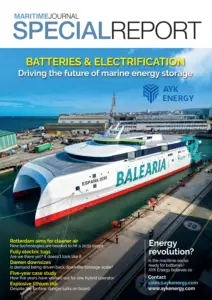 Part of our special report
Batteries, boats and the power problem · November 2026
All 6 features
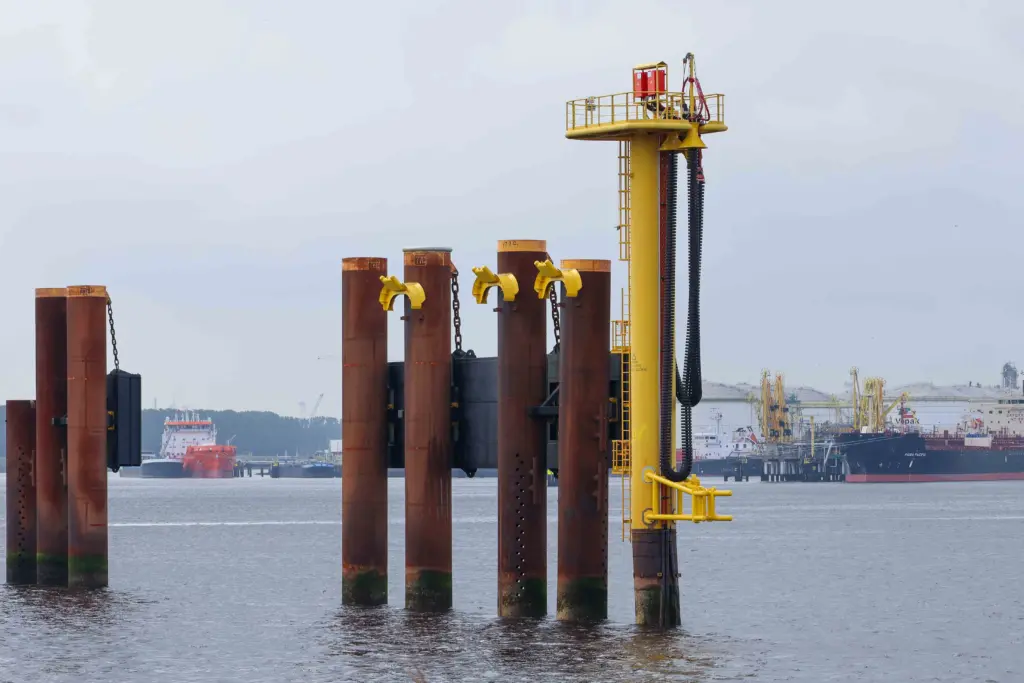
Interest in battery-powered vessels has accelerated in recent years, driven in part by advances in battery technology resulting from the rapid adoption of electric vehicles.
But what are the consequences when conventionally powered vessels, large and small, berth in built-up areas? Peter Barker investigates how Rotterdam, Europe’s largest port, is providing plug-in shore supply electricity to reduce emissions when harbour generators would otherwise be powered up.
From sail to steam to internal combustion, shipping propulsion has evolved, and diesel-electric propulsion has been part of that story since 1903. In this arrangement, diesel engines drive generators that supply electricity to electric motors. It is still regarded as the best option in terms of performance, cost and fuel availability, and remains popular with cruise ships because of their huge hotel load demands, as the same generators can supply both propulsion and hotel loads.
One example of its flexibility is diesel-powered generators supplying Azipod propulsion units. This ‘power station’ approach means the engines can be located without a fixed shaft line restricting the layout of internal spaces.
The adoption of batteries to supply all or part of a vessel’s energy demand (with or without on-board charging) has been influenced by battery technology and the operating profile and power requirements of the candidate vessel.
This is why the smaller vessels are dominating the transition to electric propulsion.
On the berth
To a greater or lesser degree, the advantages of diesel-electric or battery power include reducing emissions and improving air quality. When the vessel is moored alongside, particularly when powered solely by internal combustion engines, small vessels often use a harbour generator.
Rotterdam is an example of where ports were originally centred around the city itself: in Rotterdam’s case, the city centre is some 25km inland from the sea at Hoek van Holland.
Over time Rotterdam’s harbours and terminals have expanded gradually west, from Waalhaven, just 3km from the city centre, to the Maasvlakte 2 development, new land reclaimed from the sea in 2013, requiring the country’s maps to be redrawn. Settlements have grown to become sizeable communities, such as Schiedam, Pernis, Vlaardingen, Maasluis, Rozenburg and Hoek van Holland, with a combined population of more than 224,000 people.
The region has subsequently become increasingly exposed to emissions from these otherwise very welcome visitors, who bring employment and prosperity to the region. This is also the case in the heart of the city at Cruise Port Rotterdam, and while it makes sense for cruise ships to be close to city centres its location includes Kop van Zuid, with an expanding population.
Highrise offices and apartment blocks are sometimes just 100 metres from visiting vessels and this can put them directly in the path of emissions. But now, the cruise terminal, along with nearby residents and workers, are benefiting from the shore-based power supply that has become available for around 75% of cruise ships visiting Rotterdam.
Inland shipping accounts for around 36% of Rotterdam’s cargo volume, Barges can be many years old and while the subject of re-engining and use of alternative fuels is a separate subject, they can spend periods moored at lay-by berths, often crewed and requiring electric power, albeit less than sea-going vessels.
Port of Rotterdam Authority (PRA) says sea-going vessels alone moored on its quays consume as much electric power as 250,000 to 300,000 households a year, in the process releasing 600,000 tonnes of CO2 and 8,000 tonnes of nitrogen.
There is therefore huge scope for reducing emissions from moored vessels – but they still require electric power.
Assessing the task
Providing shore power facilities at Rotterdam’s sea-going and inland vessel berths is not a matter of simply running an extension lead from a nearby electrical socket.
Questions around finance and who pays are complex and require investment and commitment from the port, local municipalities and of course the end user. Reduced noise levels, vibration and recurring maintenance costs all have to be considered by vessel operators when they turn off their on-board generators.
While the electricity is no longer generated on the vessels themselves it has to be sourced from somewhere, and there is no benefit in just moving the source of pollution out of sight. The energy efficiency and level of emissions from conventional power stations has to be considered – and such plants may not be in areas as highly populated as the centre of the Netherlands’ second largest city.
‘Sustainable’ energy sources are an important feature and there is a growing number of offshore wind farms in Dutch waters.
The spark of an idea
In 2018, while approaching its berth, the captain of one of Heerema’s large crane ships asked why his ship, when moored, could not be powered by the wind turbines on the Rozenburg peninsular close to the berth in Caland Canal. The idea was born – and the following year Rotterdam Shore Power (RSP), a joint venture between PRA and Dutch energy company Eneco, was born.
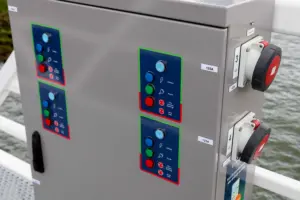
RSP’s approach was to bring together government, grid operator, insurers, energy suppliers, contractors, terminals and shipping companies to make the idea a reality.
In 2020, together with the municipality of Rotterdam, PRA reported on its ‘ambitious shore-based power strategy’ for vessels and the goal of a significant share of sea-going vessels being able to ‘plug in’ once moored. By 2030, the programme would have been accelerated and scaled to adopt shore-based power.
“Our vision combines ambition and pragmatism,” said Allard Castelein, PRA CEO, at the time. “We will be setting up eight to 10 shore-based power projects for a variety of sea-going vessel types. We will be doing this in partnership with companies in the port area and with the shipping companies that use our port. We will continually monitor the results of these projects to learn whether we can speed up the process or need to take a bit more time.”
Since then, a succession of terminal operators and ship owners have recognised the corporate value of this clean image of their operations – both in highly populated areas and more industrialised zones.
An early adopter of shore power for sea-going vessels in Rotterdam and actually pre-dating the current activity was in 2012, when Stena Line switched to shore power while its roro passenger and freight ferries were berthed at its Hoek van Holland terminal.
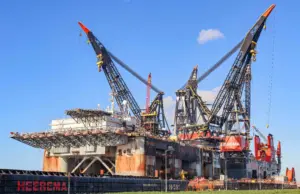
Early in 2022 Heerema’s captain got his wish, and the giant crane ships Sleipnir and Thialf were able to switch to a 20MW capacity shore power supply generated by the wind turbines at Rozenburg – or from other renewable sources when required. A standard repair/maintenance period for the vessels will see a nitrogen reduction equivalent to the annual emissions from 5,000 diesel cars.
2023 saw Boskalis introduce shore power at Waalhaven. Large offshore support vessels frequent its berths and green shore power (from Dutch wind and solar sources) was installed in conjunction with RSP, Boskalis having realised the grid connection in-house.
By the following year DFDS had introduced shore power at its freight ferry terminal at Vlaardingen. RSP reported the adjustments to ships and the port were a challenge with 2,000 metres of cable needed for the ships alone.
Scaling up
So far, shore power has involved relatively small terminals with limited numbers of ships berthed at any one time. With around 11km of quay dedicated to deep-sea container vessel operations at Maasvlaktes 1 and 2 alone, this area of the port’s operation clearly has huge potential for shore power but it needs cash and infrastructure upgrades. Around a third of the port’s cargo by tonnage is containerised.
In 2024, Rotterdam World Gateway (RWG) revealed plans to design, finance and build a shore-based power system at its container terminal at Maasvlakte 2, the first berths reported to be operational in 2026. RWG aims for a fully CO2 neutral operation with its cranes and most ground vehicles operating on ‘green’ electricity.
APMT also plans to adopt green shore power for operations at its Maasvlakte 2 deep-sea container terminal, with visiting ships expected to use around 13,000 MWh a year, the service available from 2028 well in advance of European regulations requiring shore power for container ships by 2030.
Hutchison Ports is embarking on shore-power supply for its ECT Euromax and Delta container terminals in conjunction with RSP and Heijmans. A 66kV intake station is under construction, linked to a convertor station making power suitable for moored ships.
Closer to the city itself, Rotterdam Shortsea Terminals handles more than 50 container feeder vessels a week and is another location for RSP’s shore-power. Other developments include moveable shoreside battery containers, trialled at Steinweg Beatrix Terminal and at Parkkade, a popular lay-by berth for smaller vessels close to Erasmus Bridge.
PRA’s particular focus on providing shore power for inland vessels includes a target whereby barges at all public berths are able to moor emissions-free by 2030.
Flexibility
The DFDS and Stena Line roro operations involve ships mooring in virtually the same position, determined by connecting their loading ramps with the shoreside linkspan. This potentially allows for more of a fixed shore installation, typically a crane type arm to compensate for tidal heights and small movement when connecting the cable to the vessel’s electric socket.
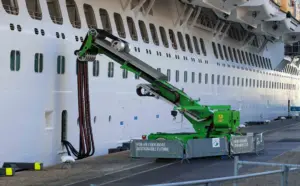
Cruise ships present different challenges, such as the different locations of each vessel’s sockets. They can moor either port or starboard side, also having to line up with the passenger walkway. The 700m long quay can also berth two vessels at once.
A consortium including Danish company PowerCon worked for nearly two years to solve these issues, including making the quay at Wilhelminakade accessible to the public when cruise ships are not present.
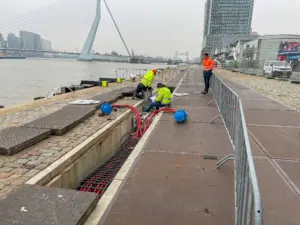
A 230m ducted trench was dug for the cables, connected to a trolley that transits along the trench to the ship’s connection point.
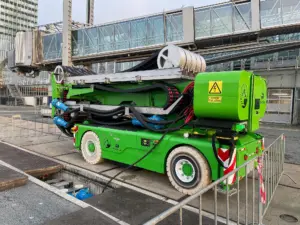
A remotely controlled support vehicle, housed within the cruise terminal building, is driven to the location and becomes in effect a junction box connecting the cables in the trench to the sockets on board the ship via a crane-type loading arm.
When the vessel sails, the cables are re-stowed in the trench, covers put back in place and the connection vehicle put back in its garage leaving the quay unobstructed and safe for the public to use.
Grid limits
One major hurdle facing ports considering shore power is whether the existing grid can take the extra load.
Portable battery containers could be one solution – see our feature on AYK Energy – for the problem of insufficient energy capacity, but for Cruise Port Rotterdam and PRA, the municipality of Rotterdam and other stakeholders, a more permanent solution has been chosen.
Constant growth over time in the area meant the existing power supply on the quay had to be extended. Dutch regional grid operator Stedin, part of the consortium, laid a 1.5km long cable from Maashaven to Wilhelminakade and in March 2025 the cruise ship AIDAnova became the first ship to ‘plug-in’ and make the air cleaner for the residents around Kop van Zuid.