






Dutch firm reveals vibration technology for silent pile driving
Dutch wind turbine foundation technology firm GBM Works says it has developed a silent method of installing offshore wind turbine foundations, virtually eliminating noise pollution.
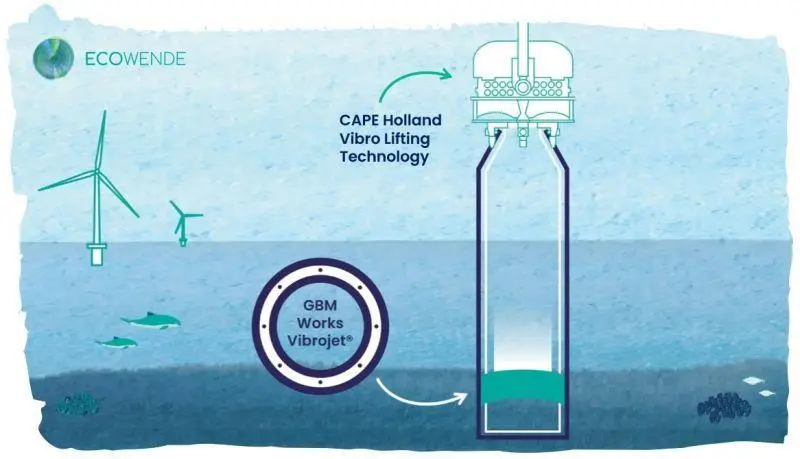
GBM Works, based in Amsterdam, has come up with ‘Vibrojet’, a technology that uses vibrations and water jets instead of traditional piling methods to install the ever-increasing foundations of offshore wind turbines.
First large-scale tests, SIMOX and SIMPLE III, are under way, and lead Operations engineer Siemen Dasselaar, who has a background in dredging vessels and deep-sea ming, says the SIMPLE III one is undergoing final tests before commercial application.
“With a 55-metre test pile, we’re now truly going deep,” he said. “Instead of hammering piles into the seabed, we use water and vertical vibrations. By creating a fluid mixture inside the monopile, we work with fluid resistance rather than soil resistance. By adding vertical vibrations, we can install the pile more efficiently and quietly.”
Bubble curtains – a conventional method of reducing subsea noise – are no longer needed, Dasselaar says.
GBM Works is collaborating with MSA-Service and their data acquisition platform, Multiped, on the projects, with the data being used to work out how monopiles behave under different lateral loads and whether those being installed in this way can last as long as hammered monopiles.
“In such an innovative project, everything depends, amongst others, on accurate and reliable data,” Dasselaar says. “We work with a wide range of sensors, such as high-frequency accelerometers, pressure-, flow-, strain sensors.”
“We’re not just looking at the installation process,” Dasselaar says. “We’re also studying how the piles behave under different lateral loads to determine whether monopiles installed with this technology can last for decades.”
Related Articles
 ELECTRICAL SYSTEMS
 ENVIRONMENT
 ENVIRONMENT