



Finding the balance: A spotlight on ecological engineering
As flood and water infrastructure must increasingly deliver biodiversity net gains alongside flood and supply resilience, engineers are finding new ways to design for wildlife without compromising the assets people depend on. Giles Squirrell, Growth Director at Ancora Group, looks at recent projects that show what that balance looks like in design and delivery.

Flood defences and water infrastructure do not have to be in conflict with conservation. Protecting communities and water supplies can, and increasingly must, sit alongside protecting the ecosystems around them.
Environmental regulations have helped drive this shift. Regulators now expect infrastructure to deliver biodiversity net gain, while engineers are asked to design for people and wildlife within the same schemes, and often the same physical structures.
Few species illustrate that balance more clearly than the European eel. Its population has fallen by more than 90% in recent decades, and its life cycle depends on movement between marine and freshwater habitats.
Embankments, weirs, sluices and pumping station intakes can therefore become barriers or hazards if eels are not considered from the start.
This issue was exactly why the Eels Regulations 2009 were introduced, ensuring those managing or altering waterways were not endangering this protected species. Not to mention the potentially large fines that failing to adhere to the regulations brings, their introduction and the novel engineering solutions they demand introduce many challenges, ranging from design to material use through to delivery. Several recent projects show how to address these challenges, preserving the balance between ecology and essential infrastructure.
A pathway for eels at Skeffling Pumping Station
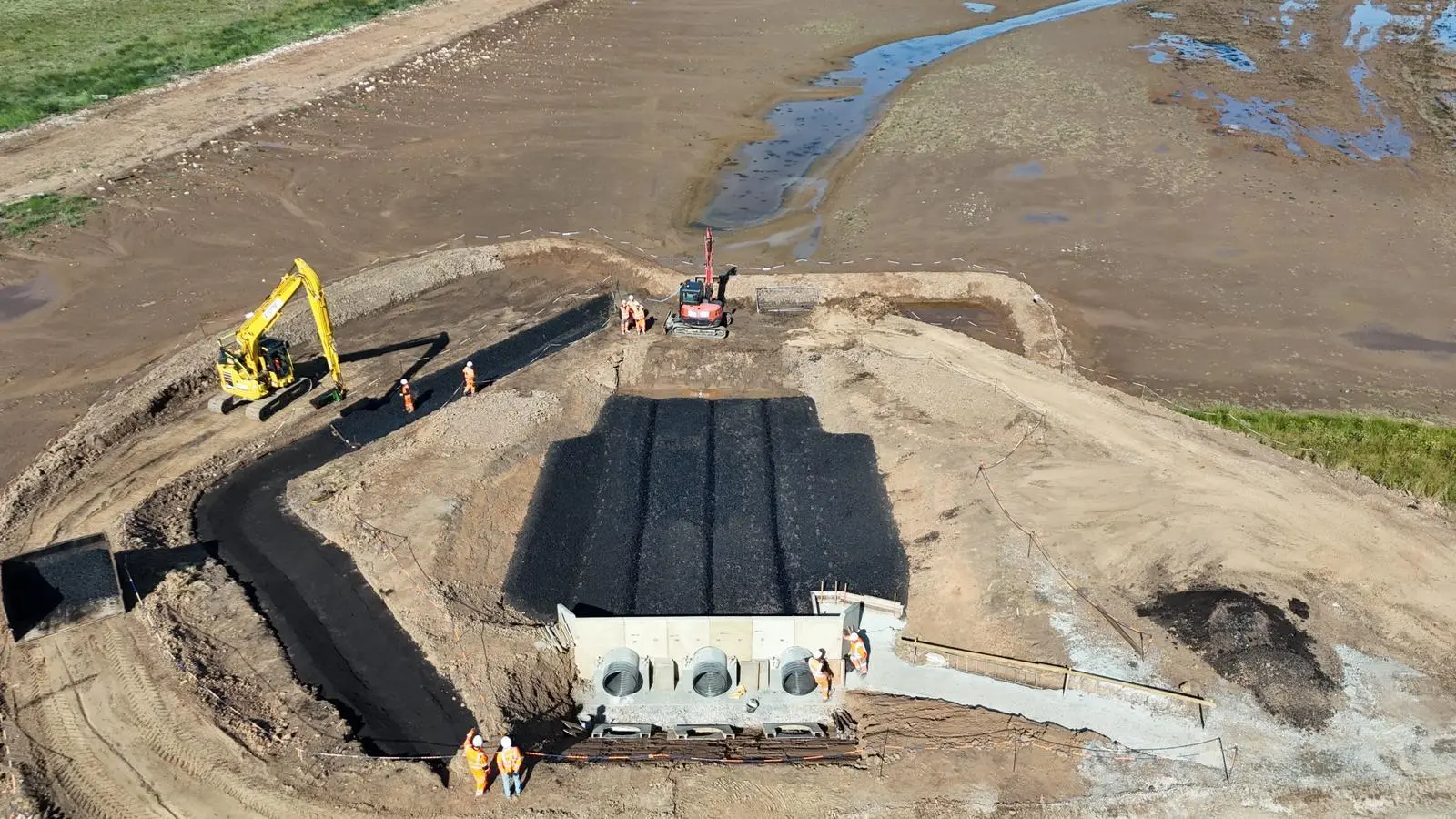
Creating an eel passage at Skeffling Pumping Station without weakening its tidal flood defence role.
On the north bank of the Humber Estuary, embankment realignment and new intertidal habitat works created a specific challenge: helping migratory eels cross the earth embankment beside Skeffling Pumping Station without weakening its tidal flood defence role.
An eel passage was proposed, but it needed the right material: durable, environmentally sensitive and able to provide the surface texture and moisture eels need to climb.Working with the Environment Agency, Hesselberg Erosion Protection identified Open Stone Asphalt (OSA) as the best fit. Its engineered asphalt system provides a naturally rough finish that retains water, replicating the wet, textured conditions eels need to climb.
The team first built a test section to check the material and profile before full installation. The trial confirmed that the OSA surface delivered the required roughness and moisture retention, allowing the complete eel passage to be installed in summer 2025 alongside the wider embankment works.
A modern fish pass at ancient Buckfast Abbey
Within the grounds of Buckfast Abbey, on the River Dart, an old weir had begun to collapse and total failure was imminent. Its pool and traverse fish pass were also dilapidated and no longer functional, and this was the last remaining weir on the Dart without a modern fish pass.
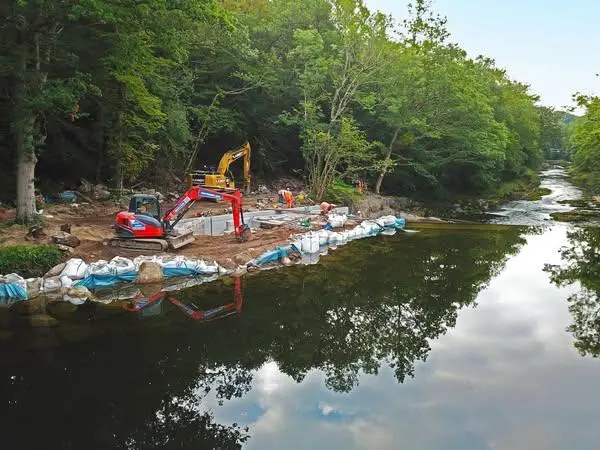
The primary challenge at this site was water control. The fast-flowing river and permeable existing dam structure demanded an elaborate water management system, without which construction at the site would have been near impossible.
TMS Maritime was appointed to tackle this construction and water management challenge. The team installed temporary measures to limit the flow of water into the primary construction areas, which then allowed them to build a Larinier fish pass from reinforced concrete, sited off-line from the main water channel. It was also fitted with a herringbone-shaped baffle bed less prone to blocking than other designs.
Once built, the structure was faced with stone reclaimed from the site to preserve the setting and reduce embodied carbon.
Keeping supply live at North Bridge Pumping Station
On the River Exe, South West Water’s North Bridge Pumping Station needed its ageing eel screens replaced with modern, environmentally compliant mechanical screens, without interrupting the community’s water supply.
TMS Maritime, appointed by Fishtek Consulting, combined dive surveys, bespoke fabrication and carefully sequenced crane operations to remove and replace the screens.
“With two live water lanes, we could phase our work to keep one lane running at all times,” said Richard Taffs, Head of Subsea and Access Solutions for TMS Maritime. “This ensured there was no supply disruption, and our temporary diversion lane meant any fish and eels were safely extracted and returned during the works, too.”
Delivered on time and safely, the project strengthened TMS’s partnership with Fishtek and led directly to further intake work at Lopwell Dam.
Precision engineering for intake screening at Lopwell Dam
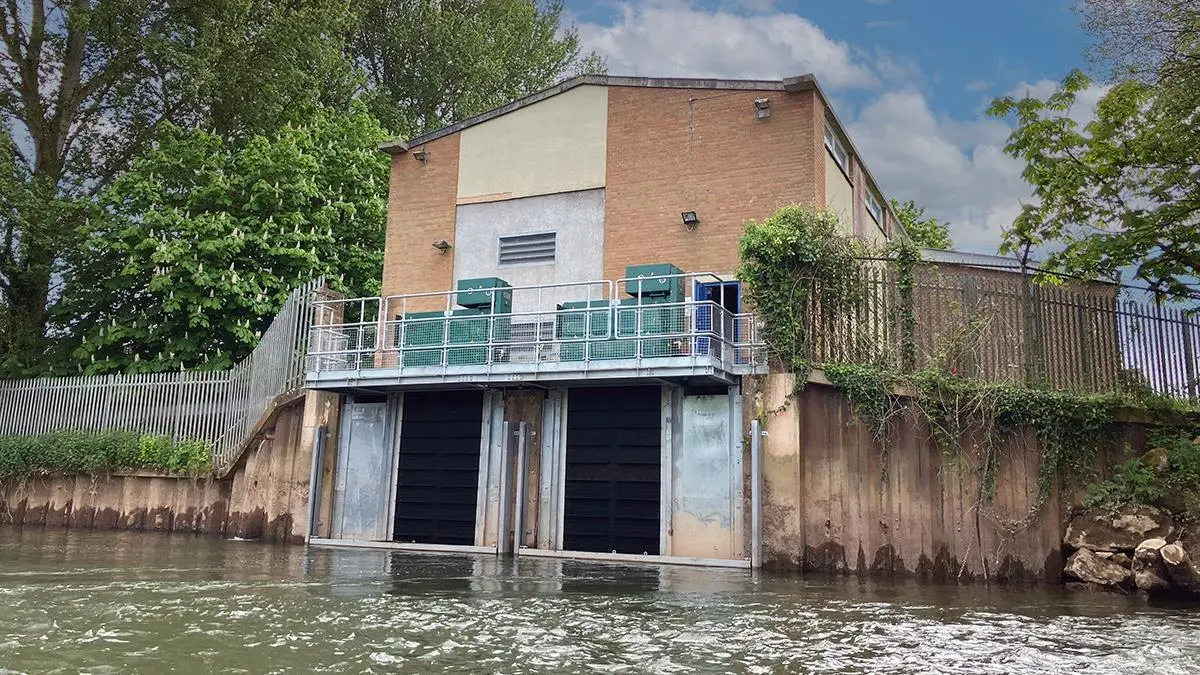
At Lopwell Dam, the project had very similar requirements. But the site’s restricted layout meant precision was the focus for delivery. Replacing old fish screens with new ones required a frame that had to be installed underwater inside an existing structure to tolerances of just 5mm.
Key work included a custom datum bar for accurate underwater alignment, crane-lift installation of the screens and frame, placement of stilling tube units, and permanent concrete stoplogs upstream of the pumping station – all delivered over a carefully coordinated six-month programme.
“At Lopwell as at North Bridge, environmental protection ran through delivery as much as it did the end product,” said Taffs. “We used temporary fish bunds to sift silts and return small fish to the watercourse, rather than treating fish protection as a separate phase from the main installation.”
Common goals and next steps
These four projects solve different problems. Some help eels move through infrastructure; others keep eels and small fish safely away from it. The underlying approach, however, is the same.
In every case, ecological performance was treated as an essential design requirement, not an add-on. Each project protected the asset’s core function, from tidal defence to continuous supply, within demanding access and environmental constraints. And each depended on close collaboration between ecological specialists and delivery contractors.
As more of the UK’s ageing water and flood infrastructure comes up for renewal, these projects show what that work increasingly demands: ecological requirements built into design from the outset, and experienced partner contractors able to deliver them in demanding environments.
Ancora Group is a UK marine infrastructure services provider comprising TMS Maritime, Hesselberg Erosion Protection, Red7 Marine and Marine Plant Hire. It delivers design, engineering, construction, installation and long-term maintenance across coastal, inland water and marine environments, including projects where ecological protection is a primary design requirement.
Marine Plant Hire and TMS Maritime are Seawork exhibitors.
Related Articles
 ELECTRICAL SYSTEMS
 ENVIRONMENT
 ENVIRONMENT