![MaritimeJournal[Seawork]](https://www.maritimejournal.com/wp-content/uploads/2026/09/MaritimeJournalSeawork.svg)





Floating wind project will power oil and gas
A Norwegian consortium is working on a project to power a Barents Sea oil platform with electricity generated by floating offshore wind.
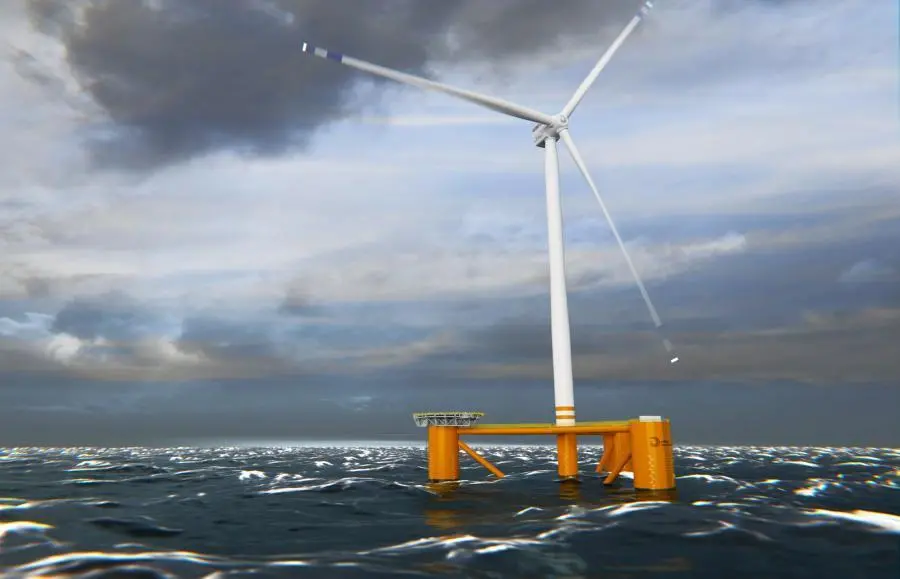
A Norwegian consortium is working on a project to power a Barents Sea oil platform with electricity generated by floating offshore wind.
Source Galileo Norge, Odfjell Oceanwind and Kansai Electric Power, in a consortium named GoliatVind, are aiming to install the floating wind around 85 kilometres northwest of Hammerfest in Norway, where the water is 300-400 metres deep.
There will only be five wind turbines at the site, each with a capacity of 15MW, which makes the total capacity 75MW.
GoliatVind’s floating foundation will come from Odfjell Oceanwind, which has developed a semi-submersible foundation with a turbine in the middle.
Each triangular platform has buoyancy columns at each corner to float the turbine tower, which is 135-170 metres tall. The rotor diameter is between 220 and 260 metres long.
Each foundation will have six anchors, either suction anchors or drag anchors, each with a horizontal anchor line 1,700 metres long.
A common substation will have an internal cable connecting it to each turbine.
Using wind to power oil
Powering oil and gas platforms with offshore wind power is not new. In August 2023, the world’s biggest floating wind farm was launched, also in Norway, off its west coast.

Hywind Tampen wind farm has a generation capacity of 88MW and supplies the Snorre and Gullfaks oil and gas platforms, which is also behind the wind farm.
Eleven floating turbines, also fixed to the seabed with anchors, supply approximately 35% of the power demand for five oil and gas platforms owned by Equinor in partnership with OMV and Vaar Energi.
“Hywind Tampen will be a testbed for further developments of floating wind, exploring the use of new and larger turbines, installation methods, simplified moorings, concrete substructures and integration between gas and wind power generation systems,” says Equinor.
While it may seem slightly contradictory to power the production of oil and gas with ‘renewable’ energy, the project developers estimate that doing so will cut carbon emissions by about 200,000 tonnes a year.
Source Galileo is also working on an offshore wind project in the Atlantic Ocean off the north coast of Ireland.
The Malin Head wind farm will cover an area of 265km2 some 32 kilometres from shore, with a projected generation capacity of 1,000MW, or 1GW, from an estimated 67 turbines based on today’s 14MW size.
Surveyed waters across the site give an average depth of 60 metres, which means it will be suitable for fixed bottom turbines, Source Galileo says.
Related Articles
 FEATURES & VIDEOS
 ENVIRONMENT
 OTHER NEWS