





Turning the volume down installing wind farms
Dutch engineering specialist IQIP has begun testing its EQ-Piling technology, which aims to reduce the marine noise generated when offshore structures like wind farm foundations are driven into the seabed.
The impact on the seabed has to be considered over the project’s entire lifetime, including the implications of eventual decommissioning.
The installation process has to use enough force to overcome soil resistance, which makes it tricky to reduce noise to meet regulations for airborne and underwater sound levels. As monopile foundations grow larger and are installed at greater depth, even more force is needed, thus more noise.
In answer, Dutch engineering firm IQIP has developed a system that moves away from the traditional ‘hammer’ pile-driving installation method and is now being tested at the Maasvlakte 2 port location in Rotterdam.
Next generation piling
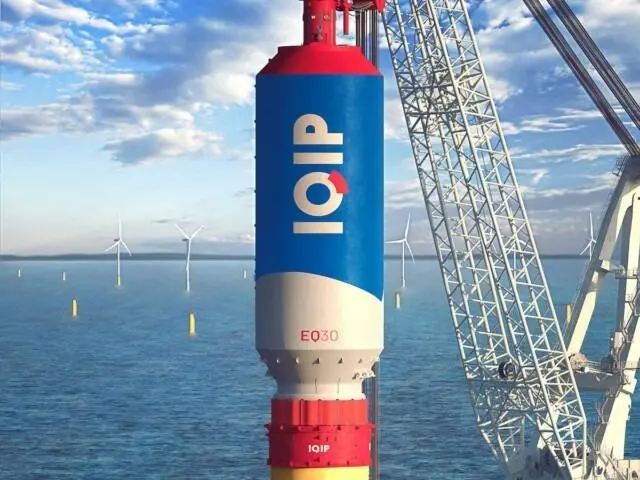
EQ-Piling employs a large water tank containing up to 1,700 tons of seawater as a drop weight, the tank raised by hydraulic cylinders and released from the drop height setpoint.
The water tank falls onto buffer cylinders that transmit the impact force onto the pile, dampening it to extend the impact time, which is 15-20 times longer than that of conventional piling, resulting in a smooth energy transfer to the monopile and significantly reduced noise levels. The tank stands at a height of 31.5m with a diameter of 11.5m and weighs in at 760t.
IQIP claims other benefits from this method of installing monopile foundations, including where pile fatigue is reduced by up to 90%, allowing pre-installation of secondary steel fixings such as crew boat landings.
Measures to reduce or even eliminate noise, such as bubble curtains, result in lower foundation and installation project costs and fewer risks of project interruption.
Construction journey
A major milestone in the development of the EQ-Piling system was passed around a year ago, when the central guiding tube was loaded out from IQIP’s production hall in Sliedrecht, the Netherlands. Following transport by road to a different site, the water tank was fitted with the base construction, housing eight hydraulic cylinders and 16 buffer cylinders also under construction.
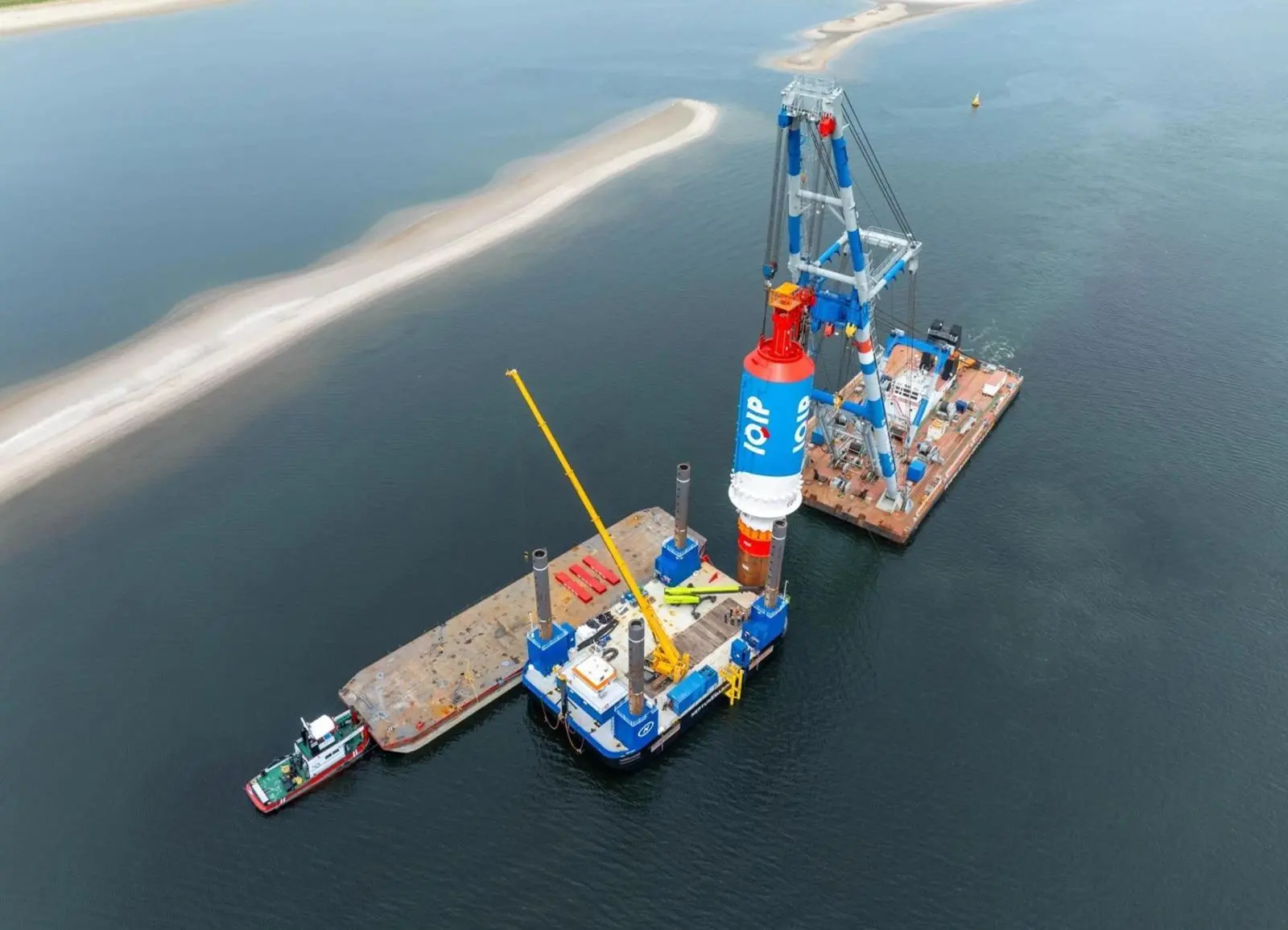
Mobilisation to Maasvlakte 2 involved two barges carrying the base construction and a test pile, the second carrying a hammer spread with both barges accompanied by a jack-up vessel and tugs.
IQIP’s story started more than 40 years ago, when three companies, all specialists in installation and foundation projects, decided to work closely together.
In the field of offshore wind, IQIP has executed more than 50 projects in a similar number of countries and its portfolio of products is not limited to this specific project.
It also produces pile-handling and positioning solutions such as upending, lifting and guiding of piles and transition pieces including for other offshore sectors.
Coastal and marine civil engineering works are also referenced in its project list, along with involvement with upstream oil and gas projects both surface and subsea.
While the popular news to report usually relates to new projects and their installation journey, everything has a ‘shelf life’ and decommissioning, even in the relatively recent history of offshore wind, is now on the agenda. IQIP will no doubt feature in the ‘cradle to grave’ aspect of the subject.
Related Articles
 ELECTRICAL SYSTEMS
 ENVIRONMENT
 ENVIRONMENT