

Unique ‘wind wall’ wins grant for offshore Norway
A new concept in offshore wind could completely change how installations are performed and maintained.
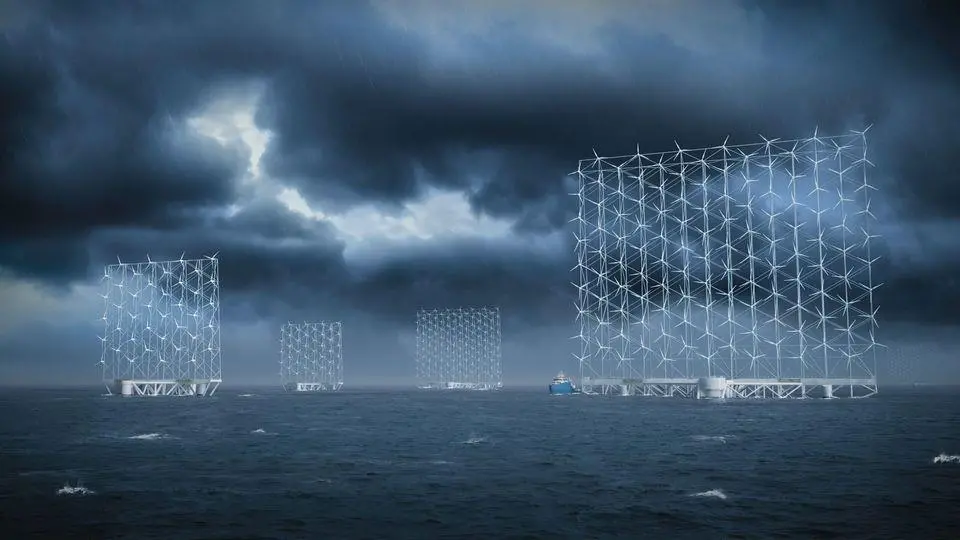
The ‘Wind Catching Demonstrator’, a floating ‘wall’ of turbines each much smaller than today’s increasingly giant mammoths, has been given NOK1.2 billion (€102 million) from the Norwegian government agency Enova to get its project into the sea.
Wind Catching Systems (WCS), founded in 2017, says it came up with its idea when it saw 1,000t offshore wind turbines being installed in a similar way to those onshore.
“We asked ourselves, is using a technology developed for installation on land the best method for floating offshore wind?” says CEO and co-founder Ole Heggheim.
“We believe the answer to the question is no. There must be a way to install more energy capacity per floater, which is why we founded Wind Catching Systems.”
The solution – a multi-turbine sail with an elevator system for maintenance and handling, scalable, easier and cheaper to maintain, and with more generation capacity.
“One of the advantages is the low complexity,” Heggheim says. “The turbines are just 1MW each, which means they are available all over Europe, from a variety of suppliers, strengthening the supply chain.
“The platforms are an old technology – used in oil and gas. Each unit moves around a centre point, turning and swivelling according to how the wind is blowing.”
With a height of up to 200 metres, the turbines are based on platforms that also have a self-elevation system to take engineers up and down to them for inspection and maintenance – as opposed to on a conventional wind farm, where technicians have to sail from one to the other.
This could be spread over hundreds of acres, so while still needing an SOV or CTV to take the engineers out to the Windcatcher, the operator will not need them to stay there for nearly so long – saving time and, of course, the huge costs involved.
WCS claims that five of its Windcatchers could generate the equivalent of 25 conventional turbines.
The proof will be in the commissioning – the Enova grant’s main condition is that the project has to be in the water and operating in five years’ time.
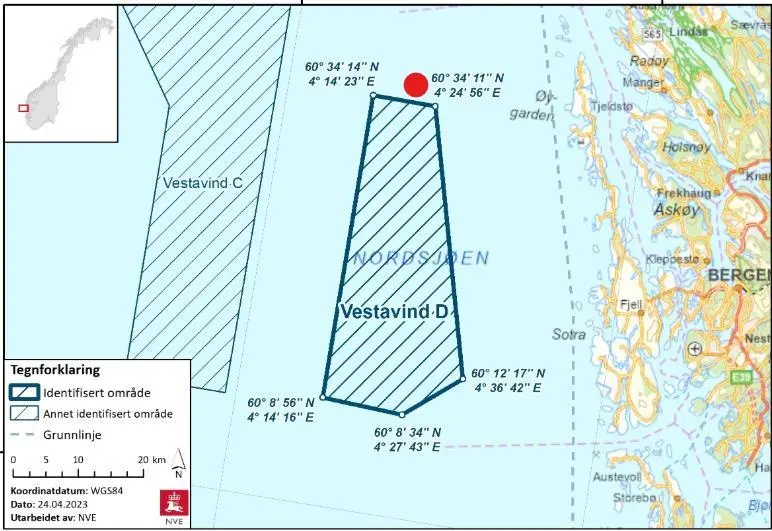
Heggheim is optimistic this will be achieved, with the first Windcatcher system to be installed off the coast of Øygarden, northwest of Bergen, with 40 Vestavind 1MW turbines.
“Floating offshore wind is an energy resource that has great potential, if it eventually becomes competitive with other energy sources, said Norway’s Energy minister Terje Aasland.
“Norway’s supplier industry and the oil and gas industry have world-leading expertise in their areas, which means that Norwegian players are well positioned to supply technology and products, also to a growing international market in offshore wind.”
“Increased production of renewable energy is crucial for reducing Norway’s greenhouse gas emissions,” said minister of Climate and Environment Andreas Bjelland Eriksen.
“The government pursues a policy that both creates jobs and cuts emissions. In Norway, we have many strong centres of expertise in offshore wind that contribute to this.”
Related Articles
 OTHER NEWS
 ELECTRICAL SYSTEMS
 ENVIRONMENT