



OTD successfully trials technician transfer device
The growth of offshore wind has been rapid across the globe, and with it a massive expansion in the size and scale of the turbines and vessels required to install and service them.
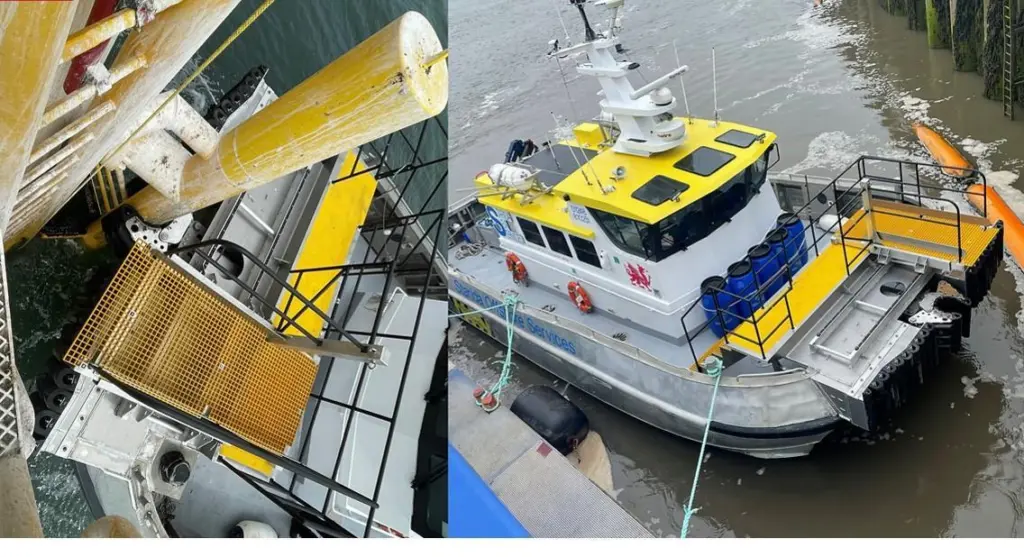
This has created safety challenges, not least the safe transfer of technicians to and from the wind turbines, often in weather conditions so harsh that in fact the transfer is impossible.
Traditional methods of crew transfers from Crew Transfer Vessels (CTVs) to turbines often rely on the CTV applying thrust against turbine foundations, creating stability for technicians to step across.
But while effective in calm waters , this method becomes risky as wave heights increase.
“It’s a tried-and-tested approach,” said Sam Strivens, with the Logistics and O&M working group, part of the Carbon Trust-led Offshore Wind Accelerator (OWA), in an interview with Maritime Journal.
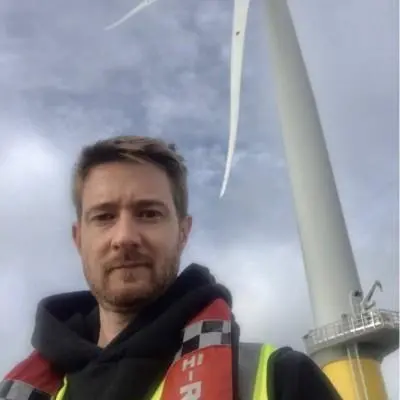
“But it has its limits, especially in rough seas.”
Day rates still have to be paid for technicians who can’t work for no fault of their own, and delaying or cancelling transfers is an expensive event as well as a safety risk.
Calls for solutions
In 2011, says Newman , the OWA, which is funded by almost all offshore wind owner operators in Europe, initiated a competition calling for something to fix the transfer issue.
“At the time, offshore wind transfer devices didn’t exist,” he says. “The maritime industry has been doing it with pilot vessels for hundreds of years, and with pilot boat transfers it’s even worse because they throw over a rope ladder and then the pilot just steps or jumps over. It’s pretty horrendous.”
Cue CTV master Daniel James, who submitted his idea to the competition – a Tube Docking Device (TDD) Prototype, which the OWA backed into trial.
It was inspired by heavy machinery and excavators and aimed to stabilise vessels more effectively during the transfer process.
While the trial successfully proved the concept worked, unfortunately the trial was cut short because the vessel involved obtained a new charter. The device could not continue to service trials and support technician transfers, so the aim of the project – to garner operational data and showcase the TDD’s capability offshore – could not be fulfilled.
Until now.
TDD in action
At last, the TDD has gone through the necessary trial steps with ‘jaw-dropping’ results, says Newman.

Thanks to continued support from the OWA, a demonstration was carried out at energy giant RWE’s Rhyl Flats wind farm in the Irish Sea off Wales.
“We fitted the device to a different vessel and this time ran the trials with members from the OWA, who are experienced mariners. They’d seen the videos, but when they actually went out on it, they were really dumbstruck at how effective it was. And it worked every time, we kept repeating and repeating the docking process.
“The term that we took away from that was ‘jaw-dropping.’”
The device, which uses a jaw-like mechanism to grip turbine fender tubes, demonstrated its ability to enable transfers during trials in wave heights up to 2.1 Hs and 3.8 Max metres —double the conventional limit of 1.0 metres .
As the boat moves forward, the fender tube touches the nudge pad , which enables the jaws to close around the tube and grip it. This increasing the surface area of the fender in contact with the fender tube, which increases grip and coefficient of friction that the vessel can achieve, and therefore increases stability and reduces fuel consumption.

“It’s not a mechanical grip,” says Newman. “It’s all activated through the motion of the vessel – it’s a very fluid process for the Master and its simple to use.”
The device has six degrees of movement, so it can counteract the movement of the waves – resulting in a stable platform pinned to the device while the stern can still be moving around.
The device has now been designed so it can be retracted if needed, and traditional transfers can still take place.
It can also be scaled up or down, from tiny daughter craft to the ever-increasing size of CTVs or SOVs (for gangway systems).
“This breakthrough expands the number of operational days significantly,” Newman says. “On one modelled site, the device could reduce weather downtime by 77 days a year, a significant cost-saving for operators.”
Present and future
The successful demonstration comes at a time when offshore wind is scaling up rapidly. Larger turbines, longer distances from shore, and the push for carbon-neutral solutions like electric vessels present new challenges that OTD believes the device is equipped to address.
“Our device could even support electric CTVs, which struggle with battery demands for Prolonged thrust operations,” says Newman – and indeed, with fuel consumption a growing headache for operators, this is always one of the main concerns.
OTD is now in discussions with several utility companies to tailor its device for specific sites and vessels.
The company aims to transition from prototype to widespread commercial adoption, and Newman is optimistic, attributing the device’s success to its robust design and industry relevance.
As offshore wind continues to grow, innovations like OTD’s transfer device highlight how the sector is constantly adapting and innovating to address its toughest challenges.
By improving safety and opening operational windows, this device could be a real boost for offshore energy operations.