





Floating Wind Turbines – New Developments in a Buoyant Market
In recent years there have been two significant trends in the wind industry – developers are searching for higher quality wind resources and turbines are getting larger and larger.
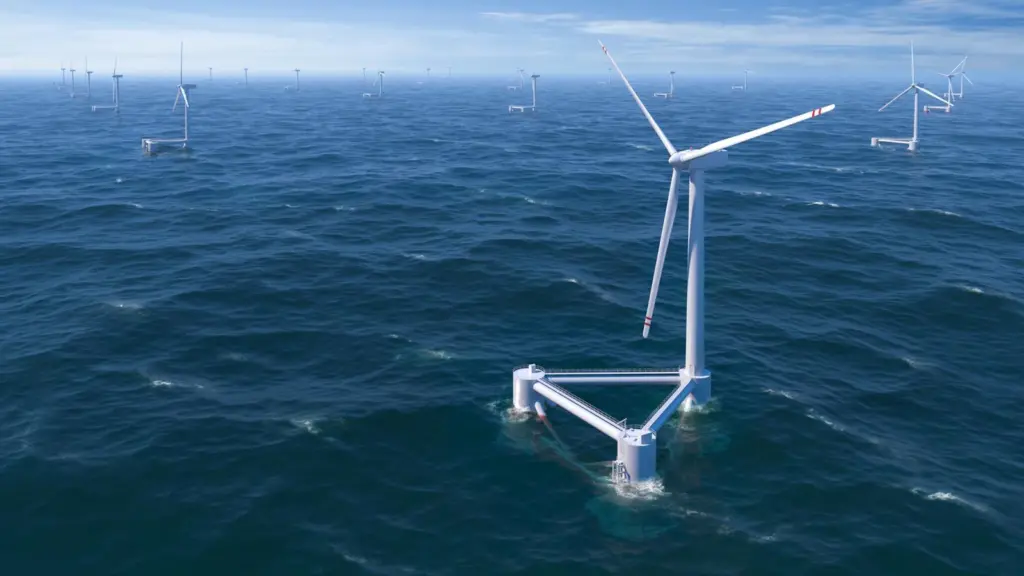
In response to these developments, the idea of ‘floating’ offshore wind, which can provide developers with better access to offshore wind resources, unconstrained by water depth, with a support structure able to accommodate larger turbines, is becoming increasingly popular.
Advantages
A key advantage of floating wind platforms is that they allow developers to access previously inaccessible areas and benefit from stronger and less turbulent winds, helping to reduce the overall cost of wind energy. They can also generally be commissioned and assembled at the quayside, without the need for heavy-lift jackup or dynamic positioning (DP) vessels, further reducing the cost and risk of deployment activities.
“Eliminating offshore lifting operations also provides for decreased weather window restrictions on installation”, said Craig Andrus, Senior VP – Europe at Principle Power.
The fact that foundations are not necessary with floating technology also means that piling activities and sea life disturbance can be avoided, greatly reducing negative environmental impact. Moreover, reduced geotechnical requirements mean that core sampling is only needed to test the seabed ahead of appropriate anchor selection, as opposed to the necessity of core sampling at every pile site.
Current Initiatives
In order to test the viability of floating wind turbines and support structures a number of pilot initiatives are currently underway at various locations around the world.
Hywind
Developed by Norwegian energy company Statoil ASA, Hywind is the world’s first full scale floating wind turbine. Located around 10 km off the Norwegian coast, the structure itself is a steel cylinder, similar to a spar buoy, filled with a ballast of water and rocks, which extends 100m beneath the sea’s surface. Attached to the seabed by a three point mooring spread, it can be employed at ocean depths of between 120m and 700m.
The turbine itself was supplied by Siemens, but the ‘floater’ was built by engineering specialists Technip, which also undertook all the offshore installation work. A submarine power line, laid by Nexans Norway, reaches the mainland near Skudeneshavn at the southern end of Karmøy, where local grid operator Haugaland Kraft operates a receiving station.
Although the Hywind turbine has been generating electricity to the Norwegian grid since late September 2009, its main objective is to test the impact of wind and waves on the structure over a two year period. The results have so far been promising and indicate the long term viability of this type of floating turbine technology.
“There is no reason to believe it shouldn’t eventually be cost competitive with ‘bottom fixed’ approaches”, said Hywind project manager, Sjur Bratland.
Following the initial test period, Statoil intends to start work on commercialising the concept with the ultimate goal of reducing costs so that floating wind power can compete in the global energy market. According to Bratland, the company has already identified a few potential sites outside Norway.
“We are looking for feasibility in Scotland and [the] US in the time frame of 2015-2017”, he said.
Blue H
Dutch company Blue H Technologies has devised a ‘Submerged Deepwater Platform’ (SDP). Essentially a modified form of a Tension Leg Platform, SDP’s are made of a buoyant hollow body that is ‘semi-submerged’ in water by chains or tethers, which are in turn connected to a counterweight on the sea bed, thus creating the necessary uplifting force to keeps the chains constantly tensioned.
In 2008, the company installed a 75% scale prototype SDP with a small wind turbine in 113m deep water some 11 nautical miles off the coast of Southern Italy near the site of the future offshore Tricase project. After six months at sea, the unit was decommissioned early in 2009.
In 2008, Blue H started engineering a second proof of concept, a tension-legged platform for a 2 MW floating wind turbine. The concept is slated for completion next year, when the company intends to install it in its Tricase wind farm. This will be followed by the deployment of a larger pre-production floating turbine in 2014, combining Blue H’s platform with a third party offshore turbine.
In the UK, Blue H also led a consortium of companies involved in Project Deepwater, a two year project that ran from 2009-2010 and looked at the feasibility and costs of generating electricity using offshore wind turbines mounted on a floating, tension legged platform in water between 70m and 300m deep.
In addition, the company is currently undertaking extensive research work with partners Timolor Leroux & Lotz in what it calls Project DIWET (Deepwater Innovative Wind Energy Technology). The project, located off the coast of Brittany, France, consists of a floating platform concept that is anchored using rigid taut lines.
WindFloat
In the US, technology company Principle Power has devised WindFloat, an integrated system, consisting of a semi-submersible floating platform capable of supporting commercial offshore horizontal axis wind turbines. The system utilizes drag embedment anchors and a conventional catenary mooring and is designed to accommodate any multi-megawatt offshore turbine.
Principle Power, alongside partners EDP, InovCapital, Vestas and others, has recently signed an agreement for the deployment of the first full scale WindFloat, with a Vestas V80 – 2.0 MW turbine, off the coast of Portugal later this year.
Testing at the grid connected site in Aguçadoura will focus specifically on performance validation of the WindFloat and turbine integration, as well as
commissioning, decommissioning and O&M studies.
“From a project perspective, Portugal has a rich maritime culture, a history of embracing marine renewables and unfortunately, or fortunately, a dearth of commercially viable shallow water sites for offshore wind deployment, said Andrus.
“WindFloat can be regarded as an economically viable competitor against conventional concepts at sites with water depths ranging from 40m to 50m.”
In the near future, Principle Power is focused on deploying WindFloats in all ‘primary markets’, namely Western Europe, the UK and the US on a commercial basis.
“The Portuguese prototype serves as validation of the technology, proof of commercial viability and a test bed for optimization of the integrated system”, said Andrus.
HiPRwind
HiPRwind is the world’s largest publicly funded research project to develop deep water offshore wind technology. Led by the German Fraunhofer research institute, the five year, €20m initiative combines the expertise of no less than nineteen companies, including Acciona Energy, ABB Schweiz, Bureau Veritas, Angewandten Forschung and Norges Teknisk.
A central objective of HiPRwind is to deliver a fully functional floating wind turbine installation at approximately one tenth of the scale of future commercial systems, deployed in real sea conditions.
“The idea behind the project is to analyse current approaches for floating turbines, pick the best one, build a downscaled model and test it, said project director Andreas Reuter, Professor of Wind Energy at Fraunhofer IWES.
“The turbine used is a modern pitch regulated variable speed turbine. The main question will be the type of floating structure to be used, here we have a couple of options.”

Key focus areas will include reliability, remote maintenance and grid integration, with a particular emphasis on how floating wind technology can help to overcome the financial and technological limitations of current wind turbines and support structures. In doing so, the project team will research improvements in rotor blade designs, structural health monitoring systems, reliable power electronics and control systems.
Ultimately, the aim is to bridge the gap in technology development between small scale tank testing and full scale offshore deployment and reduce the risks and costs of commercialising deep water wind technology.
Since the project has only just begun, Reuter explained that there are no results yet. However, he is keen to stress that the cost structure of floating turbines is the key challenge.
“The floating body is extremely expensive compared to a classic onshore foundation. On the advantage side we have the higher winds offshore, no visual impact and complaining neighbours and the possibility to ship the turbines back into the harbour for maintenance”, he said.
Looking Ahead
According to Andrus, the commercialization of floating wind turbines will certainly come much sooner than previously anticipated only a few years ago. This is because the challenges, disadvantages and hidden long term costs of fixed structures are becoming more evident and better understood.
“We believe that the sizing and design flexibility, turbine agnostitcity (the WindFloat is flexible enough to be used with almost any type of wind turbine), logistical ease of deployment and decreased risk of the WindFloat is an economically viable alternative and solution for offshore wind industry, said Andrus.
“That being said, more demonstrations, like ours later this year, need to take place in an effort to prove bankability and track record to the wind industry as a whole.”
Reuter, however, predicts that full commercialization will take a little longer, perhaps up to a decade.
“[We] will be busy improving the systems for quite awhile, including some tests with demonstrators. Going commercial is probably realistic for the years after 2020. Cost is the key issue.”
By Andrew Williams
Related Articles
 MARINE CIVILS NEWS
 OTHER NEWS
 MARINE CONSTRUCTION