





Game on
Move your hands to turn a wheel, and you generally won’t be concentrating on integrating the movements of shoulder, elbow and wrist. Frankly, having to do so would probably stop most people even flipping on the light switch without thinking.
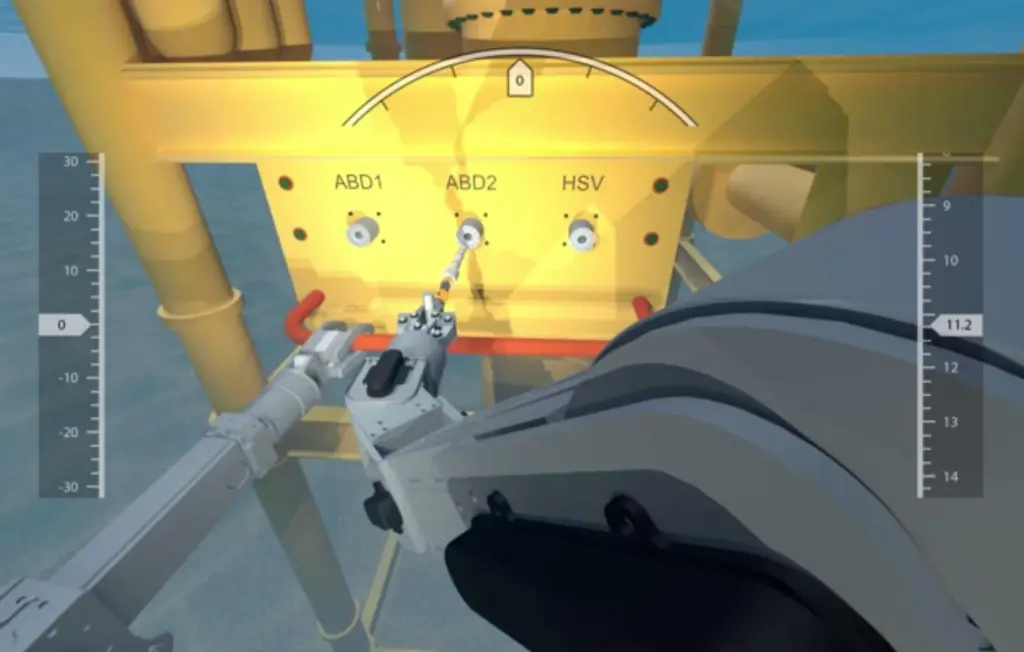
While this might not pose a problem on land, it’s a perennial issue for the subsea industry. Operating a remote, underwater WROV ‘arm’ capable of flexible, manual intervention usually requires the pilot to control each section separately, explained Donald Pickering of Seattle-based BluHaptics.
Because they often have five or six joints, an apparently simple gripper move can require attending to several different elements at the same time. He added, despite the rise of sophisticated WROV technology, “this method of working has basically stayed the same for the last 10 years”. The situation is deteriorating because not only are subsea demands increasing but according to Mr Pickering “there’s also a pilot shortage and the industry is steadily losing expertise”.
There had to be an easier way. “Instead of trying to manipulate each joint, we’ve developed software that translates this all into moving the head itself,” he explained. So, rather in the same way that people use their hands without thinking too hard about all the supporting movements, the operator only has to focus on positioning the gripper or tool head. Usefully, a move that can’t be ironed out by the software, for example pushing a joint beyond its physical limit, freezes the arm and relays a warning buzz back to the operator who then has to think again and take another approach.
Tool use itself is made much simpler. Holding the head steady for a cut can be difficult, so BluHaptics has what it calls an ‘orientation lock’ which restricts movement to a single plane, making for a nice straight line. It also helps in reaching into tight spaces, for example between vertical columns; this feature will stop the operator kinking the arm in a way that makes it difficult to retract. The software also allows setting a position; for example, a ‘resting’ pose said Mr Pickering: “This gives the pilot the ability to stow the arm away safely in one move,” which means that if unexpected issues arise, the operation can be aborted on a button press.
“We are building in a lot of simple stuff… but it reduces the cognitive stress of the pilot and makes the task relatively easy,” said Mr Pickering.
It’s not just the manipulation that has been simplified; this first version of the BluHaptics kit is an instant solution: “You just unplug your old controller and plug this one in,” explained Mr Pickering. It may look strangely familiar as the company has reached for the games console: this brings with it a couple of significant advantages – it only costs around €50 to replace if there’s a mishap and you can buy one off the shelf, plus, it’s already been extensively trialled in the hard-to-please games industry.
The approach works. Recently BluHaptics invited not just experienced pilots but the general public to use the software to carry out a virtual task. The results were striking: young or old, male or female, skilled or not, there was a 100% success rate.
Needless to say, anything this smooth needs a lot of work behind the scenes, fusing the input from sensors and processing modules with vehicle control and pilot interface. However, further development is on the cards: the system will soon add force feedback to the controls, giving operators a ‘feel’ for what the gripper is actually handling. Further, overlaid on the visual display will be a 3D model of the workspace “so you can move around the area and take different views of the subject”, added Mr Pickering.
The slightly more distant future is equally exciting as the system will be able to build up a library of objects and moves. As the original driver for the technology was dealing with unexploded ordnances, a later version will allow recognition of the UXO and the definition of a safe ‘tool path’ for a waterjet cut.
The system’s ability to remember certain moves also opens the back door to automated operations: as the kit develops “we will start to fold in machine learning” said Mr Pickering, so that eventually it will be able to operate as an independent robot, at least some of the time.
Back to the present, what do the ROV pilots themselves make of the innovation? Mr Pickering concluded: “We tested it out with experienced pilots too as getting them onboard was important… and yes, even skilled pilots like it – while some said it will take a bit of getting used to, most could see within five minutes how fast it was to pick up.”
By Stevie Knight
Related Articles
 MERGERS & ACQUISITIONS
 OTHER NEWS
 ENVIRONMENT