![MaritimeJournal[Seawork]](https://www.maritimejournal.com/wp-content/uploads/2026/09/MaritimeJournalSeawork.svg)






GE powership concept
Multinational marine propulsion major General Electric has been busy refining the oft-discussed, but seldom realised concept of a portable power station built within a ship.
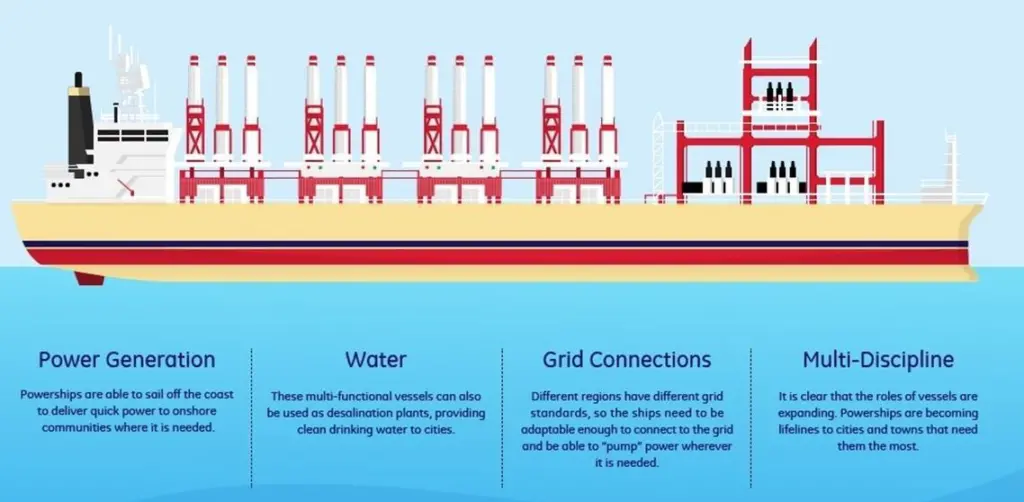
Andy McKeran, Marine Executive, GE’s Marine Solutions, proposed in a recent GE blog a floating power plant built on a ship that can travel to anywhere in the world and provide power to onshore communities where it is needed. When you consider that more than 1 billion people around the world have no access to power and many more simply lack the required amount, powerships certainly offer a much-needed alternative solution to this global issue.
Andy suggests that it is an innovative and flexible example of a microgrid, ideal for areas with poor access to infrastructure. As building a power grid can take many years and comes at a huge cost, a powership can provide distributed power generation, helping communities to have access to essential energy supplies.
However, according to Andy, realising a powership is no easy task. From financing to project management, there’s a chain of expertise that is needed to succeed. Needless to say, technology also plays an essential role in the value chain, and there are several critical considerations.
Compared to conventional shipping vessels, a powership requires significant engineering expertise to build a stable power plant on the ship’s platform, and the system must be able to withstand the harsh sea environment, which can damage equipment over time. Machines need to be specifically designed to accommodate even the most extreme climates, with temperatures ranging from -20 to 50 degrees Celsius.
While the very nature of powerships means that they can be deployed anywhere in the world, different regions have different grid codes to comply with, so the ships need to be adaptable enough to connect to the grid and able to “pump” power wherever it is needed.
Power isn’t the only thing that can be devastating when in short supply. If there’s a shortage of power, it’s likely that essential water supplies and infrastructure may be lacking or disrupted. Powerships also come into play here. They can be loaded with desalination plants, providing a supply of clean, safe drinking water. Their position close to the shore makes them the ideal short-term solution.
So, if ships are able to provide flexible power and water solutions to cities, what else could they do? It is clear that the roles of vessels are expanding. Powerships are becoming lifelines to cities and towns that need them the most.
This convergence of disciplines requires a joined-up approach from partners bringing their expertise to successful projects. Using the strength of the GE Store, GE says it is in a position to connect its experts from power generation to water desalination technology to grid connection and marine capability—enabling collaboration on solutions that provide the added value of being integrated in one organisation.
By Jake Frith
Related Articles
 ACCESSORIES & EQUIPMENT
 ACCESSORIES & EQUIPMENT
 MARINE CONSTRUCTION